




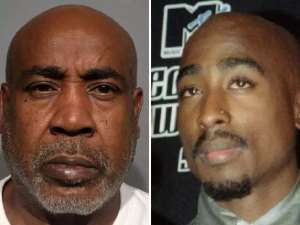
Thirty years.
That is how long America has had to move on from Tupac Amaru Shakur.
Yet here we are.
Tupac died on September 13, 1996, at only 25 years old, six days after being shot in Las Vegas. Thirty years later, Americans are still playing his music, analyzing his lyrics, watching his films, wearing his image, debating his contradictions—and talking about his death.
And now, almost exactly three decades later, the criminal case has produced something generations of Tupac fans wondered if they would ever see: a conviction.
On August 31, 2026, a Las Vegas jury found Duane “Keffe D” Davis guilty of first-degree murder for orchestrating Shakur’s killing. Davis was not accused of firing the fatal shots; prosecutors argued that he organized the retaliatory attack. The jury deliberated for roughly three hours before reaching its verdict.
Think about the historical weight of that.
A 25-year-old rapper was murdered in 1996, and America remained sufficiently fascinated with his death that, 30 years later, his case could still command headlines, a courtroom, witnesses, lawyers, journalists, documentaries and millions of interested observers.
Maybe America never stopped looking for Tupac.
That is because Tupac never became simply a deceased rapper. He became an unfinished American conversation.
Tupac carried many of the contradictions America itself carries. He could be angry and compassionate, militant and vulnerable, profane and spiritual. His music addressed racism, poverty, policing, incarceration, violence, motherhood and survival while simultaneously revealing his own imperfections.
That helps explain why America cannot put him away.
The subjects surrounding his music never disappeared. Poverty. Police encounters. Racism. Black masculinity. Mass incarceration. Motherhood. Addiction. Violence. Inequality.
Ask yourself: Which of those conversations died with Tupac?
Very few.
His artistry also escaped the boundaries of music. Juice, Poetic Justice, Above the Rim and Gridlock’d demonstrated that Tupac could command a movie screen. “Dear Mama” revealed vulnerability. “Brenda’s Got a Baby” forced listeners to confront poverty and abandonment. “Changes” became part of America's continuing conversation about race and policing.
Even death could not keep Tupac off the stage. His digital recreation at Coachella in 2012 became an international cultural moment.
So perhaps this 30th anniversary deserves something beyond another biography.
SIX “WHAT WOULD TUPAC DO?” QUESTIONS FOR AMERICA
We cannot know what a 55-year-old Tupac Shakur would believe in 2026. Anyone claiming otherwise is writing fiction, not history.
But historical imagination can expose something about us.
1. Would Tupac support Donald Trump—or ever rap on his behalf?
That question alone could generate hours of debate. Tupac grew up surrounded by Black political activism and regularly criticized American institutions, poverty, racism and government. But nobody can legitimately assign a 2026 political position to a man who died in 1996.
The better question may be: What would Tupac demand from any president seeking his support?
2. How would a 55-year-old Tupac respond to contemporary killings of Black Americans and allegations or descriptions of some racial violence as modern-day “lynching”?
Would an older Tupac use the same explosive language of his twenties? Would age soften him—or sharpen him? Would he protest through music, documentaries, political organizing or social media?
Again, we cannot answer for him. But the fact that we can imagine Tupac entering today's racial conversations demonstrates why his cultural voice remains relevant.
3. If Tupac were alive today, who would his wife be?
It is the lightest question, but perhaps one of the most revealing about our celebrity culture. Would Tupac have married another entertainer? Someone outside Hollywood? Would he even have remained a celebrity in the traditional sense?
Thirty years of missing adulthood means we remember Tupac permanently at 25. America never got to watch him become a husband, middle-aged father, elder artist or grandfather.
4. What would Tupac have said about George Floyd’s killing and the fact that millions could watch a police officer restrain Floyd as he died?
Tupac died before Facebook, YouTube, Instagram, X and TikTok transformed how Americans witness violence.
Imagine an artist already outspoken about policing suddenly living in an era when a bystander’s cellphone could place a death before the entire world.
Would Tupac have recorded a song? Marched? Produced a documentary? Spoken directly to police? Challenged protesters? Perhaps all of them.
We cannot know.
But we know America would have been listening.
5. What would Tupac say about how dangerous it can be to become a rapper in the 21st century?
Would the older Tupac tell young rappers that street credibility is not worth dying for?
Would he tell them to leave old conflicts behind once success arrives? Hire security? Stop broadcasting locations online? Separate entertainment personas from real-life disputes?
6. Would Tupac and Charlie Kirk agree on any of their remarks or song verses if they were both alive today? If so, why or why not?
Perhaps a 55-year-old Tupac's greatest contribution to hip-hop would not have been another album.
Maybe it would have been survival.
That brings me to Scripture.
Mark 8:36 asks: “For what shall it profit a man, if he shall gain the whole world, and lose his own soul?”
Tupac gained worldwide fame but never lived to see 26.
Proverbs 18:21 reminds us: “Death and life are in the power of the tongue.”
Tupac understood the extraordinary power of words. His words could comfort, confront, offend, inspire and contradict—but America listened.
And Ecclesiastes 3:1 tells us: “To every thing there is a season, and a time to every purpose under the heaven.”
Tupac’s season was remarkably short.
His cultural influence was not.
That may be the ultimate meaning of this 30th anniversary.
Tupac Shakur has now been dead longer than he was alive. Twenty-five years of life have produced three decades of music, movies, scholarship, fashion, documentaries, conspiracy theories, courtroom proceedings and cultural debate.
Thirty years later, America even witnessed someone convicted of responsibility for orchestrating his murder.
That is more than nostalgia. That is cultural permanence.
Perhaps America remains fascinated with Tupac because we never completely figured him out.
But perhaps there is another explanation.
Maybe we still haven't figured ourselves out.
Tupac’s America wrestled with race, violence, policing, poverty, incarceration, political alienation and young people wondering whether anybody in power could hear them.
Three decades later, many of those conversations remain.
So maybe the question is no longer why America keeps talking about Tupac Shakur.
The more uncomfortable question is:
Why are so many of the things Tupac was talking about more than 30 years ago still things America is talking about today? What if America paid as much attention to him when he was alive as they do after he was killed? Would he still be alive? Some still may wonder ‘if Heaven has a ghetto.’
SOURCES
Associated Press — Tupac Shakur Murder Verdict
A Las Vegas jury convicted Duane “Keffe D” Davis of first-degree murder for orchestrating Shakur’s 1996 killing.
Reuters — Duane Davis Conviction, August 31, 2026
Reports that Davis was convicted of first-degree murder after approximately three hours of jury deliberations.
Rock & Roll Hall of Fame — Tupac Shakur
Biography, artistic influence, political consciousness and cultural legacy.
Rolling Stone — “8 Ways Tupac Shakur Changed the World”
Examines Shakur’s impact on hip-hop, acting, vulnerability, fashion and popular culture.
NPR — “Tupac Shakur’s Legacy, 20 Years On”
Examines the enduring cultural significance of Shakur decades after his death.
Reveal — “The Revolutionary Roots That Inspired Tupac Shakur”
Explores the activist and Black political traditions surrounding Tupac and his family.
ABOUT THE AUTHOR
Edmond W. Davis is a social historian and one of the world's top Tuskegee Airmen authorities. Davis is a media strategist and professor. Davis founded the country’s only National HBCU Black Wall Street Career Fest. A native of Philadelphia, PA, Davis is committed to cultural empowerment and educational equity through storytelling and civic engagement. In 2026, Davis was a grand marshal at the 38th Annual African American History Month Celebration Parade. His life is told in the award-winning 2023 short documentary ‘FROM GRIND TO GROWTH: The Edmond W. Davis Story. Davis played the courthouse jailroom deputy on the NBC TV miniseries Bluff City Law.


 Thousands attend Kenya opposition rally amid anger over political violence
 Trump slams AI sceptics as Altman pauses OpenAI IPO plans over safety concerns
 WASSCE: School officials helped students cheat for years, but we now see the tru...
 Probe alleged military killing of lecturer in Bawku – Kusaug Youth demands
 ‘If we all pay GH¢1,000 each, we should be able to construct National Cathedral’...
 Mahama inspects proposed site for Upper West Regional Airport
 Mahama reiterates government's commitment to end double-track SHS system
 Police interdict officer over death of 23-year-old Ivan Baidoo on Tema Motorway
 Improved invigilation is exposing true performance of Ghanaian students — Mahama...
 There's no policy to introduce Arabic, Chinese in all public schools — Mahama


