




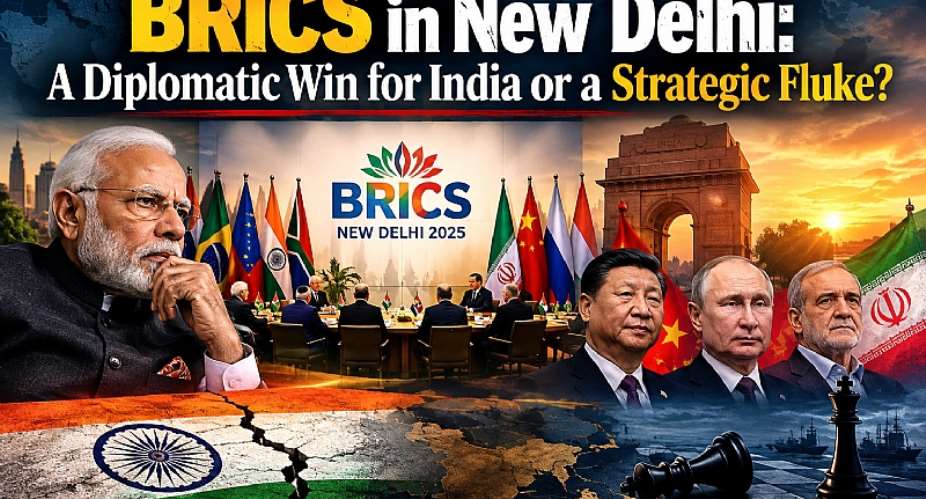
The evolving geopolitical situation in South and East Asia provides every country with an opportunity to assess the BRICS summit held in New Delhi on September 12–13. Yet, beyond the diplomatic optics, high-profile meetings and carefully worded declarations, the summit raises a fundamental question: was it a diplomatic win for India, or merely a strategic fluke in which other members gained more than the host?
As expected, the much-discussed announcement of a new BRICS currency remained in the shadows, while Indian diplomacy appeared to gain little tangible strategic leverage. First came the Delhi–Dhaka deadlock, and now a joint statement that avoided directly naming either the culprits or the victims. A statement without enforceable leverage risks becoming little more than a piece of paper—and that hardly represents a diplomatic victory for the host country.
Members of the 11-nation BRICS group, including China, Russia, Iran and India, called for calm in the Middle East in a joint statement issued during the summit. The statement expressed deep concern over the continued escalation of tensions in the Middle East and West Asia and called for maximum restraint while warning against actions that could further aggravate the situation.
This development is significant because BRICS foreign ministers had failed to agree on a joint statement when they met in New Delhi in May. Member states, including Iran, Saudi Arabia and the United Arab Emirates, remained divided over the war that began with US-Israeli strikes on February 28. Yet, after intense diplomatic efforts by host India, a statement was finally produced at the leaders’ meeting.
But the substance deserves closer scrutiny.
The statement condemned attacks on civilian infrastructure and nuclear facilities and stressed that nuclear safeguards, safety and security must be maintained even during armed conflicts. It also called for maintaining the smooth flow of global trade, supply chains and energy in accordance with international law.
Here lies the uncomfortable question: does international law still possess the authority that diplomatic statements repeatedly claim for it? If international law cannot effectively prevent attacks on civilian infrastructure, nuclear facilities or strategic shipping routes, then repeatedly invoking it without enforcement mechanisms risks reducing it to diplomatic vocabulary rather than a functioning instrument of international order.
More importantly, the summit appears to have provided Iran with an important diplomatic platform. Tehran’s carefully controlled diplomacy, led by Foreign Minister Abbas Araghchi and his team, has kept the Iranian narrative firmly on the international agenda: sovereignty, dignity, regional security and the removal of US sanctions.
The real spotlight, however, was the Iran–UAE meeting.
Iranian President Masoud Pezeshkian and Abu Dhabi Crown Prince Sheikh Khaled bin Mohamed Al Nahyan met on the sidelines of the summit and discussed efforts to ease regional tensions, promote de-escalation and strengthen regional stability. The meeting was particularly significant because it represented one of the rare high-level contacts between Iran and a Gulf state since the war began.
Iran has launched attacks against the UAE and other American Gulf allies during the conflict, while tensions surrounding the Strait of Hormuz have severely affected regional shipping. Tehran’s decision to engage Gulf states through diplomatic channels indicates an attempt to move from direct confrontation toward controlled diplomacy without abandoning its core demands.
Even Bahrain’s position is revealing. Manama indicated that it would not participate in further discussions until diplomatic relations with Tehran were restored.
So where does this leave India?
The UAE appears to have found a diplomatic shelter through the BRICS platform, while Saudi Arabia increasingly looks toward the broader Mecca Pact framework for regional security. Which framework will ultimately provide sustainable security remains uncertain. More importantly, the question is whether Washington will welcome these emerging regional arrangements or view them as a challenge to American strategic influence.
For India, hosting BRICS was an opportunity to demonstrate that New Delhi could convert its growing economic and geopolitical importance into decisive diplomatic leadership. Instead, the summit may have exposed the limits of hosting a multilateral platform without being able to control its strategic outcome.
A successful summit is not measured by the number of leaders photographed together, nor by the length of a joint declaration. It is measured by what the host country actually delivers. If Iran strengthens its diplomatic narrative, Gulf states gain new channels of engagement, the question of BRICS currency remains unresolved, and the final statement produces little enforceable leverage, then New Delhi must confront an uncomfortable reality: India may have hosted the stage, but it did not necessarily control the script.
The BRICS summit, therefore, may prove less a demonstration of Indian diplomatic supremacy and more a test that exposed the emerging limits of Indian influence. New Delhi wanted to showcase itself as a bridge between competing powers; instead, the summit may have demonstrated that in the emerging multipolar order, India is increasingly one player among several—not the player writing the rules.


 Thousands attend Kenya opposition rally amid anger over political violence
 Trump slams AI sceptics as Altman pauses OpenAI IPO plans over safety concerns
 WASSCE: School officials helped students cheat for years, but we now see the tru...
 Probe alleged military killing of lecturer in Bawku – Kusaug Youth demands
 ‘If we all pay GH¢1,000 each, we should be able to construct National Cathedral’...
 Mahama inspects proposed site for Upper West Regional Airport
 Mahama reiterates government's commitment to end double-track SHS system
 Police interdict officer over death of 23-year-old Ivan Baidoo on Tema Motorway
 Improved invigilation is exposing true performance of Ghanaian students — Mahama...
 There's no policy to introduce Arabic, Chinese in all public schools — Mahama


