




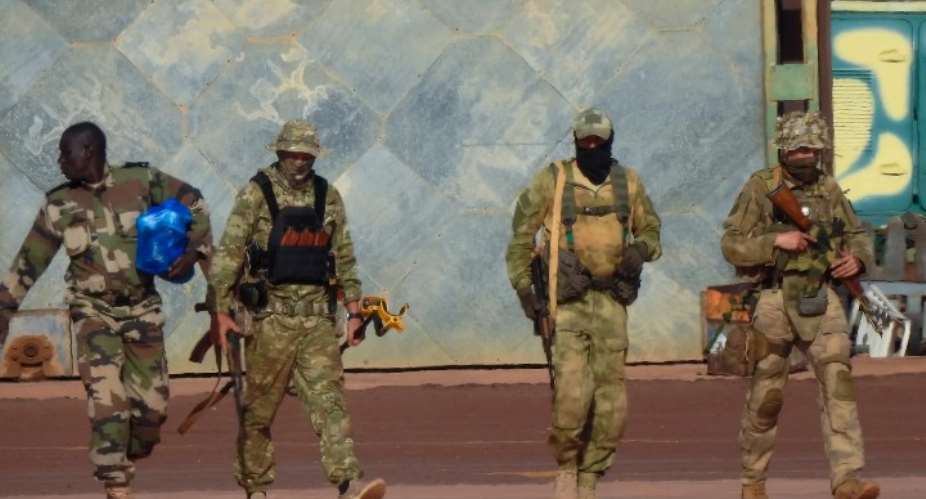
When CNN revealed this week that Ukrainian Defense Intelligence operatives are coordinating drone strikes against Russian-backed forces from inside Mali, most commentary framed it as a story about Kyiv's audacity a besieged nation improbably projecting power four thousand kilometres from its own front lines.
That framing misses the more uncomfortable part of the story: the vacuum Ukraine is now exploiting was manufactured, over more than a decade, by Western policy choices in the Sahel.
Moscow did not conquer this space. It was handed a door left open by Paris and Washington, and Kyiv has now walked through the same door behind it.
A decade of counterterrorism that didn't deliver
France's military engagement in the Sahel began with real urgency and, initially, real results Operation Serval pushed jihadist columns back from Bamako in 2013. But the follow-on mission, Operation Barkhane, ran from 2014 to 2022 without ever containing the insurgency it was built to defeat. By the time French troops withdrew, terrorism-related deaths across the region had risen roughly tenfold in five years, with the Sahel accounting for a majority of the world's terrorism fatalities.
A security partnership that consumes eight years and thousands of troops without shrinking the threat does not just fail operationally it corrodes the political legitimacy of the partner providing it. That corrosion, not Russian propaganda alone, is what turned "anti-French sentiment" from a slogan into a governing consensus across three capitals.
Punishing the coups accelerated the pivot, not prevented it
When military juntas seized power in Mali, Burkina Faso and Niger between 2020 and 2023 largely citing the failure of civilian governments and their Western patrons to stem the violence Western capitals responded with sanctions and conditionality rather than renewed engagement. Washington moved to terminate the affected countries' trade privileges over human rights concerns tied to the coups.
Whatever the merits of that response on its own terms, its practical effect was to close off a path back to Western security cooperation just as these governments were most desperate for an alternative partner willing to work without governance conditions attached.
Russia offered exactly that: a security-for-resources arrangement, delivered through Wagner and later the Africa Corps, with no demands about elections, rights records, or troop conduct.
Ukraine's entry completes the internationalisation the West started
None of this excuses what came next.
Wagner's record in Mali includes credible, well-documented allegations of mass civilian killings in Mopti, Ségou and Timbuktu, and its self-declared "victory" on withdrawal in October 2025 sits uneasily against the reality of continued JNIM offensives and a security situation that, by most measures, has not improved.
But it is worth being precise about sequencing: Russia's opportunism succeeded because a security vacuum already existed, and Ukraine's current operations training Tuareg-aligned rebels, coordinating strikes from Misrata against
Russian shadow-fleet vessels, extending anti-Shahed training to partners as far afield as the Gulf are only possible because that same vacuum has now been treated as contestable ground by a third external power.
A conflict that began as a domestic counterinsurgency, then became a Russian sphere-of-influence project, is now also a live front in a European war. Each step in that escalation traces back to an earlier withdrawal, sanction, or conditionality decision made in Paris, Brussels or Washington.
What accountability actually requires
None of this means the Sahelian juntas bear no responsibility, nor that Russia's record of civilian harm should be minimised Human Rights Watch has documented such harm from Russian troops this year, and separately found unlawful attacks on civilians by multiple parties during the April violence.
But a regional analysis that treats Russia's presence as an unprompted invasion, and now Ukraine's presence as simply a scrappy underdog story, lets the actors who created the opening through Barkhane's failure to deliver security and through sanctions policy that offered juntas no viable alternative escape the accounting entirely.
If Western governments want a genuine say in how this contest ends, that accounting has to start with acknowledging how it began.
Mustapha Bature Sallama
Medical/ Science Communicator,
Private Investigator, Criminal Investigation and Intelligence Analysis,
International Conflict Management and Peacebuilding. ( USIP)
[email protected]
+233555275880
Sources
Alex Marquardt et al., "Ukraine is fighting Russia anywhere it can even in the deserts of Africa," CNN, September 12, 2026: https://edition.cnn.com/2026/09/12/africa/ukraine-russia-drones-mali-libya-intl
Tope Akinyetun, "Security Illusions: Russia in the Sahel," Center for International Relations and Strategic Studies, January 24, 2026: https://www.ciris.info/articles/security-illusions-russia-in-the-sahel/ (Barkhane record, terrorism-fatality trend, AES formation)
Blog of the Oxford University Politics Department, on the Sahel security vacuum and U.S. trade-deal termination following the coups: https://blog.politics.ox.ac.uk/?p=18027
AtalayarAtalayar, "Russia establishes foothold in the Sahel through Wagner group after French pullout," on the French withdrawal and ACLED's civilian-harm findings: https://atalayar.com/en/content/russia-establishes-foothold-sahel-through-wagner-group-after-french-pullout
Observer Research Foundation, "Wagner's Final Chapter in Africa," on Wagner's October 2025 withdrawal and handover to the Africa Corps: https://orfonline.org/research/wagner-s-final-chapter-in-africa
Frederic Wehrey and Andrew Weiss, Carnegie Endowment for International Peace analysis in Foreign Affairs, on Russia's Sahel strategy stalling, referenced via Hvylya: https://amp.en.hvylya.net/news/1615-russia-s-sahel-expansion-hits-a-wall-as-wagner-tactics-backfire


 Thousands attend Kenya opposition rally amid anger over political violence
 Trump slams AI sceptics as Altman pauses OpenAI IPO plans over safety concerns
 WASSCE: School officials helped students cheat for years, but we now see the tru...
 Probe alleged military killing of lecturer in Bawku – Kusaug Youth demands
 ‘If we all pay GH¢1,000 each, we should be able to construct National Cathedral’...
 Mahama inspects proposed site for Upper West Regional Airport
 Mahama reiterates government's commitment to end double-track SHS system
 Police interdict officer over death of 23-year-old Ivan Baidoo on Tema Motorway
 Improved invigilation is exposing true performance of Ghanaian students — Mahama...
 There's no policy to introduce Arabic, Chinese in all public schools — Mahama


