




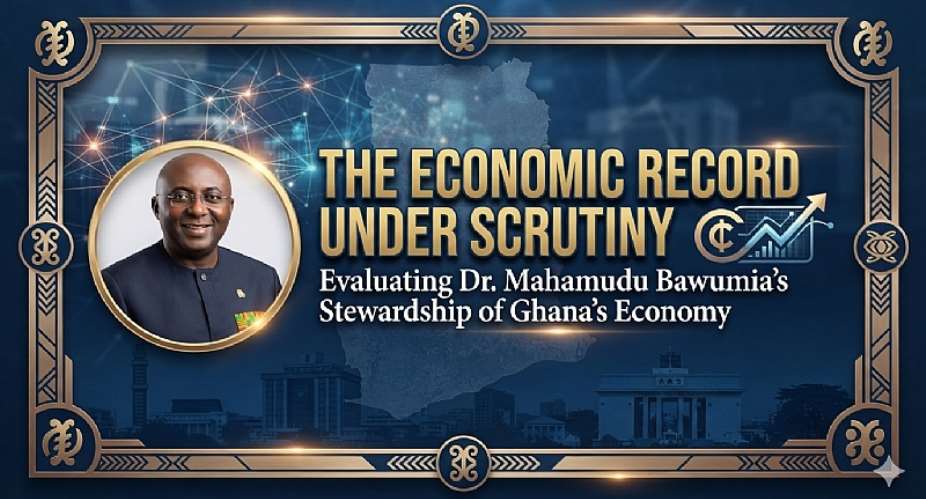
A nation's economic health serves as the ultimate test of its leadership. For the past eight years, Vice President Dr. Mahamudu Bawumia has occupied a unique role in Ghana’s governance framework—not merely as a second-in-command, but as the explicitly designated head of the Economic Management Team (EMT). Entering office with the reputation of an economic "wizard" and an institutional intellectual, Dr. Bawumia’s early lectures set an incredibly high benchmark for fiscal discipline, currency stability, and structural reform.
However, evaluating his complete eight-year tenure reveals a deep misalignment between early macroeconomic promises and the economic realities that have redefined daily life for millions of Ghanaians. Investigating the specific policies, structural choices, and major controversies that emerged under his direct economic stewardship is essential to determining his readiness to assume the presidency.
Key Macroeconomic Shifts and Policy Vulnerabilities
The core of the critique against Dr. Bawumia’s economic management lies in several historic macroeconomic shifts that occurred under his oversight:
- The Unprecedented Currency Depreciation: During his time in opposition, Dr. Bawumia famously remarked that "if the fundamentals are weak, the exchange rate will expose you." Under his direct supervision as EMT chair, the Ghanaian Cedi suffered some of its most severe historic depreciations against major global currencies, exposing severe structural vulnerabilities in balance-of-payments management.
- The Sovereign Debt Crisis and the DDEP: Despite repeated assurances that the administration would avoid external interventions due to adequate domestic resource mobilization, Ghana's national debt ballooned to unsustainable levels. This culminated in a $3 billion International Monetary Fund (IMF) bailout and the implementation of the aggressive Domestic Debt Exchange Programme (DDEP), which wiped out wealth, impaired domestic banks, and directly impacted the savings of ordinary citizens and pensioners.
- Hyperinflation and the Cost-of-Living Crisis: Under the current EMT, inflation reached decades-high peaks, significantly eroding the purchasing power of the middle class and vulnerable populations. Critics point out that internal fiscal deficits and heavy reliance on central bank financing exacerbated these shocks, leaving local businesses exposed to soaring operational costs.
- The Digitization Pivot vs. Structural Realities: As traditional economic indicators deteriorated, Dr. Bawumia increasingly shifted his primary policy platform from macroeconomic stabilization to digital transformation (such as mobile money interoperability, digital address systems, and GhanaCard integrations). While these initiatives modernized aspects of public administration, critics view the pivot as a strategic attempt to distance his brand from the fundamental failures of the real economy.
Economic Controversies and Fiscal Mismanagement Scandals
Beyond macroeconomics, the eight-year tenure of the Economic Management Team was marked by highly controversial financial arrangements, sole-sourced procurement deals, and institutional failures that directly compromised state resources:
- The PDS Concession Collapse (2019): One of the largest structural failures under the EMT’s watch was the Power Distribution Services (PDS) concession agreement to manage the Electricity Company of Ghana (ECG). The deal collapsed within months due to fraudulent demand guarantees, leading to the cancellation of hundreds of millions of dollars in US Millennium Challenge Corporation funding.
- The Agyapa Royalties Monetization Deal (2020): The administration attempted to monetize Ghana’s future gold royalties by channeling them into a special purpose vehicle registered in a tax haven (Jersey). Flagged by the Special Prosecutor for severe transparency deficits and corruption risks, the controversial deal was heavily defended by the economic team before public outcry forced its suspension.
- The National Cathedral Funding Controversies: Despite initially being framed as a private pledge, the state injected over $58 million of public funds into the project under opaque budgetary lines. The expenditure resulted primarily in a massive excavation crater in Accra, highlighting a profound misallocation of state resources during an active fiscal crisis.
- Sputnik V Vaccine Procurement Breaches (2021): At the height of a global crisis, the Ministry of Health bypassed standard procurement laws to purchase overpriced Sputnik V COVID-19 vaccines through an Middle Eastern middleman at $19 per dose instead of the $10 factory price, reflecting weak oversight over state expenditure.
- The SML Revenue Assurance Contract (2024): A major investigative expose revealed that Strategic Mobilisation Ghana Limited (SML) was awarded a highly questionable, sole-sourced revenue assurance contract in the upstream petroleum and minerals sectors. Critics and auditors flagged the deal as a multi-million dollar duplication of roles already handled by state agencies, draining vital public revenues.
- The Aborted SSNIT Hotel Sale (2024): Public outrage erupted when the Social Security and National Insurance Trust (SSNIT) attempted to sell a 60% stake in four profitable state-owned hotels to a private company owned by a sitting Minister of State. The transaction raised serious ethical questions regarding state asset divestiture and conflict of interest under the current administration.
Strategic Suggestions for Ghanaian Voters
To ensure the upcoming political transition is grounded in institutional accountability, citizens should utilize the following criteria when assessing candidates:
- Demand Accountability for Past Oversight: Voters must evaluate a candidate based on their total institutional record. As head of the EMT, Dr. Bawumia cannot separate his individual legacy from the collective outcomes of the macroeconomic policies he chaired.
- Scrutinize the Feasibility of Future Promises: Campaign pledges must be rigidly compared against past performance. Voters should ask how a candidate who presided over record inflation and debt accumulation plans to implement sustainable fiscal discipline in the future.
- Prioritize Independent Governance: Assess whether a candidate possesses the political autonomy required to investigate, audit, and correct the structural excesses, sole-sourced procurement irregularities, and controversial financial deals of the past eight years.
Evaluating Dr. Mahamudu Bawumia’s fitness for the presidency requires a clear-eyed analysis of his complete record as the leader of Ghana's economic policy apparatus. The contrast between the confident economic lectures of 2016 and the painful realities of the Domestic Debt Exchange Programme, historic inflation, and recurring financial controversies presents a profound challenge to his narrative of economic expertise. For Ghanaian voters, the path forward demands prioritizing verifiable structural outcomes over political branding, ensuring that the next leader is truly equipped to restore stability, transparency, and integrity to the republic.
✍️ Submitted by:
Retired Senior Citizen
For and on behalf of all Senior Citizens of the Republic of Ghana 🇬🇭
Teshie-Nungua
[email protected]

 WASSCE: School officials helped students cheat for years, but we now see the tru...
 Probe alleged military killing of lecturer in Bawku – Kusaug Youth demands
 ‘If we all pay GH¢1,000 each, we should be able to construct National Cathedral’...
 Mahama inspects proposed site for Upper West Regional Airport
 Mahama reiterates government's commitment to end double-track SHS system
 Police interdict officer over death of 23-year-old Ivan Baidoo on Tema Motorway
 NDC gov't ‘scored own goals’ with new SHS placement policy — Dr. Bempah Tandoh
 Five-year presidency will give governments more time to deliver — Kofi Bentil
 Improved invigilation is exposing true performance of Ghanaian students — Mahama...
 There's no policy to introduce Arabic, Chinese in all public schools — Mahama


