




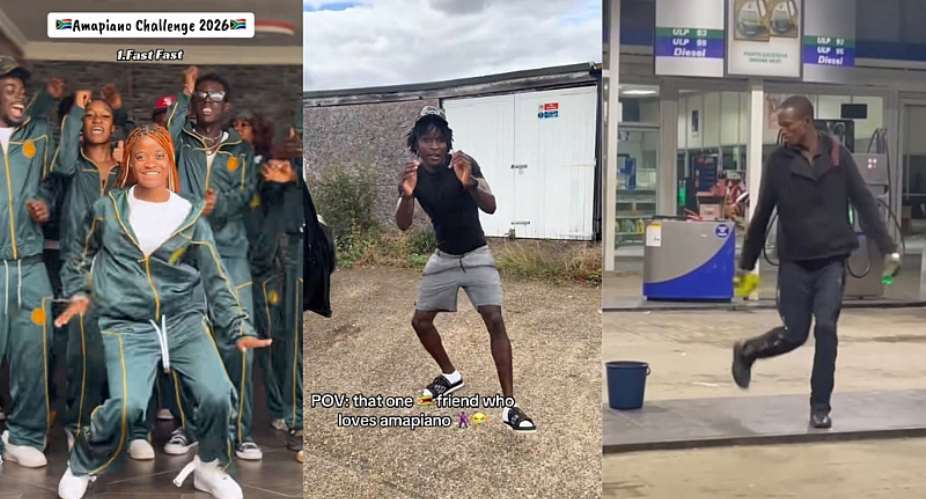
Amapiano, whose name means “the pianos” in isiZulu, one of South Africa's official languages, blends elements of deep house, jazz and kwaito, an earlier local style.
Its slower, rolling rhythms combine piano and keyboard melodies with percussion and a distinctive deep bass sound known as the log drum.
The sound emerged during the 2010s in townships in Gauteng province, home to Johannesburg and Pretoria. It has since travelled far beyond South Africa, helped by streaming and social media.
Johannesburg singer Tyla is a prime example.
Her amapiano-influenced hit “Water” spread around the world alongside a viral dance challenge and reached number seven on the Billboard Hot 100, the main US singles chart. It also won the inaugural Grammy for Best African Music Performance in 2024. South African singer Tyla performs in New York in July 2026. Her amapiano-influenced hit “Water” became a global success alongside a viral dance challenge.
Uganda's Ghetto Kids to shake it with Shakira at World Cup final
Moves on repeat
In Alexandra township in Johannesburg, amapiano rhythms can be heard everywhere – from a hair salon and car speakers to the small room where 15-year-old Olanna lives with her family and films herself dancing.
“A challenge only takes me two minutes to learn, then I film it. It's easy and sometimes I even make up my own moves,” Olanna told RFI.
“Dancing makes me happy and helps me relax, even when I'm sad.”
A few streets away, another local dancer, Angie, recreates routines she has seen online.
“I dance at school, in the yard at home, indoors – I dance everywhere. Even in shopping centres. Sometimes people join me,” Angie says.
“I like these challenges and the variety of dances. They also let you discover new artists, new music and genres I didn't know before.”
From seduction to shamanism, dance has been universal for a million years
Dance as promotion
While dance routines often emerge spontaneously, amapiano producers are paying close attention to them. Johannesburg-based artist DJ Nastor is one of those using the format to promote new music.
“I recently released a new track and encouraged people on TikTok to create challenges around it,” he told RFI.
“So it's part of the strategies we use to promote our music and this format is also very common here. Seeing people dance to my music shows that it's being well received and that it makes people happy.”
The genre reached its first 100 million streams on Spotify in 2020. In the first half of 2024, more than 855 million amapiano streams were recorded on the platform.
Clay and choreography meet in Tunisian tribute to women of Sejnane
Powered by algorithms
Dance challenges can also help individual songs find audiences around the world, introducing listeners to South African artists and music they may not otherwise encounter.
How widely these videos spread depends partly on the way social-media platforms distribute content, says digital strategy consultant and former TikTok South Africa content manager Boniswa Sidwaba.
“The reason these videos travel so widely and have become online phenomena is because algorithms allow content to emerge based on people's interests rather than their location.
“That has played a big role in distribution, allowing people around the world to be exposed to this kind of content.”
With southern summer approaching, the next amapiano hit – and the dance challenge that could carry it around the world – may already be taking shape.
This story was based on interviews done by RFI's Johannesburg correspondent Claire Bargelès.


 WASSCE: School officials helped students cheat for years, but we now see the tru...
 Probe alleged military killing of lecturer in Bawku – Kusaug Youth demands
 ‘If we all pay GH¢1,000 each, we should be able to construct National Cathedral’...
 Mahama inspects proposed site for Upper West Regional Airport
 Mahama reiterates government's commitment to end double-track SHS system
 Police interdict officer over death of 23-year-old Ivan Baidoo on Tema Motorway
 NDC gov't ‘scored own goals’ with new SHS placement policy — Dr. Bempah Tandoh
 Five-year presidency will give governments more time to deliver — Kofi Bentil
 Improved invigilation is exposing true performance of Ghanaian students — Mahama...
 There's no policy to introduce Arabic, Chinese in all public schools — Mahama


