




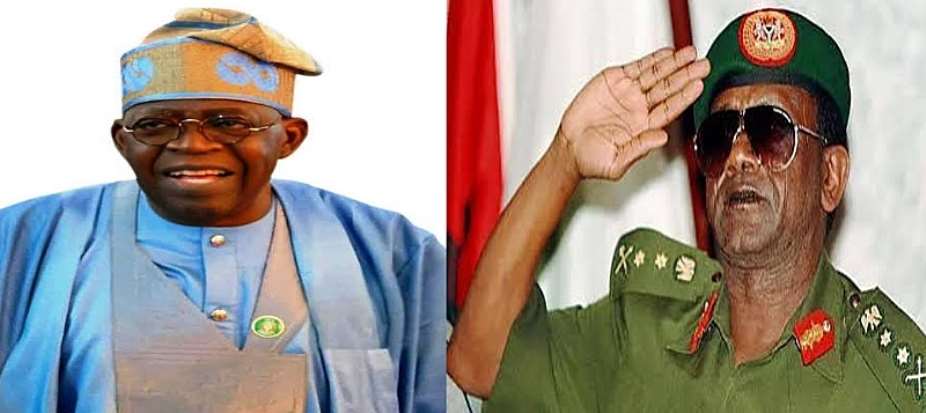
On Sunday, 13 April 1997, ThisDay newspaper carried an interview of Bola Ahmed Tinubu by Ayo Arowolo. In the interview, Tinubu said: “I don’t believe in One Nigeria”. In recent times, that statement has gone viral, drummed up by opposition agents possibly commissioned to ensure that President Tinubu does not clinch a second tenure in 2027. The statement from a newspaper interview conducted nearly 30 years ago has now acquired a new political life. It is now regularly deployed against President Bola Ahmed Tinubu by those seeking to question his commitment to the Nigerian project.
By and large, the statement was real enough to warrant examination. But so also is the historical context in which it was uttered. And that matters enormously. For anyone to lift the sentence from the circumstances of 1997 and present it as though it were a declaration made by a presidential candidate in today's democratic Nigeria is to remove the statement from the politically existential environment that produced it.
Tinubu was not in Abuja when he spoke those words. He was not a governor, a presidential candidate or the member of a governing political party. He was an opposition politician in exile in London and part of the desperate struggle against one of the most repressive military regimes in Nigeria's history. The interview itself was conducted at his London residence. To understand the importance of that interview, we must first understand the situation of things in Nigeria under General Sani Abacha. The country had embraced the Abacha era after the annulment of the June 12, 1993 presidential election by General Ibrahim Babangida. The election itself was widely regarded as the freest and fairest presidential election Nigeria had held up to that period, and Moshood Kashimawo Abiola was generally regarded as its winner. The annulment generated a national political crisis that contributed to the collapse of the Third Republic. Abacha seized power in November 1993, overthrowing the Ernest Shonekan-led Interim National Government.
The military government that followed was not merely another period of military rule. It became a period in which the state and its coercive machinery were deployed aggressively against political opposition. In September 1994, Abacha issued decrees that placed his government effectively beyond the jurisdiction of the courts and permitted the detention of people without trial. The regime's security apparatus became notorious for surveillance, arrests, intimidation and the suppression of political dissent.
For democrats and opponents of military rule, the concern was whether the country would ever recover its democratic sovereignty.
It was in this atmosphere that the National Democratic Coalition, NADECO, emerged in May 1994. Its principal demand was straightforward: the military should surrender power to civilians and the mandate of the June 12 election should be respected. NADECO became one of the most visible symbols of resistance to Abacha's draconian rule. But resistance came with a terrible price.
NADECO members were arrested, harassed and intimidated. Some were forced into hiding while others fled the country. Several prominent Nigerian democrats and journalists eventually operated from exile, particularly from Britain and the United States. The Nigerian Diaspora became an extension of the struggle inside Nigeria. From abroad, opposition leaders attempted to mobilize international pressure against the military government while those inside the country faced the danger of arrest or worse. And Tinubu was one of those opposition figures.
This piece of information is indispensable in understanding his Arowolo interview. He was speaking as an exile and NADECO activist at a time when Nigeria's political class had been subjected to extraordinary pressure by the military government. The United States and other Western governments imposed sanctions and restrictions against the Abacha regime in response to its repression. By 1996, Nigeria's relations with the Western world deteriorated severely, prompting pro-democracy activists to continue their campaigns from inside the country and from exile.
Abacha’s repressive governance was not confined to political parties. His execution of Ken Saro-Wiwa and eight other Ogoni activists in November 1995 shocked Nigeria and the international community. Human rights organizations documented widespread abuses. The military government's treatment of opponents intensified the feeling among activists that the Nigerian state had become an instrument of coercion rather than an expression of popular sovereignty. Reports from the period documented killings, arbitrary detention and attacks on political and civic freedoms.
It is against this background that the “One Nigeria” mantra needs to be appreciated. For a Nigerian living under a constitutional democracy, “One Nigeria” naturally conveys the meaning of national unity: one country, one citizenship and a common sociopolitical destiny. But for an opposition politician in exile during the Abacha dictatorship, the question could have acquired another dimension. What was the meaning of national unity when the state itself had annulled an election, imprisoned political opponents, silenced dissent and placed itself beyond effective judicial restraint? This was the Nigeria about which Tinubu was speaking.
It will therefore not be fair to reduce his position in the Arowolo interview to the proposition that he wanted Nigeria disintegrated. The wider comments attributed to him show a politician wrestling with relationships between ethnic identity, political oppression and the genuineness of the Nigerian nation. He acknowledged his Yoruba identity while he also discussed the national character of the struggle against military dictatorship. That distinction is crucial.
A person can reject a particular political conception of “One Nigeria” without necessarily advocating the physical breakup of Nigeria. Indeed, the history of Nigerian political thought contains many examples of people who have criticized the structure, inequities or political arrangements of the federation while simultaneously demanding a stronger, fairer and more democratic Nigeria. That is precisely why Tinubu’s 1997 statement demands the context and not sensationalism.
Of-course, Tinubu’s critics are entitled to ask whether his views have changed. They are entitled to question his political evolution. They are even entitled to challenge him to explain exactly what he meant by the phrase. Politics permits such scrutiny, and a public figure's words remain part of his historical record. But it will be intellectually deceptive to treat the sentence as though it was spoken in a political vacuum.
In 1997, Nigeria was not the Fourth Republic. There was no elected President to whom citizens could present their grievances. There was no democratic National Assembly. There was no constitutionally elected government to which opposition parties could peacefully hand over power. Abacha's government dissolved political institutions and operated through military decrees. So, the men and women of NADECO were not campaigning against a rival political party in a normal democratic context. They were confronting military rule. And that distinction should matter to anyone attempting to interpret historical statements fairly.
There is also an irony that should not be lost on today's critics. The man who spoke those words in London in 1997 subsequently returned to Nigeria, participated in the democratic process, became governor of Lagos State, helped build a political organization with a national reach and eventually sought and obtained the Presidency of the Federal Republic of Nigeria.
Whatever one thinks of Tinubu's administration, those later actions are difficult to reconcile with the simplistic portrait of a politician whose overriding objective was the dissolution of Nigeria. Indeed, the strongest evidence against such a simplistic interpretation is not a political defence written today. It is the trajectory of the man's political life itself. Historical statements should be judged honestly, but they should also be judged historically.
Tinubu's “I don't believe in One Nigeria” remark belongs to a period when the Nigerian state had suffered the annulment of June 12, when Abacha had seized power, when political opponents were imprisoned or driven into exile, when NADECO leaders were fighting from outside the country, when the press was under pressure, when human rights abuses were widespread and when the future of democratic Nigeria itself was uncertain. NADECO's central objective was to restore democratic rule and the June 12 mandate, not to create a separate Yoruba state.
Those who attack today's President Tinubu on the basis of that interview should certainly quote him accurately. But they should also tell Nigerians what Nigeria looked like when he said it. Because without Abacha, without June 12, without NADECO, without exile, without political repression and without the extraordinary circumstances of 1994–1997, the quotation loses the very context necessary to understand it.
History should not be used merely as ammunition. It should be used to understand how people arrived at the positions they took. If truth be told, the Nigeria of 1997 was a very different Nigeria from the Nigeria over which Bola Tinubu presides today. And in the four years he has been President he has not suggested the breakup of Nigeria by any stretch of the imagination. That should tell us something about the man.

 How IGP Yohuno led Police team to rescue victim, arrest four kidnappers in Assin...
 Akufo-Addo would have used Accra-Kumasi expressway for galamsey – Mahdi Gibrill
 Nigeria's Dangote refinery launches continent's biggest IPO
 Accra-Kumasi Expressway to cut travel time to 2hours, drive 120km per hour — Mah...
 'Our own money $2billion ready, we have not gone to borrow money from anywhere' ...
 Founder’s Day September 21 declared public holiday
 Council of State was not qualified to determine prima facie case against Torkorn...
 'Grounds for removal of Chief Justice and justice of superior court shallow, eph...
 Don't be a Bar that flips on principles but a Bar that is consistent — AG tells ...
 Prostate cancer may show no symptoms until advanced stage – Urologist warns


