




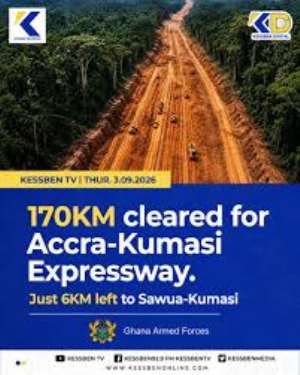
The proposed Accra–Kumasi Expressway represents one of Ghana's most ambitious road infrastructure projects in recent years, with the potential to significantly improve transportation between the country's two largest commercial centres.
The project was formally outlined in the 2026 Budget Statement and Economic Policy, presented to Parliament on 13 November 2025. An estimated US$1.7 billion was subsequently earmarked for the project as part of the government's broader Big Push Infrastructure Programme.
Parliament later approved the project, paving the way for implementation of what is expected to become an important addition to Ghana's national transport network.
The proposed expressway is intended to provide a modern alternative route between Accra and Kumasi, improving the movement of people, goods and services between southern and central Ghana.
Importantly, Minister for Roads and Highways Kwame Governs Agbodza has indicated that the new expressway is not intended to replace the existing Accra–Kumasi Highway. This distinction is important because the current highway will continue to serve numerous towns and communities along the corridor even after the new expressway becomes operational.
In January 2026, President John Dramani Mahama announced that construction of the expressway would begin, reinforcing the government's commitment to delivering the project.
One notable feature of the proposed implementation strategy is the involvement of multiple Ghanaian contractors. Under the arrangement announced for the project, individual contractors are expected to handle sections generally limited to about 10 kilometres each.
If properly implemented, this approach could achieve more than simply constructing a road.
It could provide opportunities for Ghanaian construction companies to build technical capacity, acquire equipment, employ engineers and skilled workers, and develop experience in delivering major national infrastructure projects.
The government has targeted January 2029 for completion of the expressway.
Meeting that deadline will require careful coordination among contractors, timely financing, effective supervision, land acquisition management, environmental safeguards and strict adherence to engineering and construction standards.
The economic importance of the Accra–Kumasi corridor cannot be overstated.
Accra serves as Ghana's administrative and major commercial centre, while Kumasi remains the economic heart of the middle belt and an important gateway to northern Ghana and neighbouring countries. Every day, significant volumes of passengers, agricultural produce, manufactured goods and commercial cargo move between the two cities.
A modern expressway could therefore reduce travel times, improve road safety, lower transportation costs and strengthen domestic trade.
It could also improve connectivity between industrial and agricultural production centres and major markets, supporting Ghana's broader industrialisation and economic-development agenda.
However, the construction of a new expressway should not result in neglect of the existing Accra–Kumasi Highway.
The present highway remains a critical national asset and continues to carry thousands of motorists, commercial vehicles and passengers. Sections requiring rehabilitation and improved safety measures must receive urgent attention while the new expressway is being developed.
Ghana should therefore pursue both objectives: build the infrastructure required for tomorrow while properly maintaining the infrastructure citizens depend upon today.
The Accra–Kumasi Expressway should ultimately be judged not merely by its size or cost, but by its quality, safety, economic impact, value for money and ability to strengthen Ghanaian construction capacity.
If completed successfully and within the proposed timeframe, the project could become an important example of how strategic infrastructure investment can improve national connectivity while creating opportunities for local businesses and workers.
Ghana needs modern infrastructure to support a modern economy. The Accra–Kumasi Expressway provides an opportunity to demonstrate that major national projects can be delivered efficiently, transparently and with lasting benefits for the Ghanaian economy.


 Thousands attend Kenya opposition rally amid anger over political violence
 Trump slams AI sceptics as Altman pauses OpenAI IPO plans over safety concerns
 WASSCE: School officials helped students cheat for years, but we now see the tru...
 Probe alleged military killing of lecturer in Bawku – Kusaug Youth demands
 ‘If we all pay GH¢1,000 each, we should be able to construct National Cathedral’...
 Mahama inspects proposed site for Upper West Regional Airport
 Mahama reiterates government's commitment to end double-track SHS system
 Police interdict officer over death of 23-year-old Ivan Baidoo on Tema Motorway
 Improved invigilation is exposing true performance of Ghanaian students — Mahama...
 There's no policy to introduce Arabic, Chinese in all public schools — Mahama


