




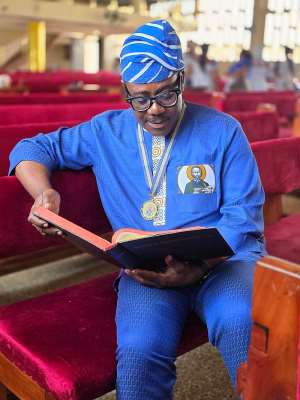
Once upon a time in Ghana’s hyper-vibrant media landscape, a microphone could strike fear into the hearts of ministers, chief executives, and public officials. In those glory days, decibel levels were directly proportional to journalistic bravery, and morning show hosts competed for who could shout “Where is the money?!” with the most fervor. Prominent among these crusaders was Johnie Beresford Hughes, whose voice was known to shatter glass and raise blood pressure across government ministries under the previous administration.
Fast forward to the present political era, and a miraculous transformation has occurred—a phenomenon that medical science might refer to as selective decibel laryngitis. The once-roaring watchdog has undergone a quiet metamorphosis, shedding its fierce canine teeth to become a contented, purring housecat nestled comfortably on the porch of the new administration.
The mechanics of this metamorphosis are fascinating to observe. In the previous era, accountability was a simple, one-step process: demand immediate answers from power, question every contract, and treat every official statement with healthy, booming skepticism. Today, however, the process has evolved into an intricate gymnastics routine. Now, when colleagues or inquisitive journalists dare to raise Right to Information (RTI) requests regarding major national expenditures—such as the funds borrowed for the Accra-Kumasi Expressway—the posturing shifts entirely.
Instead of demanding answers from the authorities, the sharp-tongued pundits turn their sights onto the inquisitors themselves. Suddenly, asking questions is no longer an exercise in holding power accountable; it is a suspicious act worthy of snide social media posts, subtle attacks, and polite condescension. "Wouldn't it be great," they tweet with a wink and a nod, targeting fellow journalists who dare to do the very job they used to boast about doing.
This pivot from accountability to defensibility would be purely comedic if the underlying consequences were not so damaging to Ghanaian democracy.
When prominent journalists swap their investigative flashlights for public relations shields, the damage to media freedom is insidious. Media freedom is not merely threatened by heavy-handed decrees or physical harassment; it is eroded from within when partisan convenience dictates editorial tone. When citizens watch a crusader suddenly become an apologist simply because the political colors at the Jubilee House changed, the moral authority of the Fourth Estate evaporates.
The ultimate victim of this hypocrisy is public trust. For a democracy to thrive, the citizenry must believe that the media serves as an uncompromising referee, regardless of which team is wearing the jersey of state power. When journalists act as zealous prosecutors under one administration and defense attorneys under the next, the public inevitably reaches a cynical conclusion: that the noise was never about principle, public interest, or transparency, but rather about positioning, partisanship, or personal convenience.
As the microphone stands in studios across the country continue to capture this sudden outbreak of selective silence, one cannot help but admire the sheer agility of it all. To pivot so seamlessly from roaring lion to defensive bodyguard takes a special kind of talent. But as public confidence in the Fourth Estate continues to plummet, Ghana's democracy is left asking a simple question: when the watchdogs become the pitbulls for the state, who is left to watch the house?


 AI risks, Iran war to take center stage at UN
 ‘I had never heard of Eswatini’: Deported by the US to a country that rejects th...
 Transport fares increased 8% from September 26
 Golokuati residents call for operationalisation of abandoned ECG office
 Frank Danquah declared wanted over alleged narcotics offences
 Ghana TVET Service warns against collection of fees in TVET institutions
 16 arrested as National Security uncovers counterfeit currency printing syndicat...
 Work without fear or favour — Shamima Muslim urges broadcasters
 MFWA begins 5-day training for journalists from northern sector on media law and...
 Law student petitions CHRAJ over alleged military killing of Gbewaa Training Col...


