




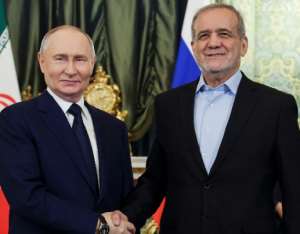
Russian President Vladimir Putin and Iranian President Masoud Pezeshkian used the BRICS Business Forum in New Delhi to deliver pointed criticism of Western economic dominance and sanctions policy, even as Indian Prime Minister Narendra Modi focused his own remarks on protecting maritime trade routes and the safety of seafarers caught up in regional conflicts.
Setting the Stage: The 18th BRICS Summit
New Delhi is hosting the 18th BRICS Summit at Bharat Mandapam on September 12 and 13, 2026, under India's 2026 BRICS chairship. World leaders including Putin, Pezeshkian, and Chinese President Xi Jinping arrived in the Indian capital in the days beforehand for bilateral talks and the Business Forum that traditionally precedes the main leaders' summit.
The gathering comes at a fraught moment: the bloc, now an 11-member grouping since its recent expansion, is trying to project unity even as members hold sharply different positions on the wars in Ukraine and the Middle East, including the ongoing US-Israel war on Iran that began earlier this year.
Putin's Message: The West Is Losing Its Grip
Addressing the BRICS Business Forum on Friday, September 11, Putin accused Western nations of resorting to "unseemly" and destructive tactics including the destruction of infrastructure and pipelines and the seizure of maritime vessels in an attempt to cling to economic dominance as their traditional leadership position erodes.
He argued the G7 nations now account for only around 18% of global economic output, compared to roughly 40% for BRICS countries, and pointedly asked, "I don't know why they call them that," referring to the G7 grouping.
Putin described the global economy as undergoing a "structural, deep, profound shift," insisting that these changes could not be reversed regardless of Western resistance.
He also referenced restrictions on international waterways and the seizure of vessels a clear reference to tensions surrounding Iran as part of what he characterized as the West's efforts to weaponize economic and logistical tools against countries outside its orbit.
Pezeshkian's Message: Sanctions as a
Weapon of War
Iranian President Masoud Pezeshkian struck an even more direct tone, telling the forum that Western sanctions against Iran have escalated to "a dangerous phase" as a result of what he described as military aggression a reference to the US-Israel war on Iran that has continued since February 2026. Pezeshkian argued that economic security cannot be separated from national and regional security, framing sanctions and military pressure as two sides of the same coercive strategy.
His remarks echoed comments he has made at previous BRICS-linked forums, where he has argued that Western powers define peace, democracy, and prosperity only in terms that serve their own interests, and that this approach has fueled increased violence and the more frequent use of sanctions as a political tool.
Modi's Focus: Keeping the Sea Lanes Open
While Putin and Pezeshkian focused their remarks on confronting Western economic power, Prime Minister Modi struck a more targeted, practical note centered on maritime security. In his meetings with both Putin and Pezeshkian ahead of the summit, Modi emphasized the need to preserve regional peace and stability, safeguard maritime trade routes, and protect the safety of seafarers a concern with direct implications for India, given the large number of Indian nationals who crew commercial vessels worldwide.
According to India's foreign ministry, in his talks with Pezeshkian, the two leaders "shared perspectives on... the conflicts in West Asia and the Black Sea region, which have impacted maritime trade and the safety and security of Indian seafarers." Modi conveyed a similar message in his meeting with Putin, reiterating calls for sustained efforts to protect shipping routes affected by both the Iran war and the ongoing Ukraine conflict's spillover into the Black Sea.
Modi's position reflects India's difficult balancing act: New Delhi has deepened its energy relationship with Russia, sharply increasing imports of discounted Russian oil, while also maintaining ties with Iran despite severe US sanctions that have forced India to halt direct crude oil imports from Tehran and complicated banking transactions with Iranian entities. At the same time, India is reportedly in the final stages of negotiating a trade deal with the United States a fact analysts say will keep New Delhi from allowing any BRICS joint statement to directly criticize Washington.
A Bloc Managing Its Own Contradictions
Analysts have noted that India's position illustrates the broader challenge facing BRICS as it expands: the bloc now includes members such as Iran, Saudi Arabia, and the UAE with starkly different, sometimes opposing, positions on the Middle East conflict. Michael Kugelman, a senior fellow at the Atlantic Council, told the BBC that India "cannot afford to have a joint statement that rails against Washington," predicting that any criticism of US policy to emerge from the summit will likely be "vague and indirect" given the group's diverse and sometimes competing interests.
Xi Jinping was expected to arrive in New Delhi on Saturday, September 12, for further bilateral talks with Modi on the summit's sidelines, rounding out a gathering that will test how far BRICS can go in projecting a unified challenge to Western economic and geopolitical dominance without fracturing over its own internal divisions.
Mustapha Bature Sallama
Medical/Science communicator, Private Investigator, Criminal Investigation and Intelligence Analysis,United States Institute of Peace (USIP), [email protected] +233555275880
Sources
Al Jazeera, "Putin, Pezeshkian in India for BRICS summit clouded by Iran and Ukraine war," September 11, 2026
The Week, "BRICS 2026: Putin slams G7 for using destruction to regain 'former leadership', Pezeshkian pushes for de-dollarisation," September 11, 2026
UPI, "Modi hosts leaders of Russia, Iran and China at BRICS summit," September 11, 2026
Associated Press (via Audacy), "Modi holds talks with Putin and Iran's president before BRICS summit of 11 nations"
News24 Online, "BRICS Summit 2026 Highlights: PM Modi stresses safe navigation and seafarers' security in talks with Iran's Pezeshkian amid rising West Asia tensions"
Maritime News, "Modi-Putin Talks Put Maritime Trade and Seafarer Safety in BRICS Spotlight"


 'There is no support’ – Prisons DG explains why ex-inmates are likely to return
 ECG announces nationwide meter audit to combat electricity theft
 Afenyo-Markin, NEIP CEO Eric Adjei settle defamation suit out of court over exto...
 GIS recovers GH¢124,552 in excess salary arrears paid to 23 officers
 Minerals Commission denies Alfred Mahama’s role in Narawa Licence revocation
 No more ‘No Bed’ excuse as Health Minister unveils real-time bed monitoring syst...
 NAGRAT alleges 38 Obuasi teachers targeted for transfers for speaking out agains...
 Immigration Service gives two officers November 7 deadline to refund GH¢57,006 u...
 'Every tonne of waste we dump is a job we bury' — Dr Siaw Agyepong
 GES directs Ashanti regional, Obuasi East educational directors to step aside ov...


