




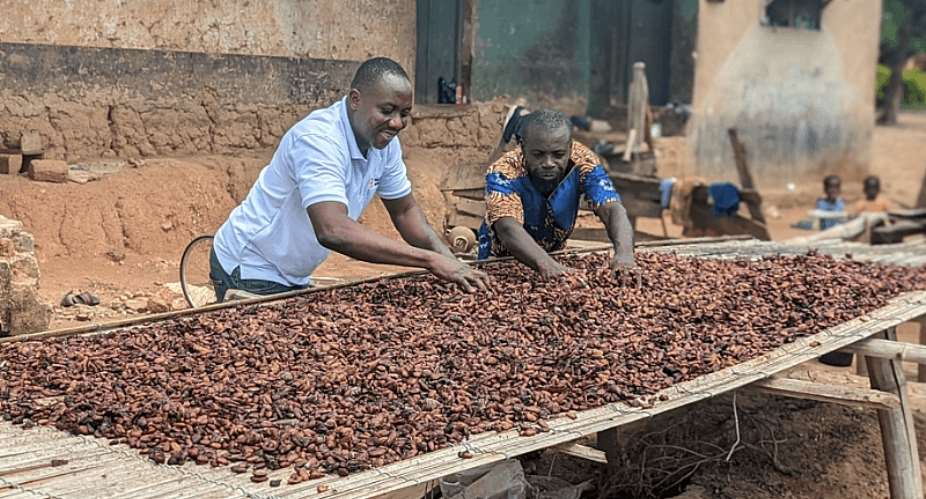
Ghana’s cocoa industry faces a challenge that goes far beyond producer prices, fertiliser, diseases and declining yields. The people who have sustained the industry for generations are growing older, while many of their children are choosing different futures.
The typical Ghanaian cocoa farmer is often described as being in their late fifties. With hundreds of thousands of farmers depending on cocoa for their livelihoods, the ageing of the farming population raises an uncomfortable question: who will produce Ghana’s cocoa when today’s farmers can no longer work their farms?
For decades, cocoa has been one of the pillars of Ghana’s economy. It has generated foreign exchange, provided livelihoods for rural families and contributed significantly to national development. Yet the communities responsible for producing this valuable commodity do not always reflect the wealth cocoa has created.
Many young Ghanaians have watched their parents work cocoa farms for decades without achieving the economic security they expected. They have seen the physical demands of farming, unstable incomes, crop diseases, climate pressures and uncertainties surrounding prices and production.
For a young person comparing cocoa farming with opportunities in Accra, Kumasi, mining communities, construction, transportation, technology or overseas, traditional cocoa farming may simply not appear attractive.
The problem is therefore not that Ghanaian youth dislike agriculture. The deeper problem is that agriculture has often failed to present itself as a modern, profitable and aspirational business.
Telling young people to return to the farm will achieve little unless farming offers them a credible economic future.
The ageing farmer population is occurring at the same time that cocoa production is confronting serious environmental pressures. Changing rainfall patterns, excessive heat, drought, pests and diseases, soil degradation and illegal mining in some cocoa-growing areas threaten productivity and the long-term availability of agricultural land.
An elderly farmer working with limited capital and traditional equipment may struggle to adapt quickly to these changing conditions. Ghana therefore faces two transitions simultaneously: a generational transition and a climate transition. Both must be addressed together.
The future of Ghanaian cocoa cannot depend on encouraging another generation to continue farming exactly as their grandparents did. The cocoa farm of the future should increasingly become a commercial enterprise supported by technology, finance, irrigation where appropriate, improved planting materials, mechanisation, climate-smart practices, digital information and professional farm management.
Young farmers should be trained not merely to cultivate cocoa but to understand costs, productivity, record keeping, financing, marketing and value addition. They should see themselves as agribusiness entrepreneurs rather than subsistence farmers.
Access to land must also be addressed. Many young people interested in agriculture cannot easily acquire secure farmland. Innovative arrangements involving families, traditional authorities, landowners, cooperatives and financial institutions could help young entrepreneurs obtain productive land under transparent long-term agreements.
There is another reason young people may not be attracted to cocoa: too much attention is placed on producing the bean while insufficient attention is given to the businesses that can develop around it.
The cocoa economy extends far beyond farming. Chocolate, cocoa beverages, cocoa powder, cosmetics, confectionery, cocoa butter, soaps and other products provide opportunities for processing, manufacturing, packaging, distribution and export.
A young Ghanaian may not necessarily want to spend every day maintaining a cocoa farm, but that same person may be interested in establishing a chocolate company, developing cocoa cosmetics, operating agricultural machinery, supplying irrigation equipment or creating digital services for farmers.
This is how we make cocoa attractive to a new generation.
Government, COCOBOD, financial institutions, universities, traditional authorities, cocoa companies and development partners must recognise generational renewal as a strategic priority.
Young people need access to land, affordable finance, modern technology, training, markets and viable returns. Women and young farmers should receive particular attention because they represent enormous underutilised potential within rural economies.
Successful young cocoa entrepreneurs must also become visible. Agriculture will attract young people when they can see people their own age building prosperous businesses from it.
Ghana cannot simply inherit cocoa indefinitely.
Trees grow old. Farmers grow old. Industries also grow old when they fail to renew themselves.
The men and women who built Ghana’s cocoa industry have done their part. The responsibility of this generation is not simply to ask their children to take over their cutlasses and cocoa farms.
We must give them a cocoa industry worth inheriting.


 Ghana wishes Guyanese diplomat well in UN Secretary-General bid – Ablakwa
 Galamsey 'stealing' boys from classrooms in Bongo – DCE raises alarm
 Leaving Majority Leader role for ministerial position was my choice – Mahama Aya...
 A Rocha Ghana stands by claim of 50-plus forest reserves affected by galamsey
 September 10: Cedi sells at GHS12.15 on forex market, GHS11.45 on BoG interbank
 Open aviation fuel supply to more players to reduce airfares – Akim Swedru MP to...
 Pay my salary arrears, terminal benefits by September 11 or face court – Former ...
 Trump says he'll give Americans $5,000 each if Republicans win midterm elections
 'Govt moves to confiscate, auction containers left at Ghana’s ports for over six...
 How honest station loading boy handed over missing £3,000, GH¢1,000 to Police


