




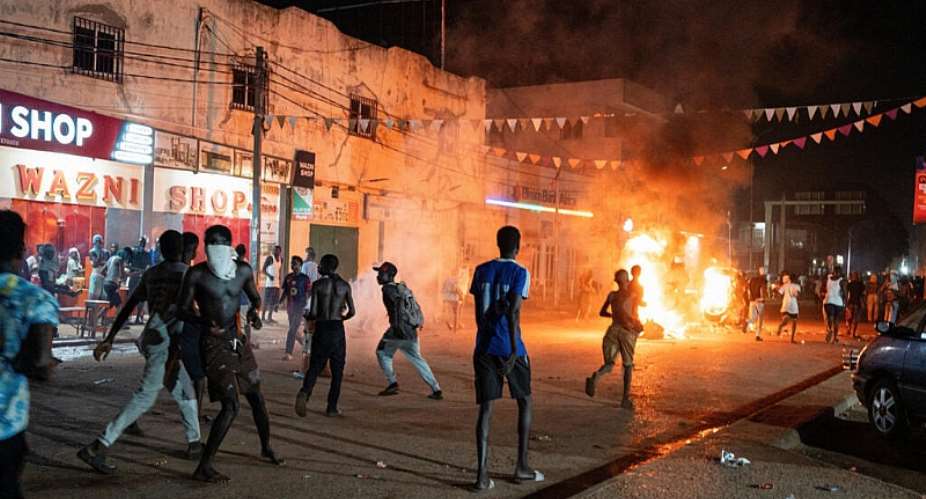
Gambians fed up with blackouts and with an increasingly unstable electricity supply, poured onto the streets of the capital, Banjul, on Monday evening.
The same scenes played out in the country's largest city, Kanifing. They also spread to the neighbouring West Coast Region, in the major towns of Brikama and Brufut.
Marching toward State House, the official residence of President Adama Barrow, protesters held candles and chanted "Barrow must go." Others burned tyres and blocked roads.
The same pattern repeated itself across different cities, Madi Jobarteh, executive director of the Gambian NGO the Edward Francis Small Centre for Rights and Justice, told RFI.
"It was largely peaceful because it was spontaneous," he said.
He explained that this latest round of power cuts has been especially harsh given the hot weather the country has experienced since June.
Jobarteh pointed to persistent daily power cuts lasting 16 to 18, sometimes 20 hours, occasionally stretching to 24, 36, or even 48 hours.
"It became totally unbearable," he said.
Gambian analyst Sheriff Bojang Junior said the protests appear to have caught the government off guard.
Both President Barrow and Information Minister Ismaila Ceesay, the government's spokesperson, have tried to calm the situation.
"Last night's events were deeply disconcerting. As a government, we recognise the frustration, anger and hardship that many Gambians are experiencing as a result of the electricity situation," Ceesay wrote in a Facebook post.
"Electricity is not a luxury. It is essential to our homes, our businesses, our hospitals, our schools and our economy", he continued.
"Government is therefore treating the situation with the seriousness and utmost urgency it deserves, and we want to assure every Gambian that we are working relentlessly to restore stability and improve the reliability of electricity supply as soon as possible."
How Europe's appetite for farmed fish is gutting Gambia's coastal villages
New generators
On Tuesday, President Barrow visited two of the country's major power plants and appealed to Gambians to be patient.
He promised that the situation would improve, or even be resolved, by the end of October.
"The Government is in the final stage of installing an additional twenty-four (24) megawatts generation machine at the Brikama Power Station, which we visited today," he said.
"This will be commissioned by the end of October 2026. For a system of our size, this is considerable power, enough to make a big difference in your homes."
At peak consumption this year, The Gambia needed 100 to 110 megawatts, according to the national utility, NAWEC (National Water and Electricity Company).
"Barrow has responded by calling the crisis an emergency, promising a new generator and an end to the chronic power cuts by the end of October," said Bojang Junior.
"But even in his televised address on Tuesday night, critics saw little sense of urgency or empathy, describing a president struggling through a prepared speech that appeared disconnected from the public mood," Bojang Junior added.
"In most parts of the country in recent weeks in particular, people are sleeping in the heat and mosquitoes, businesses are losing money, water supplies are affected and families are organising their lives around blackouts," said the analyst.
How degradation and drought are threatening the land that feeds us
Long-standing problem
Producing electricity is not a new problem for The Gambia. But the country has grown increasingly dependent on imported electricity rather than investing in its own production.
According to the IMF, about 75 percent of the Gambia's electricity consumption was imported from Senegal in 2025.
The World Bank notes the country has around 90 megawatts of installed generation capacity, but operational availability is often below 50 percent, due to ageing equipment and the rising cost of running domestic plants, which are fuelled by heavy and light fuel oil, both subject to volatile international prices.
Importing electricity has therefore become the cheaper option, with Senegal and Guinea as the country's main regional suppliers.
To help boost supply, NAWEC had also relied on a Turkish floating power plant, Karpowership, for around 30 megawatts. But rising costs made the arrangement economically unviable, and the deal was not renewed in 2025.
Through the Gambia River Basin Development Organisation (known by its French acronym, OMVG), a body of regional countries, NAWEC has managed to cut costs by up to 42 percent.
The drawback is that if one member country runs into difficulty, the effects ripple through to the others — including The Gambia. This year, high temperatures and low rainfall have limited how much hydroelectric power Guinea has been able to export, just as demand in The Gambia spiked due to the heat.
Blackouts and unstable electricity supply were also a persistent problem under former dictator Yahya Jammeh.
"Since the previous government, there has always been persistent power cuts, and many promises were given by the former president at the time," said Jobarteh.
The difference today, he added, lies in the duration of the outages and the depth of public anger, because "the government has received more support, and yet delivery is very low."
The protests may add pressure on the government to find a lasting solution to a problem that has persisted for years, particularly as Barrow seeks a third term in December's election.


 NDC not worried about NPP’s Kojo Bamba, he is small boy – Azorka
 Obuasi SHTS: 'Children are not buffet' – NPP’s Fatimatu confronts Zuba
 'I didn’t know I was supposed to chop and not work' – Blakofe on her time at GTD...
 Resource exploitation fuelling Africa’s conflicts – Mahama
 Our ports' growth always depended on collaboration across maritime, logistics va...
 Stranded Ghanaian fishermen narrate how they ate fresh fish, drunk sea water to ...
 How notorious armed robber died on the way whiles leading police to arrest accom...
 'We must continuously improve cargo handling, coordination among port operators'...
 Nii Lante Vanderpuye confident of winning NDC national chairmanship despite Gold...
 Agalga dismisses critics, assures Builsa North of progress on Sandema–Wiaga Road


