




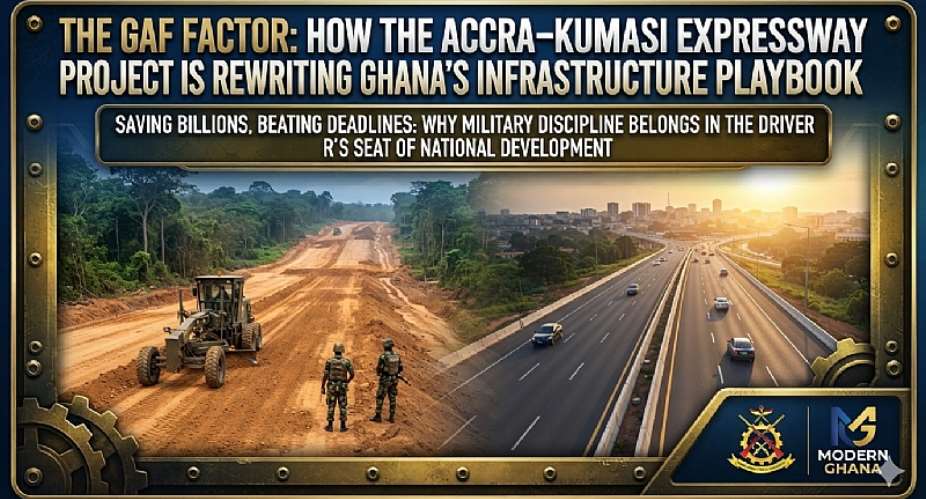
For decades, major road infrastructure development in Ghana has been synonymous with budget inflation, endless administrative bottlenecks, and missed deadlines. However, the ongoing 198.7 km Accra–Kumasi Expressway project is breaking that mold, establishing a revolutionary template for public sector execution.
By bypassing standard commercial contractors and tasking the Ghana Armed Forces (GAF) Engineers with the critical right-of-way clearing, the state has achieved what many deemed impossible: clearing a massive 175.6 km greenfield path from Greater Accra straight into the Ashanti heartland in just 19 weeks—beating an aggressive 20-week target. This milestone demonstrates that military efficiency and discipline are the missing links needed to fix Ghana’s infrastructure deficit.
Unpacking the Savings: The Power of Military Deployment
Deploying the combat work gangs of the GAF Engineers was a calculated masterstroke that has protected state coffers:
- Massive Budget Reductions: Commercial contractor baselines for heavy clearing and stripping across this intensive forest, canopy, and valley landscape ranged between GH₵15 Billion and GH₵18 Billion. GAF locked in and executed the entire phase for approximately GH₵10.9 Billion, yielding billions of Cedis in net savings.
- Elimination of Labor Overhead: The state avoided highly inflated commercial equipment leasing margins, mobilizing existing state assets alongside GAF's highly trained, non-unionized personnel.
- Time Penalties Averted: By finishing a week ahead of schedule despite torrential rains, the military prevented the typical "extension-of-time" financial claims that commercial firms leverage to push project costs up.
Connecting Communities: The Local Economic Lifeline
Far beyond just cutting down travel times between Accra and Kumasi, this project is a transformative lifeline for dozens of historically bypassed rural areas and bustling market towns:
- Unlocking the Eastern Agricultural Belt: Towns like Adeiso, Asamankese, Akyem Oda, and Ofoase will see immediate transformations. For generations, farmers in these major hubs have suffered massive post-harvest losses due to dilapidated roads. The new expressway and dedicated interchanges will turn these areas into modern agricultural logistics hubs, allowing food trucks to reach urban markets in record time.
- Boosting Ashanti Regional Commerce: As the corridor pushes into the Ashanti Region, communities such as Sewua, Bosomtwe, and the greater Kumasi enclave will be directly linked to a fast-flowing economic artery. This connection will lower freight costs, stimulate real estate development along the route, and open up the Lake Bosomtwe biosphere to unprecedented domestic tourism.
- Relieving Urban Congestion: By diverting heavy long-distance freight away from traditional choke points like Nsawam and Pokuase, local commuters in these peri-urban towns will experience dramatically reduced daily gridlock, safer streets, and cleaner air.
The Next Phase: Local Contractors & Major Bridges
With the pathfinder phase complete, the procurement and design phase is now active to roll out the main construction works:
- The 10-Kilometer Block Strategy: Rather than awarding the remaining build to a single massive joint-venture, the corridor is being split into manageable 10-kilometer blocks. This distribution allows multiple qualified local Ghanaian construction firms to build concurrently, ensuring rapid project speed while directly supporting local content.
- The Three Critical Bridges: The complex transit footprint requires constructing three major, high-capacity bridges spanning the treacherous currents of the Birim and Pra Rivers. These structures are vital to securing a continuous, safe, 120 km/h expressway speed across the regional boundaries.
Recommendations: Maximizing GAF's Engineering Power
To optimize the remaining $4 billion project budget and future state infrastructure, policy makers must consider a permanent shift in strategy:
- Award Major Road Building Contracts to GAF: The state should expand GAF's mandate beyond clearing. The military engineers should be directly awarded permanent contracts to build several of the core 10-kilometer blocks alongside local firms to enforce standard pricing benchmarks.
- Hand Over All Bridge Construction to the Military: Because bridges are highly vulnerable to commercial corruption, cost overruns, and structural failures, the construction of all three bridges over the Birim and Pra rivers should be assigned strictly to GAF Engineers. Their tactical precision and specialized training in structural bridging make them uniquely qualified to deliver maximum safety at a fraction of commercial costs.
The speed and fiscal discipline demonstrated by the Ghana Armed Forces on the Accra–Kumasi Expressway corridor have shattered standard justifications for delayed public projects. This is no longer just a story about moving earth; it is an awakening of national self-reliance and strategic public resource mobilization. If we truly desire to protect the public purse, scale our local economy, and build world-class road networks before 2028, the government must move the military from the fringes of pathfinding directly into the driver's seat of national construction. The blueprint has been drawn in the dirt—it is time for the state to fully execute it.
✍️ Submitted by:
Retired Senior Citizen
For and on behalf of all Senior Citizens of the Republic of Ghana 🇬🇭
Teshie-Nungua
[email protected]


 Auditor-General report exposes financial rot at 18 assemblies in Volta Region; C...
 Education Ministry warns against fake, manipulated CSSPS placement slips
 GPRTU, GRTCC suspend decision on proposed public transport fare increase
 ‘Gov't should not be pressured to continue National Cathedral project’ – NDC's K...
 BoG names 20 illegal loan apps, cautions against patronising them
 September 9: Cedi sells at GHS12.15 on forex market, GHS11.43 on BoG interbank
 World Bank flags GoldBod operations "insufficiently monitored" risk; Minority's ...
 FDA warns against falsified Dr Alfred Capsules adulterated with sildenafil
 WASSCE, BECE outcomes threaten future of over 200,000 students – Osahen Afenyo-M...
 US bans Canadian alcohol, motorcycles and dairy products as trade spat escalates

