




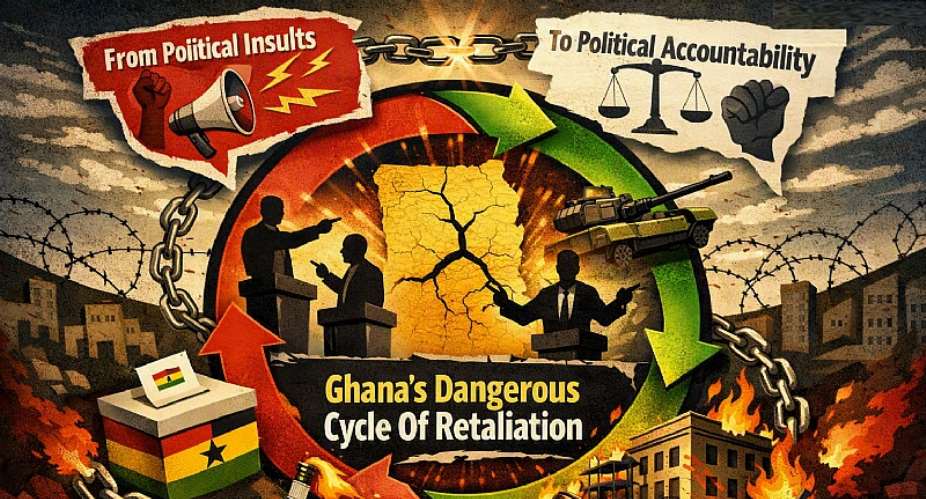
Ghana’s political insults have become louder than its political arguments.
From presidents and former presidents to their spouses, judges, chiefs, clergy, politicians and ordinary citizens, social media has increasingly become a battlefield where political disagreement is sometimes expressed not with evidence, but with abuse.
But beneath the insults lies a more serious democratic question:
Are Ghana’s politicians prepared to live with the political culture they created?
There is growing public concern about the increasingly abusive nature of political discourse on Ghanaian social media.
Supporters and opponents of the major political parties routinely trade insults, accusations and personal attacks, with prominent targets including President John Dramani Mahama, First Lady Lordina Mahama, members of the Mahama family, government officials and political activists.
The opposition has not been spared either.
Former President Nana Akufo-Addo continues to face criticism over the record of his administration, while former Vice-President Dr. Mahamudu Bawumia and his wife, Hajia Samira Bawumia, have also been subjected to harsh political attacks.
Judges, traditional leaders, religious figures and other public personalities have equally found themselves caught in Ghana's increasingly toxic online political environment.
The disturbing development is that political debate appears to have evolved from criticising policies to attacking personalities.
And this raises an important public-interest question:
Who created this political culture and who is now prepared to end it?
For years, political communication in Ghana has been increasingly shaped by social media commentators and political bloggers who have built large audiences through aggressive attacks against political opponents.
Some have used language so offensive that it has generated condemnation across the political divide.
Yet the history of Ghanaian politics shows that the culture of political insult did not belong exclusively to one party.
Those who celebrated the destruction of their opponents through aggressive online campaigning when they were in opposition can find themselves becoming victims of the same culture when they eventually take power.
And that is where Ghana's political irony becomes particularly interesting.
The National Democratic Congress itself took a strong legal position against the payment of salaries to presidential spouses during the Akufo-Addo administration.
Two NDC MPs, Rockson-Nelson Dafeamekpor and Clement Apaak, together with Frederick Nii Commey, challenged the proposed remuneration of the First and Second Ladies at the Supreme Court. Their argument was that presidential spouses were not Article 71 office holders and therefore could not constitutionally receive such salaries and emoluments from the Consolidated Fund.
The Supreme Court eventually agreed with the central constitutional argument.
In April 2024, the Court ruled that the spouses of the President and Vice-President are not Article 71 office holders and that parliamentary approval for their salaries was unconstitutional.
That judgment is now an important part of Ghana's constitutional history.
But it also creates an interesting political dilemma.
If the First Lady is not a constitutional public office holder entitled to a state salary, what exactly should the public expect from the office of First Lady?
Should the First Lady operate primarily through private charitable foundations, partnerships and humanitarian initiatives?
Should government provide institutional support for activities considered beneficial to the public?
Or should the position remain largely ceremonial and philanthropic, without becoming an unofficial extension of government?
These are legitimate questions that deserve public discussion.
But one thing must be corrected.
It would be inaccurate to suggest that First Lady Lordina Mahama has simply been inactive.
Public records show that the Lordina Foundation has undertaken health, education and humanitarian programmes.
In March 2026, the Foundation handed over a maternity and children's health facility at Asukawkaw in the Oti Region. The Presidency said the project brought to four the number of maternity and children's wards built and handed over by the Foundation, following projects at Bole District Hospital, Nkoranza Health Centre and Abodom.
The Foundation has also donated medical equipment to health facilities and supported education initiatives.
In 2025, the Presidency reported that twenty girls at St Mary's R/C Girls Basic School received scholarships through a partnership involving the Lordina Foundation and the Merck Foundation's "Educating Linda" programme.
The Presidency also reported in 2026 that Mrs Mahama's humanitarian work had been recognised by the Merck Foundation, citing programmes involving health support, women's empowerment, girls' education and medical training.
Therefore, the more serious question is not whether the First Lady is "doing nothing."
The real question is whether her activities are receiving enough public visibility, measurable impact and independent scrutiny.
That is a fair question for any public-facing figure.
And it should apply equally to every First Lady, Second Lady, president, vice-president, minister and political activist.
Ghana cannot demand accountability only when its political opponents are in power.
Neither can a government attempt to silence insults simply because those insults are now directed at its own leaders.
The solution to political abuse cannot be selective enforcement.
It must be a broader democratic culture in which criticism is protected, threats and unlawful conduct are dealt with according to law, and personal abuse is rejected by citizens themselves.
Political parties must therefore examine their own history.
The NPP cannot condemn political insults today while ignoring the abusive political culture that may have benefited its supporters yesterday.
The NDC cannot condemn online abuse today while forgetting the harsh political environment it navigated while in opposition.
And citizens must refuse to become foot soldiers in a permanent digital war.
A politician is not above criticism.
A president is not above scrutiny.
A former president is not above examination.
A First Lady is not above questions.
A judge is not above legitimate criticism.
But none of them deserves dehumanising abuse.
Ghana needs political journalism that investigates.
It needs citizen journalism that verifies.
It needs political activists who argue.
And it needs politicians who can withstand scrutiny without confusing criticism with disrespect.
Because the greatest danger is not that one party will insult another.
The greatest danger is that Ghana will gradually normalise political abuse until insults become more powerful than facts.
The country has crossed this river before.
It must not burn the bridge behind it.
The challenge now is simple:
Can Ghana replace political insults with political accountability?
The answer will determine not only the quality of Ghana's political conversation today, but also the kind of democratic culture the next generation inherits.


 National Service personnel to demonstrate over delayed refunds, unpaid allowance...
 Even a dog would win Karaga seat from Dr. Amin Adam for NDC in 2028 — Former MP
 UK stranded Barosky to receive psychological, financial support after his repatr...
 Highlife Musician Barosky repatriated to Ghana after homelessness in Manchester
 Mahama dragged to Supreme Court over Council of State vacancy
 Contractors risk blacklisting over delayed projects — Works Minister
 Ghana to introduce biometric SIM verification before end of 2026 — Sam George
 Gomoa Chiefs to collect revenue in disputed areas in Effutu after clash
 Houthi attacks disrupt Saudi oil facilities and wound more than 70
 Place all 54,985 affected BECE candidates in schools and publish final outcome —...

