




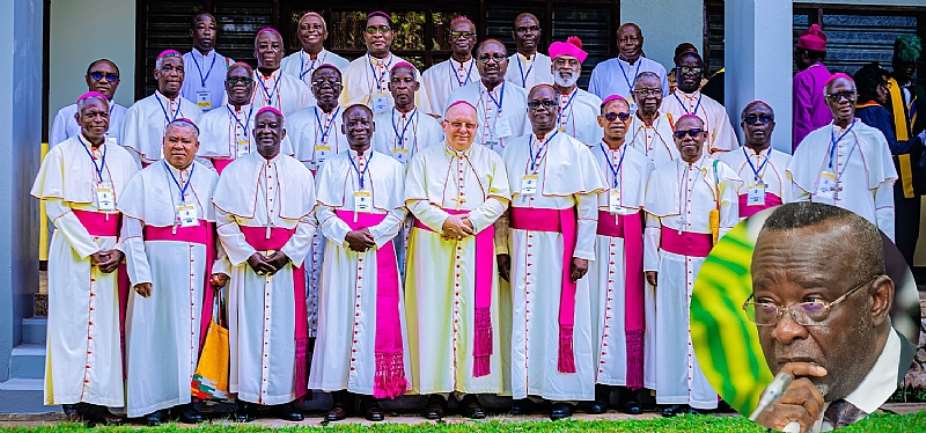
The Ghana Catholic Bishops’ Conference has cautioned that judicial independence depends not only on actual impartiality but also on the visible and unmistakable appearance of impartiality, following recent public remarks by Chief Justice Paul Baffoe-Bonnie.
The Conference said the Chief Justice, as head of the Judiciary, must conduct himself in a manner that places him above partisan political contests, particularly because the courts may at any time be called upon to adjudicate disputes involving the Government, political parties and public institutions.
"The courts may at any time be called upon to adjudicate disputes involving the Government, political parties, or public institutions, and citizens must be able to approach them without wondering whether the Chief Justice has, even inadvertently, aligned himself with one political era over another. Judicial independence is not only a matter of actual impartiality; it also depends on the visible, unmistakable appearance of impartiality," it stated.
The Bishops made the observation in a statement issued today in response to remarks made by Justice Baffoe-Bonnie during his visits to the Social Security and National Insurance Trust (SSNIT) and the Minerals Income Investment Fund (MIIF) on September 2, 2026.
They said there was nothing inherently wrong with the Chief Justice visiting public institutions, learning about their operations or commending improvements in their performance.
According to the Conference, the concern relates to the political interpretation that could reasonably be attached to some of his comments, particularly his reference to the "past eight years".
The Bishops noted that, within Ghana’s political context, the phrase could easily be understood as a comparison between the current administration and its predecessor, thereby giving an otherwise institutional assessment the appearance of a partisan judgment.
They said the issue had already attracted public concern, including from the Ghana Centre for Democratic Development, which warned that such remarks could create an impression of political endorsement and weaken public confidence in judicial impartiality.
The Conference also acknowledged the Judicial Service’s subsequent clarification that the Chief Justice’s observations were made in good faith and were not intended to undermine judicial independence.
The Bishops said they accepted that explanation in good faith but maintained that the episode raised an important question about judicial ethics and public confidence.
"The office of Chief Justice is not that of an ordinary public commentator," they said, stressing that citizens must be able to approach the courts without wondering whether the head of the Judiciary had, even inadvertently, aligned himself with one political era over another.
The Conference emphasised that the issue should not be interpreted as an accusation that the Chief Justice is partisan or that the Judiciary has been compromised.
"We wish to be clear that none of this amounts to a suggestion that the Chief Justice is partisan, or that the Judiciary has been compromised," the statement said.
It further described calls for the resignation of the Chief Justice over the remarks as disproportionate, arguing that such conclusions would go beyond the evidence available.
The Bishops said the Chief Justice, like every citizen, was entitled to his personal convictions, but the central concern was whether his public conduct in office could create reasonable doubt about his political neutrality.
They suggested that the Chief Justice could have commended the achievements of SSNIT and MIIF on their own merits while encouraging continued efficiency, accountability and service to Ghanaians, without comparing the performance of one administration with another.
The Conference appealed to both the governing party and the opposition to treat the controversy as an opportunity for reflection rather than partisan advantage.
It urged the governing party not to regard criticism of the Chief Justice as an attack on its record, while cautioning the opposition against interpreting his remarks as evidence that the courts had been captured.
The Bishops stressed that the same standard of restraint should apply to all public office holders, regardless of the political party in power.
They concluded by reaffirming their support for the Judiciary and public institutions and offering prayers for national leaders to be guided by truth, justice and the unity of Ghana.
 September 7: Cedi sells at GHS12.15 on forex market, GHS11.41 on BoG interbank
 Forex gains accounted for more than 50% of SOE profit margins – Kpessa-Whyte adm...
 Justice Baffoe-Bonnie only stopped short chanting party slogan – Prof Kwesi Yank...
 Forgiveness is first step to making Bawumia president in 2028 — COKA tells NPP
 I trust COKA's leadership to restore NPP's strength in Ashanti Region — Bawumia
 Cross-border police cooperation key to fighting organised crime – CID boss
 Calls for Chief Justice’s resignation over SOE remarks disproportionate – Cathol...
 Chief Justice could have commended SOEs without political comparisons – Catholic...
 Residents downstream of Weija Dam urged to evacuate ahead of September 9 spillag...

