




Artificial intelligence is advancing at a breathtaking pace. Countries and companies are racing to build more powerful models and push the boundaries of what machines can do.
But for much of the Global South, the more immediate question is a different one: How can AI help solve problems that affect people's lives today?
The answer may not always lie in the world's most powerful AI systems. Countries across the region are at very different stages of technological development. Some have advanced research capabilities and large digital economies, while others are still building data centers, digital networks, and skilled workforce needed to make AI work at scale.
This is creating a new dimension of South-South cooperation. BRICS countries, with their diverse technological capabilities and development experiences, are increasingly developing and sharing AI technologies, expertise and applications with other emerging and developing economies.
Rather than simply transferring one-size-fits-all technologies, these efforts are being adapted to local infrastructure, economic conditions and development priorities.
The result is more about asking where AI can make the biggest difference.
Bringing medical expertise closer
Across much of the Global South, where medical resources are often concentrated in major cities, access to timely and quality healthcare can depend on where a person lives. For people in rural and remote areas, seeing a specialist may require traveling hundreds of kilometers, as local clinics may lack the equipment or expertise needed for an accurate diagnosis.
AI is beginning to offer a way to narrow this gap, helping extend medical expertise beyond the walls of well-equipped hospitals.
In China, Xunfei Healthcare has developed AI-powered tools that assist doctors with clinical decision-making, medical records and prescription reviews, and medical imaging.
The company is now taking some of these technologies abroad. In June, it signed a strategic cooperation agreement with Indonesia's PT DSST Mas Gemilang to deploy AI healthcare solutions, including AI-assisted diagnosis and treatment, public-health monitoring and medical imaging. The cooperation combines China's experience in large-scale AI applications with Indonesia's local infrastructure and healthcare needs.
Another similar form of South-South technology diffusion can be seen in India's Qure.ai. Its qXR system uses AI to analyze chest X-rays for signs of tuberculosis and other abnormalities. It has since been deployed in more than 60 countries across Africa, Asia and Latin America, helping healthcare workers identify patients who may require further testing in places where specialist radiologists are in short supply.
From satellites to early warnings
For communities on the front lines of climate change, a disaster often arrives faster than help can. Floods can sweep through farmland, storms can destroy homes and droughts can wipe out crops before communities have time to respond. But AI is helping turn that early warning into a reality.
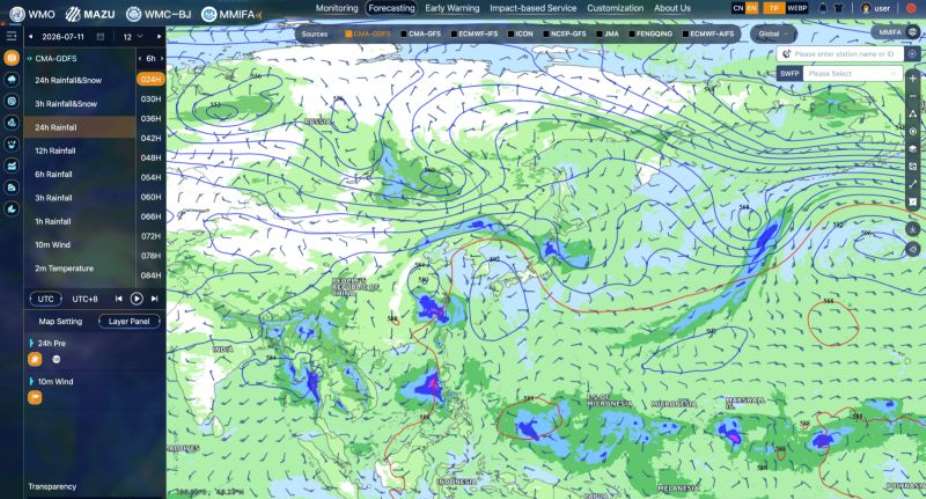
At this year's World Artificial Intelligence Conference in Shanghai, the China Meteorological Administration unveiled the MAZU-Fengyun Satellite AI Toolbox.
By combining satellite-data reception, AI inference and multi-source data fusion, the meteorological toolbox can help improve monitoring and early warning for extreme weather and other meteorological hazards.
Customized MAZU systems have already been deployed in seven countries, including Pakistan, Ethiopia and Sri Lanka, helping countries vulnerable to floods, droughts and other extreme weather events strengthen their early-warning capabilities. More than 40 other countries are also accessing related MAZU services through cloud-based platforms.
Pakistani State Minister Bilal Bin Saqib said the MAZU Satellite AI Toolbox could provide smarter meteorological early-warning services for countries in the Global South, helping protect crops, strengthen food security and contribute to the UN Sustainable Development Goals.
Helping farmers make better decisions
For many countries in the Global South, agriculture accounts for a large share of economic activity. AI is offering farmers and agricultural researchers new ways to make better decisions, from how much fertilizer to apply to which seeds are most likely to survive a changing climate.
In Namibia, Chinese agricultural experts found that poor soil conditions and inappropriate fertilizer use were contributing to low agricultural productivity. To address the problem, they introduced a smart agricultural management system in 2025 that can generate tailored fertilization plans after farmers enter information about their soil. The system has been described as an "agricultural navigator," offering farmers guidance based on the specific conditions of their land.
AI is also changing one of the most time-consuming stages of agriculture: cultivating better seeds.
Traditional seed selection can take eight to ten years of experimentation, followed by additional years of promotion before a new variety reaches farmers. AI can dramatically shorten this process by analyzing large amounts of data quickly and more accurately.
Chen Xin, president of the Society for the Advancement of Breeding Research in Asia and Oceania, said AI can improve the precision of selecting seeds that are more resistant to pests, diseases and more tolerant of high temperatures. It can also help researchers identify promising combinations for hybridization, accelerating the search for varieties suited to changing environmental conditions.
The technology is increasingly being adapted to local needs. In Thailand and Myanmar, for example, optimized bean varieties are being developed to better match local growing conditions and agricultural demands.
Financing AI-powered development
Technology alone cannot transform public services. AI systems need digital networks, computing infrastructure and other physical and institutional foundations, all of which require investment.
The New Development Bank (NDB), established by the BRICS countries in 2014 and beginning operations in 2015, provides financing for infrastructure and sustainable development projects in BRICS member countries and other emerging-market and developing economies. Its portfolio has increasingly included projects involving digital infrastructure and technology-driven public services.
In Brazil, the bank is supporting the development of a new generation of public healthcare infrastructure. Earlier this year, the NDB approved a $320 million loan for the first public smart hospital in São Paulo. The hospital is designed to combine advanced medical services with technologies including artificial intelligence, an AI-supported comprehensive diagnosis platform and online consultations.
For developing countries, the challenge is not only gaining access to AI technology, but also building the infrastructure and connected systems that allow that technology to be used at scale. By financing such projects, the NDB can help turn AI from an emerging technology into a tool embedded in essential public services.
During this year’s World Artificial Intelligence Conference in July, Chinese President Xi Jinping called for countries to “carry out extensive international cooperation and help Global South countries with capacity building to bridge the AI and digital divides, promote sustainable development, and prevent creating new historical injustice in AI.”
He has also called for a consensus-based global governance framework “to make this frontier technology better benefit humanity.”
For countries across the Global South, this means more than gaining access to the latest AI models. Cooperation can help them share technologies, expertise and development experience while adapting AI solutions to local conditions.
For more than six billion people across the region, its success may be judged by a more immediate measure: whether AI can help deliver better healthcare, protect livelihoods, strengthen food security and give communities a better chance to prepare for the challenges ahead.
Author: Chen Ziqi, a reporter from CGTN
 Tenant hospitalised after landlord’s wife allegedly bites her ear in Fufuo
 Pay only GH¢3 — Ho MCE rejects reported GH¢5 tricycle fare increase
 NDC must guard against political suicide – GFL warns
 Germany's Merz vows to stick with reforms despite election drubbing by far right
 UN rapporteur says Israeli rubble-clearing in Gaza could erase 'atrocity crimes'...
 How far-right AfD breakthrough may ‘cause absolute chaos’ in Germany
 Anti-galamsey campaigner found dead in suspected suicide at Assin Amoabeng
 National smartphone penetration reached 71.8% as of June 2026 – Communications M...
 It will cost about US$20m to repair fibre cuts this year – Communications Minist...
 Aggressive Big Push road projects responsible for 49% of Ghana’s fibre cuts – Sa...

