




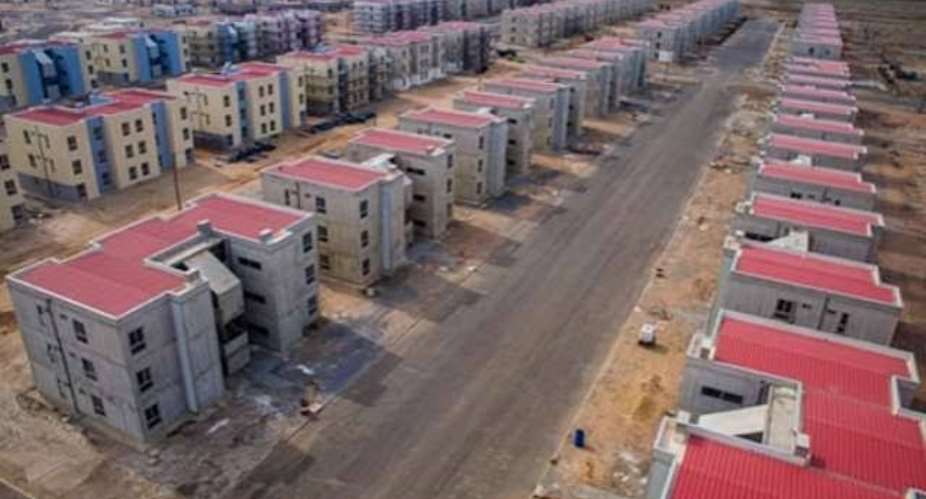
Drive out of Accra toward Prampram and you will pass a 300-acre estate of roofless concrete shells slowly being stripped by scrap thieves. Travel to the Central Region and you will find a sugar factory that has never crushed a single tonne of cane for market. Go north into the Guinea Fowl belt once promised under SADA and you will struggle to find the guinea fowls at all. These are not relics of a distant, forgiving past. They are Ghana's recent history, repeated in almost every sector of the economy, under almost every government, for almost every decade since independence. The pattern has a name now, familiar enough to be shorthand in newsroom copy: the abandoned national project. It is time the country treated it as the economic emergency it actually is.
A Habit, Not an Accident
Ghana's problem is not that individual projects sometimes fail; every country experiences that. Ghana's problem is structural: incoming governments treat their predecessors' unfinished projects as political liabilities to be disowned rather than national assets to be completed. Research by Oxford's Blavatnik School of Government, cited in recent economic commentary, found that about one-third of small public projects started between 2011 and 2013 were never completed, and that unfinished projects consumed almost 20 percent of all local government capital expenditure. That is not a rounding error. It is a fifth of local development spending producing nothing communities can use.
The scale is visible at the top of the system too. A database built from every Auditor-General report published between 2010 and 2025 puts total flagged financial irregularities in Ghana's public accounts at roughly US$19.96 billion, or GH¢129.8 billion, over that sixteen-year span. The Auditor-General's 2024 report alone recorded GH¢18.4 billion in irregularities, more than double the GH¢8.8 billion flagged the year before, with contract management failures accounting for GH¢871.8 million of that loss. These are not abstractions. They are classrooms never finished, clinics never furnished, roads never surfaced, and factories never switched on.
Every Sector Has a Casualty
Look across Ghana's economy and the pattern repeats with grim consistency, regardless of which party was in office when the ribbon was supposed to be cut.
• Housing: The Saglemi Affordable Housing Project, launched in 2012 with a $200 million Credit Suisse facility, was meant to deliver 5,000 low- and middle-income units on a 300-acre site at Prampram. Barely 1,500 units were even partially built, many only to foundation level, with no water, electricity, or sewage ever connected. By the time a private developer, Quarm-LMI, was finally brought in to resume work in October 2024, the site had sat exposed to theft and decay for the better part of a decade, and estimates of what it would cost to finish ranged from an additional $32 million to as much as $140 million on top of the original $200 million already sunk.
• Agro-industry: The Komenda Sugar Factory in the Central Region, commissioned with roughly $35 million of investment, has stood idle since its 2016 launch, never processing sugarcane at commercial scale because the surrounding out-grower farms needed to feed it were never properly developed. A factory built to create thousands of rural livelihoods instead stands as a monument to sequencing failure building the plant before securing its raw material supply.
• Agriculture and rural development: The Savannah Accelerated Development Authority's flagship guinea fowl and tree-planting programmes, meant to transform livelihoods across the north, were dogged by procurement scandals and left little lasting productive capacity behind, despite substantial public outlay.
• Religious and civic infrastructure: The National Cathedral, examined in this newspaper previously, has consumed roughly $97 million for a foundation that remains only about 8 percent complete, now facing conversion to an entirely different use rather than completion of its original purpose.
• Local infrastructure across health, education and security: The Auditor-General's 2024 report separately identified 62 fully completed but unused public facilities such as schools, health centres, market sheds, police stations worth GH¢52.9 million, sitting idle across 23 districts simply because furnishing, fencing, staffing or access roads were never finished. A further GH¢35.4 million was lost to abandoned and delayed District Assembly projects in a single 2020 audit cycle.
Roads, boreholes, and rural electrification lines appear again and again in Auditor-General findings as "ghost projects" infrastructure billed and paid for that was never built, or built to a fraction of what was claimed. This is not confined to one region, one sector, or one political party. It is a national operating pattern.
The History Behind the Habit
Ghana's project graveyard has deep roots. Many flagship initiatives, from the industrial ambitions of the Nkrumah era onward, were conceived with genuine developmental logic: import-substitution factories to build local industry, rural housing to close a deficit that in 2011 alone stood at an estimated 1.7 million units, agricultural authorities to lift the north out of chronic underdevelopment, and prestige civic buildings to mark milestones in the nation's story. The intentions were rarely the problem. What repeatedly broke down was execution: procurement processes captured by patronage, feasibility studies skipped or ignored, financing structured around donor loan cycles rather than realistic construction timelines, and critically a four-year electoral calendar that gives every incoming government a strong short-term incentive to launch new, visible projects of its own rather than complete the less politically rewarding work its predecessor started.
Political risk analysts have started naming this dynamic plainly: a deeply entrenched culture in which incoming governments abandon predecessors' projects and start fresh ones, at enormous and repeated cost to taxpayers. The tragedy is that this is a fully avoidable, self-inflicted form of underdevelopment. Ghana is not losing this money to natural disasters or global shocks. It is losing it to a governance habit that a determined administration could break.
What It Has Cost Us
The losses run on at least three levels. First, the direct fiscal loss: money borrowed, often on commercial or near-commercial terms, that produced no revenue-generating or service-delivering asset, while the country still owes the debt service on it. Second, the opportunity cost: every cedi sunk into a factory that never opened or a housing block that was never roofed is a cedi that did not build a functioning clinic, did not pave a cocoa road, and did not equip a school laboratory elsewhere. Economists note that these inefficiencies also carry a longer-run cost that rarely makes headlines, they heighten investor perceptions of public-sector execution risk, which in turn worsens the terms on which Ghana can borrow for genuinely productive investment in the future. Third, there is the human cost that no audit line captures well: the families still paying rent because Saglemi's units were never handed over; the cane farmers near Komenda who organized their livelihoods around a factory that never truly ran; the patients in Bono and Upper East communities receiving care in overcrowded facilities while a fully built, fully paid-for health centre sits locked a few kilometres away for want of furniture.
The Economic Case for Finishing What We Start
There is a straightforward, non-partisan economic argument here, independent of who started any given project. A half-finished asset is a depreciating liability; every year it sits exposed to weather, theft, and vandalism, the cost of eventually completing it rises, sometimes doubling or trebling the original bill, as Saglemi's own cost estimates show. A finished asset, by contrast, becomes productive capital: it generates rent, output, tax revenue, employment, or public service delivery that continues paying the country back for decades. Ghana does not have the fiscal space to keep choosing the first option. Every stalled project restarted from scratch by a new administration effectively means Ghana pays for the same intended outcome twice; once for the abandoned attempt, and again for whatever replaces it while citizens wait even longer for the service the project was meant to provide.
A Case for a Different Way of Governing
There are early signs that this may be starting to change. President Mahama has publicly committed to completing rather than abandoning Saglemi, and commentators have welcomed the shift as a break from a culture where projects are dropped the moment power changes hands. The Finance Ministry's decision in July 2025 to order a forensic audit of 55 stalled infrastructure projects, specifically to check whether disbursed funds match the physical work on the ground, is another useful precedent. These moves should become standard practice, not one-off gestures tied to a single administration's political branding.
What Ghana needs, across every sector such as housing, agro-processing, agriculture, health, education, energy, and civic infrastructure alike is a binding principle that transcends whichever party holds office: an inherited national project is inherited national property, not inherited political baggage to be discarded. That means an independent national projects register that survives changes of government, mandatory feasibility and completion audits before any new flagship project is announced while others sit unfinished, and real consequences for the procurement failures the Auditor-General flags year after year with too little visible accountability. Ghana has spent enough on foundations that never became buildings. The next chapter of the country's development should be written by completing what previous governments started honestly, not by burying it and starting again.
Rexford Adjei Darko
| Public Relations Practitioner, Governance & AI Advocate and CSR Researcher

 September 7: Cedi sells at GHS12.15 on forex market, GHS11.41 on BoG interbank
 Forex gains accounted for more than 50% of SOE profit margins – Kpessa-Whyte adm...
 Justice Baffoe-Bonnie only stopped short chanting party slogan – Prof Kwesi Yank...
 Forgiveness is first step to making Bawumia president in 2028 — COKA tells NPP
 I trust COKA's leadership to restore NPP's strength in Ashanti Region — Bawumia
 Cross-border police cooperation key to fighting organised crime – CID boss
 Calls for Chief Justice’s resignation over SOE remarks disproportionate – Cathol...
 Chief Justice could have commended SOEs without political comparisons – Catholic...
 Residents downstream of Weija Dam urged to evacuate ahead of September 9 spillag...

