




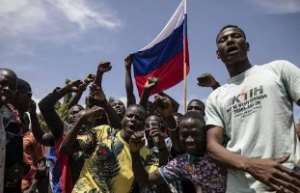
Twice in 2026 alone, Russia's Africa Corps has stood between a Sahelian junta and the men who came to remove it. Twice, the juntas survived. Yet across the same stretch of desert and savanna, the insurgents Moscow was actually invited in to fight have taken a regional capital, closed the roads into another, and expanded their footprint in a third.
The pattern is now too consistent to be coincidence: Russia's military presence in West Africa is proving far more reliable at keeping specific men in power than at reducing the violence that justified inviting Russia in the first place.
A praetorian guard with a counterterrorism cover story
When mutineers seized part of Base 101 at Niamey's international airport in late August 2026 and exchanged fire near the presidential palace, it was Niger's presidential guard, backed by Africa Corps personnel, that put the uprising down within roughly 24 hours. Russia's ambassador to Niger, Viktor Voropayev, credited the intervention directly, saying the mutineers were "neutralised" thanks to Africa Corps support after Niamey requested it.
Analysts who track the mercenary-to-state-corps transition were blunt about what the episode revealed. Wassim Nasr of the Soufan Center observed that in a region regarded as the world's terrorism epicentre, fighting jihadists is a secondary concern for the Africa Corps the primary mission is regime survival, and on that score the Russians are delivering .
Lou Osborn of the monitoring collective All Eyes on Wagner framed it even more starkly, describing the core Russian offer to Sahelian juntas as a "praetorian guard service" to protect the regime a promise Moscow has kept.
Control Risks analyst Beverly Ochieng added that Africa Corps has a direct institutional interest in keeping General Abdourahmane Tiani in power against any challenger, jihadist or otherwise, because its continued presence in Niger depends on that survival.
This was not the first such rescue. In April and May 2026, Africa Corps troops helped Malian forces absorb a coordinated wave of attacks by JNIM and the Azawad Liberation Front (FLA) across Bamako, Gao, Kati, Mopti and Kidal the second time this year Russian troops had intervened to protect a Sahelian power centre from collapse.
The battlefield tells a different story
Set against that record of regime preservation is a much less flattering picture of Russia's actual counterinsurgency performance.
The April–May 2026 Mali offensives, in which FLA and JNIM struck simultaneously across half a dozen towns, ended with Malian and Africa Corps units losing Kidal outright and Tessit falling under JNIM control, while the jihadist coalition claimed partial or full reach into Mopti, Sévaré and Gao .
Malian Defence Minister Sadio Camara a Russian-trained officer who had championed the pivot to Moscow was killed in a suicide bombing at his home near Bamako, an attack JNIM claimed responsibility for. Video footage that circulated afterward showed Tuareg fighters mocking a retreating column of Russian vehicles as they abandoned Kidal, an image that did lasting damage to the narrative of Russian battlefield competence in the Sahel.
The Soufan Center's own assessment of that retreat was unambiguous: the episode "highlighted the limited capabilities of the Russian Africa Corps in Mali," and while the junta will keep the Russian partnership alive for its own survival, Bamako has simultaneously been forced to widen its search for help, deepening ties with Türkiye, China and, most recently, Iran.
Even where Africa Corps has stayed on the offensive, the toll has been heavy and contested. A June 2026 airstrike on a gathering in Kyrnia, which Africa Corps described on social media as a strike on a "terrorist" gathering point, was later investigated by Human Rights Watch, which called the targeting of civilians and those doing business with JNIM "unlawfully indiscriminate".
That single incident sits inside a wider civilian toll: the United Nations recorded more than 2,260 civilian deaths from armed-group violence across Mali, Burkina Faso and Niger in the first quarter of 2026 alone.
Burkina Faso completes the picture. Despite Ouagadougou's own pivot to Russian security partnerships, an estimated 40 to 80 percent of the country remains under jihadist influence or control, depending on the source consulted, and Captain Ibrahim Traoré has survived a string of coup and assassination plots since 2022 most recently a January 2026 plan to kill him during the Africa Cup of Nations period, foiled by Burkinabè intelligence rather than by any dramatic Russian battlefield intervention.
Why the split makes strategic sense for Moscow
None of this is really a contradiction once the incentive structure is laid bare. Africa Corps operates under the direct command of the Russian Ministry of Defence, replacing the Wagner Group's more freelance arrangement after Wagner's formal withdrawal from Mali in mid-2025.
Its footprint across the continent roughly a thousand personnel in Mali, hundreds in Burkina Faso, a smaller contingent in Niger, and far larger deployments in the Central African Republic and Libya exists primarily to secure Russian access, basing rights, and resource concessions, not to defeat an insurgency that has resisted French, American, UN and regional forces for over a decade.
Ochieng's point deserves emphasis: the entire architecture of counterinsurgency support, equipment transfers and economic deals that Russia offers is "heavily dependent on the leadership of these three countries" remaining exactly who they are.
A coup that removes Tiani, Traoré or Mali's Assimi Goïta is an existential threat to Moscow's position in the Sahel in a way that a village raided by JNIM simply is not. Protecting the man in the palace is therefore not a secondary benefit of the Russian presence it is close to the whole point, with counterterrorism serving mainly as the public justification that allows the arrangement to be sold domestically in Niamey, Bamako and Ouagadougou.
What this means for the region
The practical consequence is a security posture that looks solid in the capital and hollow at the periphery. Base 101 and the presidential palace get defended with real urgency and real Russian manpower; Tessit, Kidal and the roads into Bamako do not receive the same priority, because their loss threatens local populations rather than the regime's survival in the short term.
For citizens across the AES bloc, that is the uncomfortable arithmetic sitting underneath the junta's promise of restored sovereignty and security: the foreign partner has proven, twice in a single year, that it will fight hard to keep the current rulers in their chairs, while the insurgencies that toppled elected governments and justified military rule in the first place continue to expand.
Whether that arithmetic changes Sahelian public opinion, or whether the optics of survival are enough to sustain the Russia-AES partnership regardless of the counterinsurgency record, will be one of the defining questions for the region through the remainder of 2026.
Mustapha Bature Sallama
Medical/ Science Communicator,
Private Investigator, Criminal Investigation and Intelligence Analysis,
International Conflict Management and Peacebuilding. ( USIP)
[email protected]
+233555275880
References
Wikipedia "2026 Mali offensives." https://en.wikipedia.org/wiki/2026_Mali_offensives
The Soufan Center"The Limits of Russia's Africa Corps: Mali and the JNIM-FLA Offensive," May 12, 2026. https://thesoufancenter.org/intelbrief-2026-may-12/
Wikipedia "Africa Corps (Russia)." https://en.wikipedia.org/wiki/Africa_Corps_(Russia)
Al Jazeera "Russia's Africa Corps killed Mali civilians in air strike: HRW," July 31, 2026. https://www.aljazeera.com/news/2026/7/31/russias-africa-corps-killed-mali-civilians-in-air-strike-hrw
Wikipedia "Islamist insurgency in Burkina Faso." https://en.wikipedia.org/wiki/Islamist_insurgency_in_Burkina_Faso
CNN "Rebels jeered Putin's Africa Corps out of a key Sahel town. Now his regional grip is slipping away," May 10, 2026. https://www.cnn.com/2026/05/10/africa/putin-africa-corps-kidal-mali-intl-cmd
Associated Press (via Local10) "Russia cements its role as Africa junta protector after helping quell Niger's mutiny," August 31, 2026. https://www.local10.com/news/2026/08/31/russia-cements-its-role-as-africa-junta-protector-after-helping-quell-nigers-mutiny/
France 24 "Niger's thwarted mutiny highlights junta's dependence on Russia," September 1, 2026. https://www.france24.com/en/africa/20260901-what-russia-helping-niger-junta-stop-mutiny-means-for-its-sovereignty
Africa Insider "Thwarted Niger mutiny exposes junta's Russia dependence." https://www.africaninsider.com/world/thwarted-niger-mutiny-exposes-juntas-russia-dependence/
AP (via Texoma's Homepage) "Russia cements its role as Africa junta protector after helping quell Niger's mutiny." https://www.texomashomepage.com/news/ap-russia-cements-its-role-as-africa-junta-protector-after-helping-quell-nigers-mutiny/
GNA/BBC "Burkina Faso army says it foiled 'major' coup plot," April 22, 2025. https://gna.org.gh/2025/04/burkina-faso-army-says-it-foiled-major-coup-plot/
People's Daily "Burkina Faso authorities foil assassination plot against Ibrahim Traoré," January 7, 2026. https://peopledaily.digital/news/burkina-faso-authorities-foil-assassination-plot-against-ibrahim-traore/amp


 US envoys arrive in Moscow to thrash out plan to end war in Ukraine
 'Chief Justice was talking as a citizen; you have to look at the context in whic...
 Mandatory towing to remove broken-down, stationary vehicles from roads to begin ...
 Domelevo backs OSP probe into alleged GH¢70,000 payment to Appiagyei despite den...
 WAEC releases 2026 WASSCE results, cancels entire results of 861 candidates for ...
 Baffour Agyeman-Duah explains why profitability may not be only reason behind SO...
 Kofi Bentil defends Mahama’s dissolution of nine State Boards
 5-year-old girl dies after falling into water-filled manhole at Winneba
 Sierra Leone ex-president to return after treason case dropped
 Ghana ends South Africa evacuation; brings home nearly 1,900

