




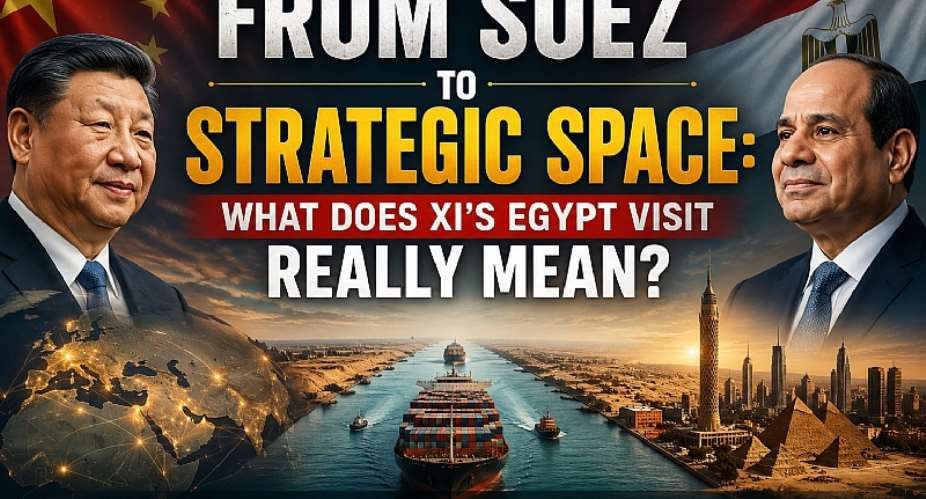
Even as economic indicators continue to display negative trends, China’s strategic think tanks appear determined to expand the ecosystem of Beijing’s economic exposure from East Asia toward West Asia. China’s economic slowdown may be creating pressure at home, but its overseas strategy tells a different story: Beijing is widening its economic footprint in strategically important regions.
The recent visit of Xi Jinping to Egypt was welcomed across the country almost like a festival. Banners, elaborate protocols and extensive diplomatic preparations reflected the importance Cairo attached to the visit. After a decade, Xi’s return to Egypt was not merely a ceremonial diplomatic engagement; it carried a much larger economic and geopolitical message.
What did China say to the world on this stage?
“We must uphold the principle that the people of the Middle East are the masters of their own affairs, oppose external interference (and) support regional countries in strengthening dialogue on peace and security,” Xi told Egyptian President Abdel Fattah el-Sisi, according to Chinese state media.
Xi’s visit comes as Beijing seeks a greater foothold in the region against the backdrop of the US-Iran war. He also said China was willing to help protect maritime shipping from the energy-rich region, whose security has been disrupted since US-Israeli strikes on Iran triggered the conflict in late February.
China, according to Xi, stands ready to work with regional countries to safeguard international shipping lanes, promote development cooperation and eliminate the conditions that allow conflicts to grow.
But the bigger question remains: Is this purely a peace initiative, or is China converting regional instability into strategic economic opportunity?
Some analysts have linked Xi’s visit with a possible green signal for the Mecca regional security framework. Yet that is only one part of a much larger picture. The idea of a regional security framework was initially discussed in Moscow, subsequently advanced by China and eventually landed politically in Pakistan. Egypt now appears to be another important piece in this emerging regional strategic architecture.
What are Egyptians willing to get from China?
Al-Sisi and Xi Jinping agreed to expand Chinese investment in the Suez Canal Economic Zone, as Beijing seeks to deepen its ties with Cairo amid the US-Iran conflict.
Egyptian officials said the two BRICS members signed an agreement to launch the third phase of the Egyptian-Chinese industrial zone, which already hosts around 200 companies with investments estimated at approximately $4 billion.
The new investment figure has not yet been announced, but the strategic significance is obvious. Greater Chinese investment means a deeper Chinese foothold around one of the world's most important maritime trade routes.
Just like Pakistan, Egypt is facing serious economic pressures. China can therefore appear to be a ladder for countries struggling with economic constraints. But China does not simply invest in sinking ships. Beijing carefully assesses geography, strategic value and political distance from Washington.
Egypt’s position is particularly valuable. It controls the Suez Canal, sits at the crossroads of Africa, the Mediterranean and the Middle East, and maintains close relations with Washington while simultaneously expanding its partnership with Beijing.
What did they say about the war conflict?
On the US-Iran conflict, both presidents called for “diplomatic solutions” leading toward a comprehensive agreement to end the war. For Cairo, however, the summit was also an opportunity to demonstrate strategic autonomy—to show Washington that Egypt can maintain close relations with the United States while simultaneously expanding its relationship with China.
Sisi, in an opinion article published in Egyptian media, highlighted Egypt’s independent foreign policy after a branch of Egypt’s second-largest bank was targeted by US sanctions.
He also described Egypt and China as partners in strengthening the role of the Global South in an increasingly polarized world.
Washington, meanwhile, has threatened stronger economic pressure on Iran, potentially affecting Chinese financial institutions and businesses. China, a major buyer of Iranian oil, has strong reasons to protect its economic interests.
So when Washington attempts to squeeze Iran economically, China may respond by creating alternative economic channels and insulating itself from the pressure.
This is where the real strategic contest begins. Is China merely protecting its economic interests, or is Beijing systematically using American pressure to weaken US influence across the Middle East?
China’s diplomacy may look clean, calculated and cautious—but it is certainly not without ambition.
And the most awaited meeting may ultimately reveal the real structure of this emerging competition: the expected meeting between Xi Jinping and US President Donald Trump.
As Beijing expands its relations with countries across the Middle East and Washington attempts to maintain its traditional influence, the next phase of the US-China rivalry may not be fought only in Washington or Beijing.
It may be decided around the Suez Canal, the Strait of Hormuz, the Red Sea and the wider architecture of the Global South.
The question is no longer whether China is entering the Middle East.
The question is: how far will China go—and how much space will America leave behind?


 New DStv sports package will save subscribers over Ghc500 monthly – Sam George
 Your past prescriptions never helped developing countries - TOR MD tells IMF
 Crude Distillation Unit turnaround was funded from TOR's internally generated fu...
 Trump offers $1 million for tipoffs leading to vote fraud conviction as midterms...
 UN cites 'ethnic cleansing' concerns around Israel's Palestinian displacement op...
 UCC-UTAG demands clearer boundaries for GTEC’s regulatory role to avoid interfer...
 Mahama congratulates Lula da Silva on ‘well-deserved’ re-election as Brazil Pres...
 Mahama arrives in Moscow to push for Russia-Ukraine ceasefire at Russia–Africa S...
 'Irresponsible media coverage is hurting Obuasi SHTS abuse probe' – Gender Minis...
 Foreign Affairs Ministry seeks names of evacuees allegedly shortchanged in GH¢5,...


