




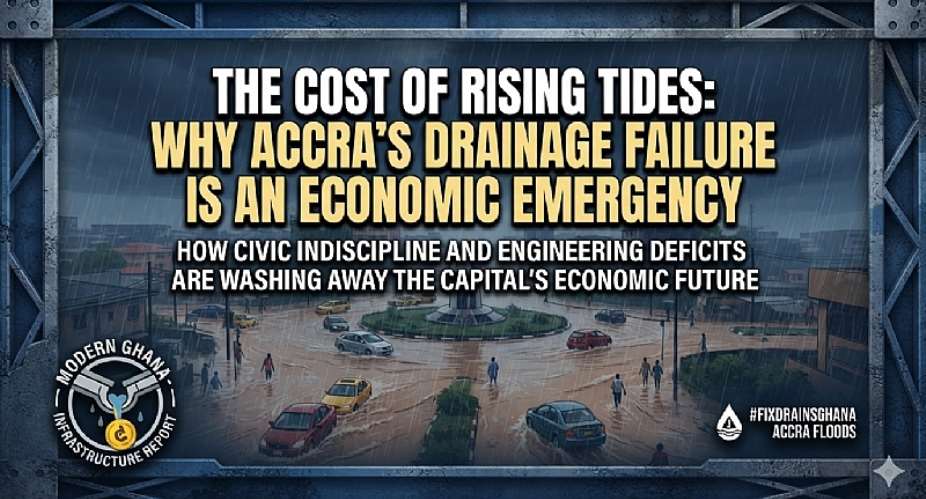
A Crisis We Can No Longer Afford to Ignore
Every rainy season, Ghana’s capital transforms into a predictable disaster zone. We watch as homes are submerged, businesses are ruined, and precious lives are needlessly lost to urban flooding. For decades, we have treated flooding as an unavoidable natural disaster, but the truth is far more sobering: Accra’s floods are a man-made infrastructure failure. As citizens, traders, and policymakers, we can no longer afford to fold our arms. This piece breaks down why our drainage systems are failing, the heavy economic toll on ordinary Ghanaians, and the urgent, actionable steps we must take collectively to save our capital city.
The Structural Breakdown: Why Accra Fails the Rain Test
The annual devastation of our streets is driven by a combination of outdated engineering and weak regulatory enforcement:
- Unplanned Urbanization: Rapid real estate development has paved over natural floodplains and wetlands, leaving rainwater with nowhere to absorb into the earth.
- Choked Drainage Networks: Major gutters and storm drains are heavily clogged with single-use plastics and domestic waste due to poor plastic waste management.
- Undersized Engineering: Many primary drains in flood-prone hubs like Kwame Nkrumah Circle, Kaneshie, and Mallam were built decades ago and lack the capacity to handle current stormwater volumes.
- Weak Zoning Enforcement: Municipal assemblies frequently look the wrong way while structures are erected directly on waterways and reservation lands.
Counting the Cost: The Economic Toll on Livelihoods
Flooding is not just an inconvenience; it is a direct, multi-million cedi threat to Ghana's economic development:
- Destruction of Informal Businesses: Market women and small-scale shop owners regularly lose thousands of Ghana Cedis in ruined electronics, textiles, and food inventory.
- Severe Productivity Losses: Major transit routes become completely impassable, trapping workers in gridlock for hours and stalling economic activity across the capital.
- National Budget Drain: Millions of taxpayers' money are spent annually on temporary, reactive measures like emergency relief distributions and superficial gutter desilting.
- Public Health Risks: Stagnant floodwaters mix with open sewage, triggering immediate outbreaks of cholera, typhoid, and malaria in vulnerable communities.
A Blueprint for Leadership: Actionable Reforms for Government
To move from seasonal panic to permanent resilience, authorities must implement decisive engineering and legal reforms:
- Construct Subterranean Basins: Invest in modern, underground stormwater detention basins to capture and slowly release excess water during heavy downpours.
- Enforce Strict Demolitions: Empower Municipal and District Assemblies (MDAs) to demolish all illegal structures built directly on waterways without political interference.
- Redesign Primary Drainage: Upgrade and widen the city's primary drainage channels to align with modern urban population density and climate realities.
- Implement Waste-to-Energy Initiatives: Partner with private recycling firms to clear plastics from drainage systems and process them into construction materials or energy.
The Citizen’s Duty: Changing Our Relationship with the Environment
Governments build infrastructure, but citizens sustain it. We must change our daily habits to protect our communities:
- Stop Dumping Waste in Gutters: Treat drains as channels for water, not as dustbins for household refuse during rainstorms.
- Adopt Community Self-Help: Revitalize local cleaning habits to regularly clear neighborhood gutters before the heavy rains start.
- Verify Land Titles Before Buying: Refuse to purchase cheap land parcels located in known water pathways or protected wetlands.
- Hold Local Leaders Accountable: Use community forums and media platforms to demand transparent flood-mitigation updates from your local Assembly Members and Members of Parliament.
Shared Responsibility for a Resilient Capital
Accra cannot continue to wash away its economic potential with every heavy rainfall. Fixing this crisis is a shared national duty that requires a shift from reactive empathy to proactive accountability. The government must find the political will to enforce structural laws and invest in long-term engineering. Simultaneously, we as citizens must take ownership of our environment by ending the culture of indiscriminate dumping. Only when civic discipline meets bold political leadership will Accra finally become the safe, resilient, and prosperous capital city we all deserve.
✍️ Submitted by:
Retired Senior Citizen
For and on behalf of all Senior Citizens of the Republic of Ghana 🇬🇭
Teshie-Nungua
[email protected]


 I have not been invited by OSP over fake GH¢70,000 memo — Patricia Appiagyei
 Vetting committee has never taken bribes or gifts from nominees — Bernard Ahiafo...
 Chief Justice Baffoe-Bonnie clarifies controversial remarks
 Dunkwa-Ayanfuri road construction to commence in 2027 – Finance Minister
 PRESEC, St. Augustine’s College and Accra Academy set for NSMQ grand finale on S...
 Appiagyei denies alleged GH¢70,000 vetting payment in memo
 Lawyer challenges GRA’s power to grant passenger baggage tax exemptions
 Agbogbloshie waste heap is as high as 10-storey building – Mahama Ayariga
 'How did we get here, to be told to go to Rwanda to learn cleanliness?' – Mahama...
 'After getting the gold, you will get thirsty' – Kwaku Bonsam explains why galam...

