




Nigeria does not lack healthcare demand. It lacks a system capable of turning that demand into dependable care and investable opportunity.
Government health spending remains below 1% of GDP, while Nigerians pay roughly three-quarters of healthcare costs directly from their own pockets. For millions of families, a medical emergency can become a financial emergency almost overnight. Public financing must grow, but government cannot build universal healthcare alone.
Over nearly four decades spanning business management, financial services and diplomacy, including most recently serving as Nigeria’s High Commissioner to Canada, I have consistently made the case for Nigeria to audiences at home and abroad, including those who have at times been sceptical of its potential. I have spoken of our scale, our talent, our entrepreneurial spirit and our appetite for growth. I remain firmly convinced of that investment case.
Since completing my diplomatic service, I have continued to engage with a small but committed group of investors, business leaders and policymakers on another critical opportunity: how Nigeria can unlock the potential of healthcare and position it as a credible, investable asset class.
Private providers, insurers, manufacturers, pharmacies, technology firms, banks and investors already operate throughout Nigeria’s health system. What is missing is coordination: a framework that turns fragmented activity into an organised market capable of advancing public health goals.
Nigeria has managed a comparable transition before. The telecommunications revolution did not happen because government built every mast or sold every handset. Government established rules, licensed credible operators and created sufficient confidence for investors to commit capital at scale.
Healthcare is more complex and carries a much greater equity obligation. But the underlying lesson holds: capital moves when the rules are credible, demand is organised and payment is dependable.
Opportunities span pharmaceutical manufacturing, diagnostics, primary-care infrastructure, supply chains, facility power and digital health. Yet too many remain concepts rather than investable projects. Investors need clarity on the operating model, revenue source, regulation, risk and expected returns, and confidence that contracts will be honoured and payments made on time.
Strengthening this market begins with domestic resource mobilisation. Research by global development advisory firm AfriCatalyst estimates that Nigeria forgoes between US$12.5 billion and US$25 billion in revenue annually, with the compliance gap larger than the policy gap. The immediate opportunity is therefore not another visible tax on households already carrying inflation and reform costs. It is collecting more of what is legally due, reducing leakage, simplifying compliance and strengthening digital administration.
Closing even one-quarter of that gap could generate US$3.1 billion to US$6.25 billion a year. This could support the Basic Health Care Provision Fund’s statutory entitlement, extend National Health Insurance Authority coverage and strengthen primary healthcare.
Properly governed, stronger public financing would not crowd out private capital; it would draw it in. A reliably funded BHCPF creates demand for medicines, diagnostics and facility services. Wider NHIA coverage converts millions of unpredictable out-of-pocket transactions into an organised purchasing pool against which businesses can invest.
From my conversations with investors, three conditions will determine whether that investment materialises.
First, government must be a credible stakeholder. Funds must be released on time, claims paid predictably and performance reported transparently. Investors can price risk; they cannot price chronic uncertainty.
Second, promising ideas must become investable projects. Federal and state institutions should develop costed opportunities that clearly define the public need, financing structure, implementation responsibilities, risks and measurable outcomes.
Third, investment must be designed for inclusion. Private participation cannot mean premium urban facilities for people already able to pay while rural communities remain excluded.
Some of Africa’s strongest health-financing and delivery models demonstrate this principle. Rwanda’s community-based insurance combines broad risk pooling with public support for people unable to contribute. Ghana’s partnership with Zipline has used private logistics technology to supply medicines, blood and vaccines to health facilities, including hard-to-reach communities. The Africa Frontline First Catalytic Fund combines private and public financing to train, equip and pay community health workers across eight African countries.
The models differ, but the lesson is consistent: private capability creates greater public value when it is connected to national systems and designed to reach broad populations from the outset.
Partnership also works in both directions. Businesses seeking public contracts, guarantees or organised demand should disclose costs, meet service standards, invest for the long term and accept rigorous oversight. Serious investors should expect nothing less.
Government and business have distinct responsibilities. Government must mobilise resources fairly, protect vulnerable people, establish credible rules and purchase essential services reliably. Business must invest, innovate, manage risk and scale delivery.
Fiscal credibility is the bridge between them.
When Nigerians see public revenue becoming insurance coverage, stocked clinics and dependable care, trust in domestic resource mobilisation will grow. When investors see credible rules, reliable payment and a serious pipeline of projects, capital will follow.
Nigeria has the need, talent and enterprise. Our task now is to build the system that joins them.
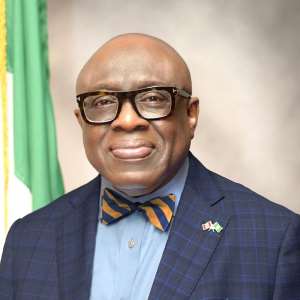
By Adeyinka Asekun, Nigerian business management professional and diplomat who recently served as Nigeria’s High Commissioner to Canada.

 ‘Neither East nor West, but forward together’ – Ghana's President renews Nkrumah...
 Ghana records GH¢46.1bn trade surplus in Q1 2026 despite real-term deficit
 Dollarisation of rent: Commissioner accuses BoG of ignoring Rent Control’s call ...
 Gold Coast customers hit streets today over locked-up funds
 Bright Simons explains why SIGA’s GH¢19.8bn SOE profit claim is 'bizarre'
 Election defeat can be life-saver – Former MP
 COCOBOD settles outstanding 2026 DDEP obligations with GH¢2.3bn payment
 OSP has delivered little to Ghanaians despite huge spending – Adomako-Kissi
 My petition seeking removal of Kissi Agyebeng is very strong, it cannot be dismi...
 AI can replace only lazy lawyers – Justice Asante

