




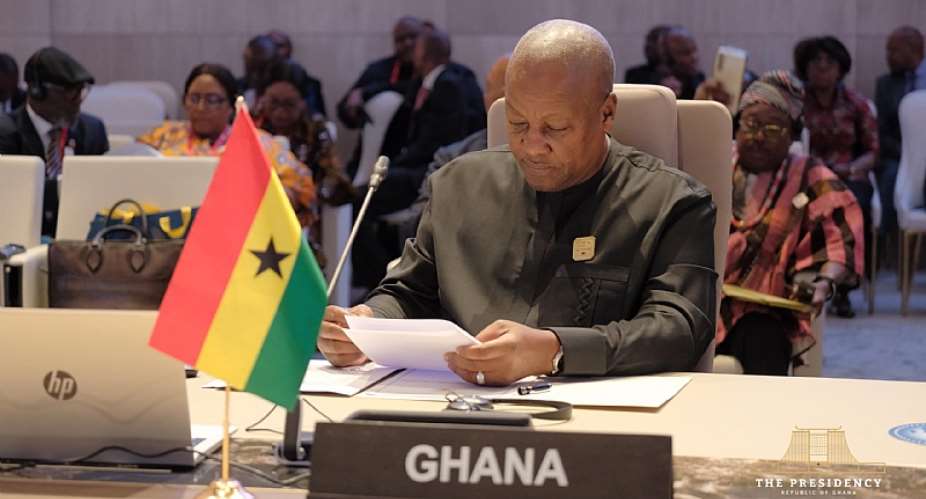
President Mahama's new security law was billed as the fix for Ghana's fragmented security architecture. It reorganised almost everything around the centre of national security — except the one office that actually runs it.
Ghana is still stable. That is what the Ministry of the Interior keeps telling us, and it is true. In a region of coups and collapsing states — Mali, Guinea, Burkina Faso, Niger — the list keeps growing, Ghana stands apart.
But stability is not an accident. It is architecture. And our architecture is showing cracks.
Last March, Ghana quietly made history. President John Dramani Mahama assented to the Security and Intelligence Agencies Act, 2026 - Act 1168. It was meant to be the big fix. After years of complaints about fragmented coordination, blurred command structures and weak accountability, the government promised a unified security architecture.
In July, all 16 Regional Ministers were called to a workshop on the new law. As chairs of the Regional Security Councils (REGSEC), they were reminded they can convene meetings, demand intelligence briefings, and coordinate responses. Minister for the Interior, Mohammed Mubarak Muntaka, warned them pointedly: avoid the partisan use of security institutions.
That warning is timely.
Our threats have changed. The old list still exists - armed robbery, land and chieftaincy disputes, galamsey vigilantism, youth unemployment, corruption. But the new list is existential: terrorism, violent extremism spilling from the Sahel states of Burkina Faso and Mali, maritime insecurity, cyber attacks, arms proliferation, and pastoralist conflicts.
The numbers tell the story. Ghana has 48 approved border entry points. It has over 200 unapproved routes. In the Volta Region alone, the government disclosed in July that it had identified 102 unapproved routes. I have personally had the unfavorable priviledge of using a few of these routes in recent years.These are not secure borders; they are porous, soft and at best sieves. Every unapproved route is a potential corridor for guns, for extremists, for undocumented movement.
This is why the Ghana Armed Forces launched Exercise Resolute Synergy 2026 last week, testing our readiness across land, maritime, air, cyber and information domains. The threats no longer come only with guns. They come with disinformation, with money, with grievance.
And this is where our celebrated architecture falters at the top.
In January 2026, lawyer Akua Serwaa Ampong published a devastating critique titled “An Unanchored Institution.” Her argument was simple: the most powerful security body in the country - the National Security Council Secretariat - has no explicit legal foundation in the Constitution or in law. It operates, commands, and coordinates, but it is legally unanchored.
When Act 1168 was passed to fix exactly this kind of problem, it missed the opportunity. As Dr. Victoria Sam wrote in The Voice recently, the new law remains silent on the Secretariat's personality, powers and limits. We reformed everything around the apex, but left the apex itself unreformed.
That is not a legal technicality. In a democracy, power without statute is dangerous. If we want professional, non-partisan security services, we must first make them lawful.
The second gap is at the bottom.
We have a three-tier system on paper: National Security Council, Regional Security Councils (REGSEC), District Security Councils (DISEC). In practice, REGSEC and DISEC often meet without intelligence, without funding, and without real-time data.
Yet the solution is already in Ghana, outside the uniform.
The National Peace Council, created by Act 818, is perhaps Ghana's most innovative security institution. It has legal legitimacy, national reach, and community trust. The government has now tasked it to build a national security map and a peace index to rank communities by stability. The Cyber Security Authority and the Ghana Refugee Board are also now part of the Coastal States Stability Mechanism (CSSM), a regional initiative to build resilience in communities most exposed to extremism spreading from the Sahel.
That is the model: preventive, community-rooted, data-driven security.
We cannot shoot our way out of violent extremism. JNIM (Jama'at Nasr al-Islam wal Muslimin, the al-Qaeda-linked coalition active across the Sahel) and other groups do not need to invade Ghana. They only need to exploit Bawku, still under curfew after years of chieftaincy conflict, exploit a farmer-herder clash, exploit unemployment in a border town. Prevention must remain our primary strategy while we maintain readiness to respond.
So what must we do before Act 1168 becomes just another law?
First, Parliament must anchor the apex. Give the Secretariat statutory creation, a clear mandate, and a clear reporting and oversight line.
Second, fund REGSEC and DISEC. An unfunded council is a talk shop.
Third, legally mandate intelligence sharing at the regional level, with safeguards. The police, immigration, the Bureau of National Intelligence and military cannot continue to hoard information.
Finally, stop treating peacebuilding as soft. The Peace Council's map, the gun amnesty programme, and development in the north are not charity; they are counter-terrorism.
Ghana is stable today because past governments built an architecture that worked. Keeping it stable tomorrow requires us to admit where that architecture is still unanchored. The men are ready.
The law must now catch up.


 Sophia Akuffo calls for limits on Supreme Court interlocutory appeals to avoid u...
 Online fraud accounts for 47% of cybersecurity incidents in Ghana — CSA
 ‘Resign and join NDC’ — NPP tells Chief Justice over alleged political commentar...
 Gomoa Central MP A-Plus accuses Police of killing two, injuring 19 in New Winneb...
 Norway seizes Russian ship to enforce $4.22 billion Ukrainian compensation claim
 Okuapeman-Mount Sinai SHSs violence clash barbaric, perpetrators must face justi...
 Foreign Affairs Ministry reaffirms zero-tolerance on middlemen in attestation se...
 Bawumia engages nurses and midwives on healthcare policy and welfare
 September 3: Cedi sells at GHS12.15 on forex market, GHS11.33 on BoG interbank
 FDA orders recall of Arcan Bitters within 14 days over undeclared sildenafil

