




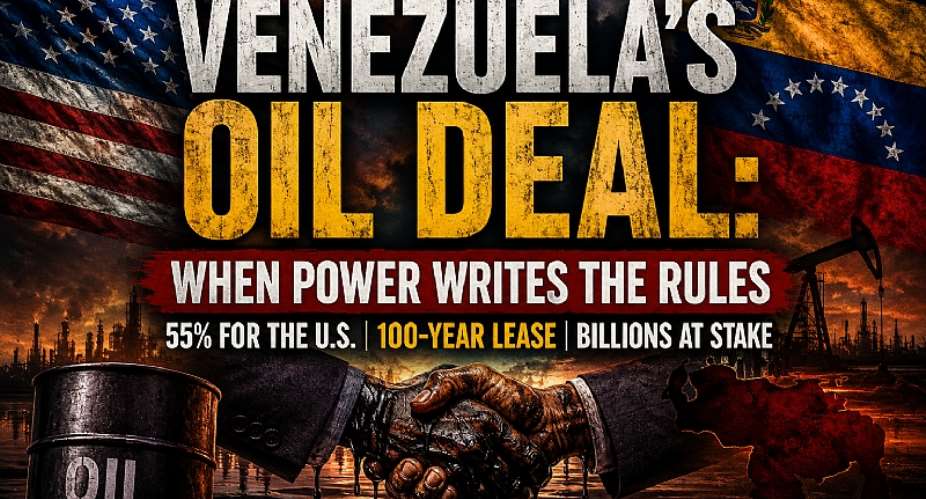
The most lucrative strategic deal America could have imagined in the post-1970 energy order may now have emerged from Venezuela. What makes the development particularly controversial is not simply the size of Venezuela’s oil reserves, but the political circumstances surrounding the agreement. The capture of Nicolás Maduro, the subsequent political transition and Washington’s growing influence over Venezuela have created a situation that critics are increasingly describing as a new form of power politics—one in which political pressure and regime change can ultimately be converted into economic access.
Trump may find a sigh of relief after securing a deal with Venezuela’s new leadership that reportedly gives the United States a 55 percent stake in a major joint venture, while private American oil companies also gain access to Venezuela’s energy sector. At a time of rising global oil prices and continuing instability surrounding the Iran war, the agreement appears to offer Washington a strategic solution to its growing energy concerns.
What Is Actually the Deal?
According to reports from Washington, the United States will take a 55 percent stake in a new joint venture with a private Venezuelan operator. The reported 100-year oil-field lease could create one of the largest oil companies in the world in terms of proven reserves, potentially ranking behind Saudi Aramco.
For Washington, therefore, the arrangement represents more than a commercial transaction. It is a strategic victory. At a time when the Iran war has contributed to uncertainty in global energy markets and increased pressure on oil prices, the Trump administration appears to have found what it considers a prudent solution: direct and long-term access to one of the largest concentrations of oil reserves on earth.
What Is the Gain for Venezuela in the Deal?
Venezuela possesses approximately 303 billion barrels of proven oil reserves, and the newly formed company is expected to control around 65 billion barrels of those reserves. That amount alone would represent a major strategic energy asset and would significantly expand American access to global oil resources.
Venezuela’s new leadership has argued that the agreement could boost the country’s economy, attract investment and provide support for reconstruction and public recovery following recent disasters. The argument is simple: greater investment in the oil sector could generate revenue, restore infrastructure and improve the living conditions of ordinary Venezuelans.
But giving such extraordinary leverage to a foreign power also raises serious concerns. A country suffering from political instability, sanctions and economic collapse cannot necessarily negotiate on equal grounds with the world’s most powerful economic and military power. The margins for independent decision-making become extremely narrow.
Even if sanctions are removed and investment begins to flow, the benefits may take years to reach ordinary Venezuelans. The question is whether this agreement represents genuine economic cooperation—or whether Venezuela’s political weakness has been transformed into an opportunity for external powers to acquire long-term strategic control over its resources.
How Will the World Respond—Will It Remain Silent?
This is perhaps the most important question of all.
If Russia invades Ukraine, the world speaks of international law and sovereignty. If China were to invade Taiwan, the consequences would be discussed as a potential global catastrophe. If Pakistan were to intervene militarily in Afghanistan, or when Israel’s military actions in Gaza are debated, the international community invokes principles of territorial integrity, human rights and international law.
Yet the reality remains uncomfortable: might increasingly appears to be right.
There is no international order that consistently applies the same standards to every country. Powerful nations often shape the interpretation of international law according to their strategic interests. What is condemned when done by a rival may be justified when carried out by an ally or a dominant power.
When a deal is made, it should be made on equal grounds and through mutual respect. National sovereignty, territorial integrity and political independence cannot become negotiable commodities simply because one country is economically or politically weaker than another.
The Venezuelan oil deal may ultimately produce economic benefits and increase oil production. But the larger issue is the precedent it could establish. If political pressure, regime change and strategic intervention are followed by privileged access to natural resources, then the world must ask whether the principles it claims to defend still have any universal meaning.
The real danger is not simply who controls Venezuela’s oil.
The real danger is the continued erosion of a global order in which power increasingly determines legitimacy—and where, once again, might makes right.

 Supreme Court dismisses Solomon Asamoah’s injunction bid in Skytrain Trial
 Over 6,000 phone numbers linked to scams as 50% traced to TikTok — TrustGH
 Supreme Court nominee explains why he opposes the idea of separate Bail Act
 Krobohene praises community for embracing Christianity after ancestral deity goe...
 Accra: FDA seizes cigarette-shaped lollipops, arrests key suspect
 August 31: Cedi sells at GHS12.20 on forex market, GHS11.26 on BoG interbank
 SOEs swing from GHS2.25bn loss in 2024 to GHS19.8bn profit in 2025 – SIGA
 56 years on: How Edward Akufo-Addo became Ghana’s President
 UDS graduate working as head porter gets second chance to return to University
 Amenfi Central MP Joana Gyan Cudjoe ends relationship with KECHE

