




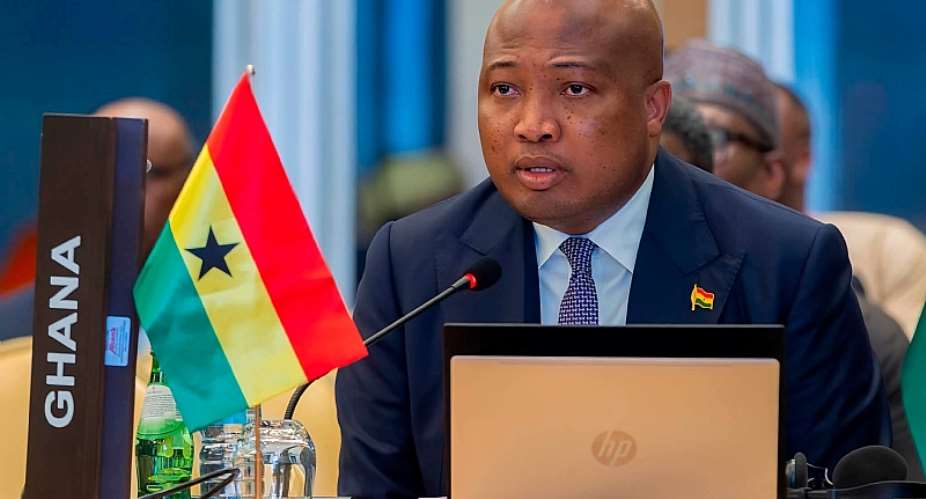
Ghana's Foreign Minister, Samuel Okudzeto Ablakwa, used a rare platform before his African Union counterparts in Luanda, Angola, on Saturday to press a blunt argument: money alone will not buy the continent peace.
A summit born of urgency
Ablakwa was addressing the 26th Extraordinary Session of the AU Executive Council, convened on August 29, 2026, as the ministerial curtain-raiser to the 21st Extraordinary Session of the AU Assembly of Heads of State and Government, held the following day in Luanda under the theme "Strengthening Mechanisms for Conflict Prevention and Resolution in Africa."
The summit stems from an African Union Commission announcement that the extraordinary session on strengthening conflict prevention and resolution mechanisms would be held in Luanda from 29-30 August 2026, with the ministerial Executive Council session preceding the Assembly.
The gathering is the initiative of Angolan President João Lourenço, acting in his capacity as AU Champion for Peace and Reconciliation, and follows a February 2026 Assembly decision directing the continental body to overhaul its conflict-prevention architecture. Delegates were working from a draft Luanda Decision, Action Plan and Implementation Matrix intended for adoption by heads of state.
"An earnest introspection"
In his remarks, Ablakwa argued that the continent's habit of treating conflict, terrorism and humanitarian emergencies as background noise had to end. He called on Africa to carry out an earnest introspection, saying the continent could no longer continue normalizing conflicts, terrorism, violent extremism and humanitarian crises, and needed to take a new path.
He acknowledged the AU's efforts to recapitalise its Peace Fund but insisted resourcing was secondary to political will, telling ministers that no amount of money in the fund whether one billion, ten billion or a hundred billion dollars would deliver peace without a change of course and a new leadership paradigm.
Naming the drivers
Ablakwa located the roots of Africa's instability in injustice, youth joblessness, underdevelopment, corruption, exploitation of the continent's resources, intolerance, insincerity among leaders, and the readiness of some states and actors to serve as proxies for external forces. He tied this directly to the mismanagement of Africa's own wealth, urging a recommitment to job creation, industrialisation, genuine decentralisation and a fairer sharing of the continent's diamonds, gold, bauxite, oil and gas. Africa, he argued, remains the world's resource-richest continent even as millions of its young people go without electricity or opportunity.
The Ceuta warning
To underline the cost of inaction, Ablakwa pointed his colleagues to events at Europe's southern doorstep just weeks earlier. In late July 2026, Spain's North African enclave of Ceuta was overwhelmed when an estimated 72,000 people mostly young men illegally crossed the border from Morocco, mainly by swimming around the Tarajal and Benzú breakwaters or moving along the shoreline, overwhelming local reception capacity and prompting Ceuta's government to request a national emergency declaration.
Spanish authorities reported dozens of deaths in the crush, and by early August most of those who had crossed had been returned to Morocco, though thousands, largely from sub-Saharan Africa, were still believed to remain in the enclave.
For Ablakwa, the images were less a Spanish border crisis than an African governance failure proof that the continent's youth are voting with their feet, and that silencing the region's guns is inseparable from creating jobs at home.
What comes next
The Executive Council's draft Decision and Action Plan now go to the Assembly of Heads of State and Government, chaired for this session by Burundi's President Évariste Ndayishimiye, with AU Commission Chairperson Mahmoud Ali Youssouf pressing member states on the need for pooled resources, stronger coordination between the AU Peace and Security Council and Regional Economic Communities, and implementation of UN Security Council Resolution 2719 on financing AU-led peace operations.
Morocco's Foreign Minister Nasser Bourita struck a similar prevention-first note at the same session, while Zambia's President Hakainde Hichilema, in a statement read on his behalf, argued that preventing instability is markedly cheaper than rebuilding after it. Whether the Luanda Decision translates into the "new leadership paradigm" Ablakwa invoked will be tested when the documents reach the Assembly for adoption.
Mustapha Bature Sallama
Medical/Science communicator, Private Investigator, Criminal Investigation and Intelligence Analysis,United States Institute of Peace (USIP), [email protected] +233555275880
References
- African Union, "21st Extraordinary Session of the Assembly of the African Union on Conflict Prevention and Resolution in Africa," https://au.int/en/newsevents/20260829/au-extraordinary-summit-conflict-prevention-and-resolution
- Ghanamma.com, "Foreign Minister Ablakwa calls for new approach to address root causes of conflict and youth migration," August 29, 2026, https://www.ghanamma.com/2026/08/29/foreign-minister-ablakwa-calls-for-new-approach-to-address-root-causes-of-conflict-and-youth-migration/
- GBC Ghana Online, "Foreign Minister Ablakwa calls for new approach to address root causes of conflict and youth migration," https://www.gbcghanaonline.com/general/ablakwa-luanda-migration/2026/
- Wikipedia, "2026 Ceuta migrant crisis," https://en.wikipedia.org/wiki/2026_Ceuta_migrant_crisis
- TASS, "African Union prepares action plan to prevent conflicts on continent," August 29, 2026, https://tass.com/world/2179363
- Atalayar, "Nasser Bourita Calls for Prevention to Ensure Peace and Security in Africa," https://www.atalayar.com/en/articulo/politics/nasser-bourita-calls-for-prevention-to-ensure-peace-and-security-in-africa/20260829203943228814.html
- Open Zambia, "Zambia Calls for Stronger Conflict Prevention in Africa," August 30, 2026, https://www.openzambia.com/politics/2026/8/30/zambia-calls-for-stronger-conflict-prevention-in-africa
- Social News XYZ, "African Union Commission (AUC) Chairperson at 21st Extraordinary Session of the Assembly of the African Union on Conflict Prevention and Resolution in Africa," https://www.socialnews.xyz/2026/08/30/african-union-commission-auc-chairperson-at-21st-extraordinary-session-of-the-assembly-of-the-african-union-on-conflict-prevention-and-resolution-in-africa/


 Supreme Court dismisses Solomon Asamoah’s injunction bid in Skytrain Trial
 Over 6,000 phone numbers linked to scams as 50% traced to TikTok — TrustGH
 Supreme Court nominee explains why he opposes the idea of separate Bail Act
 Krobohene praises community for embracing Christianity after ancestral deity goe...
 Accra: FDA seizes cigarette-shaped lollipops, arrests key suspect
 August 31: Cedi sells at GHS12.20 on forex market, GHS11.26 on BoG interbank
 SOEs swing from GHS2.25bn loss in 2024 to GHS19.8bn profit in 2025 – SIGA
 56 years on: How Edward Akufo-Addo became Ghana’s President
 UDS graduate working as head porter gets second chance to return to University
 Amenfi Central MP Joana Gyan Cudjoe ends relationship with KECHE

