




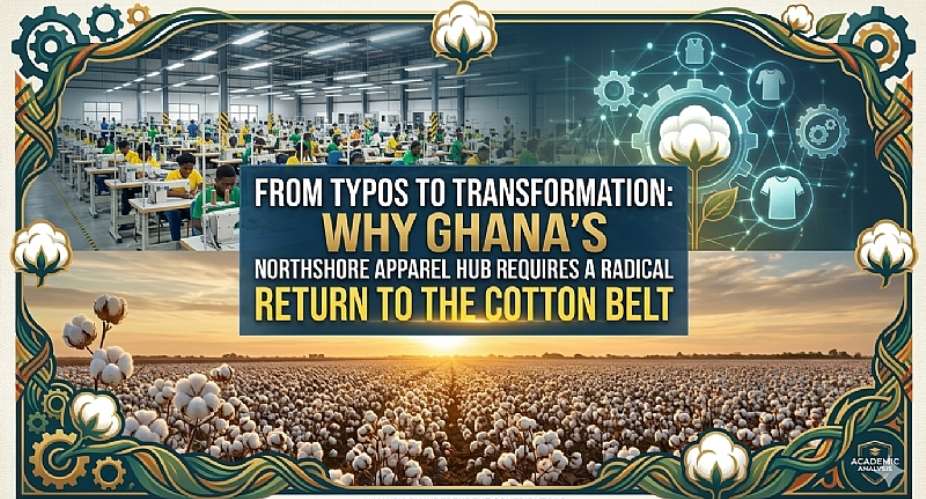
The Myth of the Fabric-less Factory
The contemporary discourse surrounding Ghana’s industrialization remains deeply flawed, paralyzed by a superficial obsession with political optics over structural substance. The recent commissioning of the Northshore Apparel Ghana Limited facility in Savelugu—and its subsequent reduction to a social media debate over a typographical error labeling it "Nothing Apparel"—perfectly illustrates this intellectual bankruptcy. While partisan actors squabble over whether this mega-complex represents the fruition of the current administration’s One District, One Factory (1D1F) initiative or a real-time proof-of-concept for the opposition’s 24-Hour Economy mandate, a far more critical macroeconomic vulnerability is ignored.
The harsh reality is that Ghana is building high-tech downstream apparel plants while completely neglecting its upstream agricultural foundations. For decades, northern Ghana possessed a highly integrated, self-sustaining textile value chain where localized cotton production directly fed domestic processing mills. Today, factories like Northshore risk operating merely as glorified assembly hubs, import-dependent on foreign textiles and vulnerable to volatile international shipping corridors. True economic emancipation and sustainable job expansion will not be realized by merely plugging sewing machines into a grid; it requires a radical, state-backed re-engineering of our domestic cotton industry to achieve authentic "seed-to-garment" sovereignty.
Structural Reality: Scale, Capital, and Capacity
To critique the facility effectively, one must first recognize the scale of what has been constructed. Northshore is not a minor intervention; it is a monumental structural template for geographic decentralization:
- Phased Expansion and Macro-Scale: The facility currently features 50 active sewing lines situated within a 40,000-square-metre industrial footprint. However, the facility's master plan outlines a definitive three-phase trajectory explicitly designed to double its immediate capacity to 200 sewing lines.
- The Blended Finance Paradigm: Crucially, the hub bypasses traditional, predatory commercial loan structures. By integrating a blended finance model featuring state capital from the Ghana Export-Import Bank (GEXIM), the Agricultural Development Bank (ADB), and international development support via Germany's KfW Development Bank, Northshore sets an academic benchmark for how public-private partnerships should be capitalized in Sub-Saharan Africa.
- The Employment Multiplier: Currently absorbing over 2,300 workers into its continuous, round-the-clock shift structures, the factory is projected to expand its payroll to 10,000 direct jobs upon full phase-three completion. In a region structurally historically starved of formal, non-farm employment, this represents an essential counterweight to rural-urban youth migration.
The Supply Chain Crisis: Overcoming the Raw Material Bottleneck
The fatal flaw of contemporary African manufacturing models is the reliance on imported inputs. To transform Northshore from a foreign-input assembly plant into a sovereign industrial powerhouse, Ghana must confront the collapsed state of its local cotton value chain:
- The Geopolitical Advantage: As noted by CEO Alhaji Nurudeen Mohammed, Savelugu sits strategically at the exact doorstep of the lucrative West African cotton belt—sharing proximity with dominant regional producers like Burkina Faso, Mali, Benin, and Togo.
- The Outgrower Imperative: Northshore’s proposed Phase Three fabric mill and cotton outgrower scheme must be aggressively accelerated. Instead of allowing domestic cotton to leave West African ports as low-value raw bales, a state-enforced, vertically integrated framework must guarantee that northern smallholders serve as the primary raw material source for the factory's fabric mills.
- Reviving the Integrated Past: We must academically harken back to the economic era of the Ghana Cotton Company, which historically secured guaranteed offtake for northern farmers, ginned the lint locally, and fed spinning giants like Juapong Textiles to supply domestic wax print industries. Re-establishing this domestic circular economy is the only mechanism available to shield Ghanaian factories from global supply chain shocks and volatile raw material pricing.
Strategic Recommendations for Structural Sustainability
To prevent Northshore from becoming another monument to unfulfilled industrial promises, the state and private sector must aggressively implement the following interventions:
- Institutionalize National Procurement Mandates: Parliament must enact strict legislative frameworks making it mandatory for state agencies—including the military, police, customs, and public schools—to source 100% of their uniforms directly from domestic hubs like Northshore.
- Aggressively Capitalize the Cotton Outgrower Scheme: The Ministry of Food and Agriculture, in tandem with GEXIM, must subsidize high-yield seed distribution, modern ginning equipment, and input credits for at least 50,000 smallholder cotton farmers across the Northern, Upper West, and Upper East regions to completely domesticate raw material sourcing.
- Sustain 24-Hour Energy Subsidies: The state must deploy dedicated off-grid renewable energy infrastructure—leveraging the factory's planned 1.5 MW solar and battery storage installation—and provide discounted industrial tariffs to ensure that night-shift production remains globally cost-competitive.
- Transform Vocational Education (TVET): Academic curricula at local technical universities must be aggressively overhauled to offer specialized degrees in textile engineering, automated apparel mechanics, and industrial design, shifting local employment from basic manual labor to high-wage technical management.
Demanding a Sovereign Industrial Future
The Northshore Apparel Hub is a profound testament to what can be built when strategic development finance intersects with local entrepreneurial ambition. Yet, it remains an unfinished project. We must aggressively reject the naive political consensus that celebrates the opening of a factory while its essential raw materials remain docked at foreign ports. The political classes must look beyond the immediate horizons of the next election cycle and realize that Northshore’s true metric of success is not the number of sewing machines it houses today, but the number of Ghanaian cotton farms it revitalizes tomorrow. Only by aggressively binding our agricultural heartland to our industrial centers can we convert temporary assembly lines into a permanent, sovereign economic triumph.
✍️ Submitted by:
Retired Senior Citizen
For and on behalf of all Senior Citizens of the Republic of Ghana 🇬🇭
Teshie-Nungua
[email protected]


 Supreme Court dismisses Solomon Asamoah’s injunction bid in Skytrain Trial
 Over 6,000 phone numbers linked to scams as 50% traced to TikTok — TrustGH
 Supreme Court nominee explains why he opposes the idea of separate Bail Act
 Krobohene praises community for embracing Christianity after ancestral deity goe...
 Accra: FDA seizes cigarette-shaped lollipops, arrests key suspect
 August 31: Cedi sells at GHS12.20 on forex market, GHS11.26 on BoG interbank
 SOEs swing from GHS2.25bn loss in 2024 to GHS19.8bn profit in 2025 – SIGA
 56 years on: How Edward Akufo-Addo became Ghana’s President
 UDS graduate working as head porter gets second chance to return to University
 Amenfi Central MP Joana Gyan Cudjoe ends relationship with KECHE

