




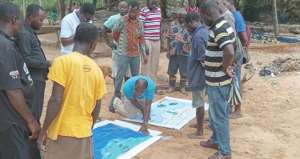
Calmness and tranquillity enveloped Cape Three Points, a serene village in the Ahanta West District of the Western Region, as residents went about their daily routines.
At about 11:40 a.m. on a Thursday, the Daily Graphic arrived to speak with residents about Ghana's newly designated Marine Protected Area (MPA).
Along the shoreline, fishermen mended their nets, while women processed fish and others ran small food businesses, most linked to the ocean.
But beneath the calmness of this coastal community lies a growing uncertainty.
Cape Three Points, like many fishing communities along Ghana's coastline and particulalry the host communities of the MPA, is confronted with a difficult question: How would declining fish stocks be rebuilt while ensuring that the people whose lives depend on them were not left poorer?
Unsettling is the fact that stakeholders still await the management plan to guide its implementation.
Currently, the MPA is being managed by an interim Management Executive Committee (MEC) which holds meeting to communities to further educate them on the MPA MPA size
Cape Three Points is among 21 coastal communities covered by Ghana's first MPA, a 703.86-square-kilometre conservation zone in the Western Region.
Doris Konadu (left), a fish processor at Cape Three Points, speaking to Joana Kumi, the journalist
Declared in April 2026 under the global 30×30 agenda, the MPA aims to restore declining fish stocks, protect marine ecosystems and safeguard the livelihoods of fishing communities.
According to Sagoe et al. (2021), marine conservation initiatives such as MPAs are increasingly being adopted globally as a strategy to rebuild fish populations, conserve biodiversity and support sustainable livelihoods.
However, for many residents within the Greater Cape Three Points area, the intention of the MPA still remains unclear.
Fish processor and a resident of CApe Three Points, Doris Konadu said some residents remained uncertain about the MPA's impact on their livelihoods.
“My understanding of the MPA is that the government is coming to take the sea from us. But we have to work to survive.
How can we put food on the table and educate our children if the government takes away the sea?”
She called for soft loans, skills training and jobs for young people, while acknowledging concerns over declining fish catches and the need to protect the ocean. Beyond a fishing ban
However, conservation practitioners said it would not mean a total fishing ban.
The Deputy Director of Hen Mpoano, a civil socioety organization in coastal protection and conservation, Stephen Kankam, explained that the Greater Cape Three Points MPA would be managed through different zones, with the Fisheries Commission, the MEC and community members playing roles in the management process, allowing conservation and regulated human activities to exist together.
He further explained that the zoning would include no-take zones, gear-restricted zones and transition zones where multiple uses would be permitted.
Fish processors at Akwidaa called for support to sustain livelihoods with the implementation of the MPA
He stated that no-take zones would be areas where fishing would be prohibited, allowing fish stocks and marine habitats to recover.
Other sections would restrict certain fishing methods, while regulated fishing would continue in designated areas.
According to Mr Kankam, “the question about the no-take zone and the percentage of the total MPA would have to be agreed upon using science, but not only science; local ecological knowledge and true consensus building.”
Unlike the annual closed fishing season, which temporarily stops fishing, an MPA provides permanent management of a defined marine area with varying levels of protection.
The explanation, however,is yet to completely allay concerns among some community members who fear that the conservation measures could affect their livelihoods.
Mr Kankam observed, “without livelihood improvements that are tangible, I don't think we can have a successful MPA implementation”
He explained that conservation efforts should recognise the realities of fishing communities, many of whom have limited economic options beyond fishing and fish processing.
He said community involvement would remain critical because local people possessed valuable knowledge about the marine environment.
According to him, combining scientific evidence with traditional ecological knowledge would create a stronger foundation for managing the protected area. Ocean under pressure
Ghana's MPA comes amid growing pressure on marine fish stocks.
Fisheries research and Fisheries Commission assessments show declines in key small pelagic species, including round sardinella (Eban), flat sardinella (Antebo), anchovies (Abobi) and chub mackerel (Salmon).
These species are vital to coastal communities, providing food and livelihoods for fishermen, processors and traders.
A Daily Graphic report on Prof. Aggrey-Fynn's inaugural lecture identified overfishing, illegal fishing practices, destruction of marine habitats and changing ocean conditions among the factors contributing to the decline.
Experts said although the Greater Cape Three Points MPA covers 21 coastal communities mostly dependent on the sea, the government has not yet conducted a detailed socio-economic assessment showing the exact number of fishermen, fish processors and households directly dependent on the protected area.
During visits to Cape Three Points and Akwidaa, the Daily Graphic found that education had improved understanding of the MPA, but residents still wanted clearer assurances about its impact on their livelihoods.
Residents supported ocean protection but said its success would depend on practical livelihood support alongside conservation measures. Conservation and survival
At neighbouring Akwidaa,a host an community, a fish processor, Grace Ansah, who has smoked fish for about 40 years, said women fish processors were already experiencing challenges due to declining stocks.
“We need opportunities for our children. They need support so that they do not destroy the environment out of hunger,” she said.
For fisherman Charles Cromwell, who has spent about 45 years fishing, protecting parts of the ocean had become necessary because of the changes he had witnessed over the years.
He called for alternative livelihood programmes, including skills training, farming support and employment opportunities for young people who would be affected by possible restrictions.
For some residents, therefore, the question is not whether the ocean should be protected, but whether communities that depend on it will receive the support needed to adapt. Support for protection
Another fish processor at Akwidaa, Cynthia Dadzie, who spoke to the Daily Graphic, said she supported the declaration of the MPA, saying declining fish stocks showed the need to protect marine resources.
“The MPA is really good, and it is going to help us if we all comply,” she said.
She, however, called for improved roads and health facilities, citing difficulties transporting pregnant women and other patients.
“Many people die because of these poor roads,” she said.
However, fisherman Kofi Ackon expressed concern about whether sufficient consideration had been given to the fishing grounds on which communities depend.
While acknowledging the importance of restoring fish resources, he questioned the possible impact of restricting access to areas where fishermen traditionally operate. Concerns beyond the MPA
The conversation about marine protection is not limited to communities located within the Greater Cape Three Points MPA.
In Elmina, a major fishing hub in the Central Region, a fisherman, Ampah Dwama, questioned how growing coastal populations would cope if access to fishing grounds became restricted.
“Our population is growing. If you take part of the sea away, what will we do?” he asked.
However, at Moree, fisherman Kofi Adukwaa supported efforts to protect marine resources but urged the government to ensure that affected fishers received support during the transition. Success and community ownership
For traditional authorities and community representatives involved in the management process, the success of Ghana's first MPA would depend largely on whether local people see themselves as partners rather than victims of conservation.
The Chief Fisherman of Agyan and a member of the MEC of the MPA, Nana Korankye Kwesi Asuawa, said fishermen should be recognised as important stakeholders because of their understanding of the marine environment.
He noted that all 21 communities within the MPA had deplorable roads, a situation that had heightened their frustration and raised their expectations. He explained that these existing challenges made it difficult to engage the communities effectively on the MPA and its implementation.
“When the people understand and accept it, they will protect it,” he said. Fisheries Commission
The Western Regional Director of the Fisheries Commission, Dr Charles Teye, said Ghana's first MPA was established to address declining fish stocks and secure the long-term future of fisheries.
“What we are saying is that for this area, we have identified that it could help us. We are bringing restrictions,” he added.
Dr Teye said management structures, including the Management Executive Committee, had been established to encourage community participation in decision-making.
According to him, experiences from other countries showed that protected areas could create opportunities through activities such as tourism, conservation-related enterprises and sustainable resource management. Reality check
Dr Evans Kwesi Arizi, Chairman of the MPA's Technical Advisory Committee, said the declaration was only the beginning.
“The declaration has been made. What is left is the management aspect,” he said.
He said the MPA's management plan would guide enforcement, monitoring and community participation, while restricting destructive fishing methods and prohibited gear in permitted areas.
Dr Arizi, however, cautioned against expecting immediate nationwide results, noting that the Greater Cape Three Points MPA alone covered only about 0.3 per cent of Ghana's Exclusive Economic Zone (EEZ). Livelihood concerns
Dr Arizi said little had been done on proposed retirement schemes by the government for the fishermen while no specific alternative livelihoods, such as skills training for fishers, had been promised.
He said tourism could create income opportunities as the MPA develops, while Hen Mpoano had begun training in sewing, hairdressing and carpentry to support affected communities. Test of partnership
Ghana's Greater Cape Three Points MPA seeks to protect declining fish stocks while safeguarding coastal livelihoods and food security.
Its success would depend on community understanding, trust and participation.
As implementation begins, Ghana should balance ocean conservation with the needs of fishing communities whose survival depends heavily on marine resources.
— Graphic Online

 Kwame Dzokoto reportedly dies
 Ghana intensifies airport screening and Ebola surveillance amid reported cases i...
 'Our wives are not our slaves' – Nigerian man urges husbands to share housework
 'My son is mentally unstable' — Father of man arrested over alleged Gbewaa Palac...
 15,000 aspirants to contest NDC constituency executive elections this weekend
 Seven 'missing' Sekondi fishermen to be repatriated from Benin to Ghana — Police
 Websites go dark as AI exposes critical security flaws worldwide
 Ghana remains friends to all and enemies to none — Mahama
 October 22: Cedi sells at GHS12.25 on forex market, GHS11.66 on BoG interbank
 Foreign Affairs Ministry denies Minority’s claim of harassing staff over South A...


