




We set sail from Belle-Île-en-Mer, a rocky island about 20 kilometres off the coast of Brittany in western France, on a 20-metre monohull sailing boat called Whirlwind.
Aboard are a captain, a first mate and four amateur navigators, who are spending four days training with Philippe Posth.
Wearing a yellow sailing jacket, with greying hair and a deep voice, Posth has the look of a sea dog. But he's not a professional and describes himself as a "recreational" sailor.
Posth is first and foremost a shopkeeper, selling calculators, specialist books and sextants – the essential instrument for astronomical navigation, which has been his passion for 25 years.
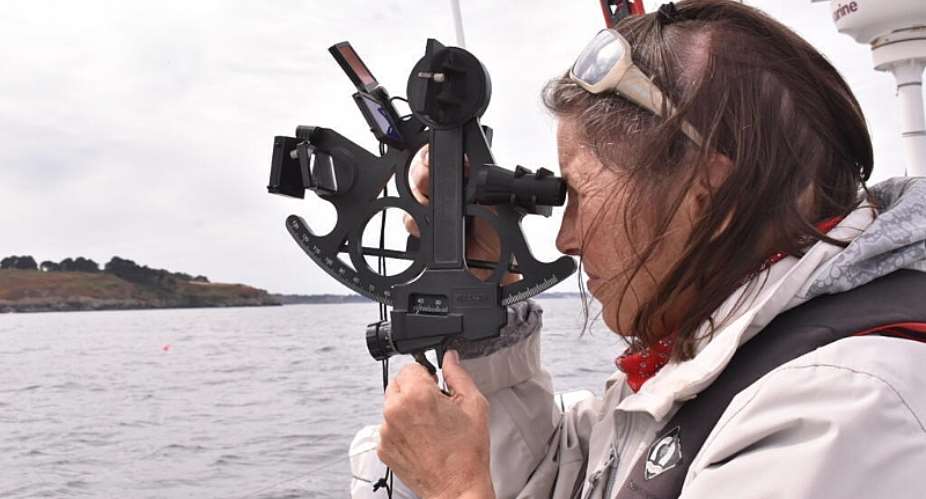
“The sextant is an optical measuring instrument that measures angles between celestial bodies and the horizon,” Posth explains, holding one in his hand.
The celestial body can be the Moon, some planets or certain stars. But nine times out of 10, sailors use the Sun because it's easier to identify. Philippe Posth, a sailor in his spare time, has been teaching his passion for astronomical navigation for 25 years.
Onlookers stunned as flaming meteor streaks across skies of Brittany
Reading the sky
Margo, one of the four trainees, carefully begins a demonstration.
“I first have to put the filters on to protect my eyes,” she says as she raises the sextant. “I point it towards the Sun, then I turn the dial, called the limb, to bring the image of the Sun down towards the horizon and determine the angle.”
But the exercise is cut short.
Clouds gather above the boat, blocking out the Sun. The horizon becomes hazy. Margo removes one filter, then another, in a final attempt to take a reading, but the sky is completely overcast.
That's one of the limits of astronomical navigation: suitable weather is essential for obtaining useful readings.
“Taking a sight with the sextant is the most difficult stage,” Posth says. It requires concentration and precision, and errors can be costly.
“An error of four seconds in the time of the sight results in an error of one nautical mile when you arrive,” he notes.
Mathematical 'recipe'
The sight is only the first step. The second takes place below deck, around a table. The readings taken with the sextant have to be converted into longitude and latitude through a series of mathematical calculations that can look daunting to beginners.
“They're just additions and subtractions,” Posth says. “The only difficulty is knowing where to find the recipe.”
The information comes from two sources: nautical almanacs, which “give the position of celestial bodies for every hour and every second of the year”, and pre-calculated navigation tables that make it possible to work through the lengthy trigonometry more quickly. While the calculations themselves are not particularly complicated, finding your way around the nautical almanacs and navigation tables is another matter.
Total eclipse gives scientists chance to probe Sun's mysteries
The result gives a deliberately false position.
“It is reductio ad absurdum [reduction to absurdity],” Posth explains. “We start from an incorrect position and use that error to correct the false position and obtain the exact position.”
The calculations produce what is known as a line of position. The boat is somewhere along this line, but its exact location is still unknown.
To find it, the process has to be repeated from the beginning – another sight and another set of calculations. But this must be done at least three hours later, when the Sun has moved.
“The second sight makes it possible to cross the first line of position. The intersection of the two lines gives the exact position of the ship.” Free French naval cadets learning the use of the sextant on board the Président Théodore Tissier survey ship during WWII.
Daredevils who ski across Antarctica and sail oceans in barrels
Strategic alternative to GPS
The arrival of GPS at the end of the 20th century pushed astronomical navigation into the history books and turned the sextant into a heritage object.
But technology is not infallible, which is why some sailors want to keep the skill alive.
“I'd like to be able to manage on my own if there's an electronic problem on my boat,” says Margo, who sails as a hobby. “If you have no way of knowing your position, you risk running aground on a rock, for example, which you didn't even know was there because you're not where you thought you were.”
Astronomical navigation also has a strategic role on today's seas.
“In the French and US navies, the sextant, which was forgotten for a time, is being used again,” says Laurent Nieuwjaer, the Whirlwind's captain.
“Technological warfare means navigation systems can be jammed. Being able to work out your position manually and empirically makes navigation safer.” The calculations make it possible to find the point where two lines of position intersect, giving the exact position of the sailing boat.
French skipper Coville sets new round-the-world sailing record
A course through history
Beyond its practical use, Nieuwjaer says, astronomical navigation offers the pleasure of sailing in a more intuitive way – the opposite of the touchscreen tablet attached to the boat's helm, which removes much of the decision-making.
“It tells me which route to follow and which obstacles to avoid. If the boat also has an autopilot, it can follow a route on its own without any problem,” the captain explains.
For Margo, learning the technique is also a way of preserving a part of maritime culture and the history of the great explorers.
“I find it romantic to feel that, in my own small way, I'm following in the footsteps of the navigators of the 18th century, who crossed the oceans with the sextant as the key to successful navigation.”
Putting your course in the hands of the sky can also make you more aware of it, Posth says.
“It's extraordinary. You can achieve an accuracy of around two to three kilometres by measuring the Sun, which is 150 million kilometres away. Astronomical navigation allows you to look at the sky differently, by understanding the position of the celestial bodies in relation to one another.
“It's astronomy from a practical perspective.”
In 25 years of training sailors, Posth has seen few young people take up the skill – something he regrets. But he takes comfort in the thought that perhaps this is a passion people discover with age.
This article was adapted from the original in French by Baptiste Coulon.
► Looking up: Hunting stars and nebulae from the peaks of the French Alps
► Looking up: French radio enthusiast captures ISS signals from his garage
► Looking up: Amateur meteorite hunters search for clues to origins of universe
► Looking up: French collector gathers lunar photos that changed our view of space


 Police restrict concrete mixer trucks on Accra, Tema roads from August 28
 Supreme Court nominee Anthony Forson Jnr. opposes proposal to cap number of just...
 Justice Bernasko Essah explains why Supreme Court may depart from its previous d...
 Two NDC MPs whose ‘secret’ marriages have shocked Ghanaians
 All you need to know about Hon. Millicent Yeboah-Amankwa, wife of Hon. Mahama Ay...
 ‘A true trailblazer and cultural icon’ – Bawumia mourns Grace Nortey
 Vetting: 'Suspects should sue police if detained beyond 48 hours' - Supreme Cour...
 Speaker Bagbin outdoors uniforms for new parliamentary security guards
 Minority NPP boycotts vetting of three Supreme Court nominees over rushed timeta...
 Styrofoam ban is long overdue – Dr. Zanetor Agyeman-Rawlings

