




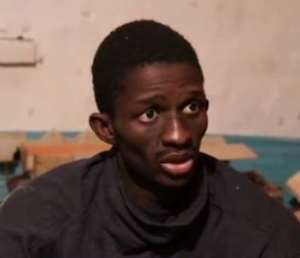
In March 2025, a video filmed on the Donetsk front spread across Senegalese social media. It showed an exhausted 25-year-old man in a Russian military uniform being questioned by Ukrainian soldiers.
His name is Malick Diop. The young Senegalese man had travelled to Russia to study. He eventually found himself on the front line, enlisted in the Russian army, before being captured by Ukrainian forces. Eighteen months after his capture, his fate remains uncertain: for the Kremlin, an African can be Russian enough to die under Moscow's uniform, but apparently not Russian enough to be claimed in a prisoner exchange.
A Promising Start, Cut Short
Born in 2000 in Keur Mandoumbé, in the Kaffrine region, nothing seemed to point Malick Diop towards the battlefield. He obtained his baccalaureate in 2020 and went on to study at the Faculty of Political and Legal Sciences at Alioune Diop University in Bambey. In 2023, he travelled to Russia to continue his studies.
In early February 2025, facing severe financial difficulties, he signed a contract with the Russian army.
He was reportedly promised a position as a cook, with a salary of around 800,000 roubles per month approximately 5.3 million CFA francs as well as the prospect of obtaining Russian citizenship. In reality, he underwent accelerated military training and was sent to the front in March, to one of the deadliest sectors of the conflict.
On March 15, communication with his family stopped. A few days later, footage of his capture began circulating. Eighteen Months Later, Still a Prisoner and Apparently Not Russian Enough for Moscow
In August 2026, nothing has changed. Malick Diop remains a prisoner of war in Ukraine. In February 2026, Dakar said it was following the case "with particular attention" and was working towards his release, but has struggled to move the case forward.
Russia, meanwhile, has not taken action. Yet it is Moscow that should be negotiating his release. Malick signed a contract with the Russian army, fought under a Russian uniform, and was sent to the front by Russian military authorities. It is therefore difficult to understand why Russia would not make his case a priority in prisoner negotiations and exchanges.
This is especially troubling since such exchanges do take place.
Dozens of operations have already resulted in the release of thousands of prisoners since the beginning of the war. Yet no African prisoner held in Ukraine has so far been included in these exchanges, which have focused primarily on Russian nationals.
An Increasingly African Russian Army
Malick Diop's case is far from an isolated one. According to figures published in August by Ukraine's Ministry of Foreign Affairs:
At least 2,982 nationals from 37 African countries have fought or are fighting in the Russian army. Among them, 486 have been killed.
Ukraine currently holds 35 citizens from 17 African countries as prisoners of war.
The recruitment pattern is reportedly always the same: promises of civilian employment, attractive salaries, contracts signed in Russian, limited military training, and rapid deployment to the front line. Recruitment generally takes place through social media.
Once the contract has been signed, African recruits are assigned to the most exposed units and used to reinforce Russian defensive lines.
In his 2025 video, Malick Diop summed up his experience: "The Russians ruined my life. They destroyed everything: my plans, my future. To young Africans, don't even think about joining this army. They did not respect me, they did not treat me like a person."
When a state sends men to fight and then refuses to take responsibility for bringing them home, it reveals what it truly thinks of their value. Senegalese people, like other Africans, are not being treated as human beings worthy of respect. They are being treated as a disposable resource for the Russian army.
For the young Africans to whom Russia promises a better future, Malick's story should at the very least serve as a warning before signing: what happens if Russia sends you to war and you are captured?
What Ghana Achieved, Can Senegal Demand the Same?
On August 17, 2026, in Moscow, former Ghanaian Foreign Minister Samuel Okudzeto Ablakwa secured a commitment from Sergei Lavrov to end the recruitment of Ghanaians for the Ukrainian front.
Accra reported 62 deaths and 15 missing. For the first time, Russia agreed to work with an African government to curb these enlistments.
This initiative shows that African governments can demand that the Kremlin stop treating young Africans as cannon fodder. What is Senegal waiting for to formally ask Russia to stop recruiting its citizens and to make the return of those already captured a priority?
Mustapha Bature Sallama
Medical/Science communicator, Private Investigator, Criminal Investigation and Intelligence Analysis,United States Institute of Peace (USIP), [email protected] +233555275880
References
https://www.pravda.com.ua/eng/news/2025/04/23/7508812/
https://english.elpais.com/international/2026-03-07/nearly-2000-african-soldiers-recruited-by-russia-are-fighting-in-ukraine.html
https://www.ukrinform.net/amp/rubric-ato/4127056-russia-has-recruited-nearly-3000-africans-from-36-countries-to-fight-against-ukraine-mfa.html
https://twitter.com/s_okudzetoablak/status/2089715695193883081?s=46

 ‘Containment is not prevention’ – National Security boss outlines 18-month maste...
 Wontumi withdraws from NPP Chairman contest
 ‘Who can pay us?’ – KSM denies being on NDC government payroll
 Vigilante groups adopting covert networks, mobilizing through encrypted chats – ...
 ‘We are solidly behind you’ — Christian Council rallies support for Ghana Medica...
 CHRAJ, NCCE and NSS equip university leaders with tools to fight corruption and ...
 Mahama to cut sod for multi-tiered car park, hotels complex at Accra Internation...
 24-hour economy is bigger than ‘three people, one job’ – Rashid Pelpuo
 Ghana much safer this year than even 2025 - Interior Minister
 Ghana’s economic recovery impressive — IMF

