




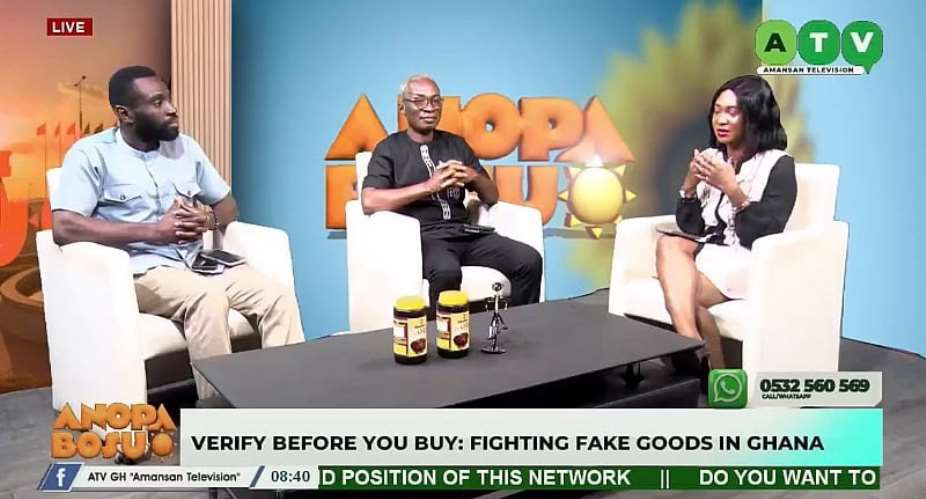
The Ghana Standards Authority (GSA) has commended Communication for Development and Advocacy Consult (CDA CONSULT) for its sustained consumer empowerment and protection campaign, dubbed “Trust Economy: Verify Before You Buy.”
Dr Victor Kwansa, Head of the Enforcement and Legal Unit of the GSA, gave the commendation during a stakeholders’ sensitisation programme organised by CDA CONSULT and hosted by Amansan Television (ATV) on its Anopa Bosuo programme in Accra.
The programme, held under the sub-theme “Fighting Fake Goods in Ghana,” forms part of CDA CONSULT’s broader national advocacy aimed at promoting consumer empowerment and protection, strengthening market integrity and building economic resilience through informed purchasing decisions.
Dr Kwansa said the GSA’s mandate extended beyond setting and enforcing standards to protecting and empowering consumers, making private-sector initiatives that supported those objectives worthy of collaboration.
“CDA CONSULT has demonstrated rare consistency, professionalism, and a public interest focus. The Trust Economy campaign is timely, impactful, and aligned directly with our enforcement drive. We appreciate the support and energy,” he said.
Consumer vigilance
Explaining the GSA’s enforcement mechanisms, Dr Kwansa said the Authority relied on a three-pronged approach involving market surveillance, product certification and legal enforcement.
He said enforcement measures included the seizure of non-compliant products, closure of offending businesses and prosecution of persons found culpable.
However, he stressed that consumer vigilance remained the first and most effective line of defence against counterfeit and substandard products.
“We can inspect, test, and prosecute, but the market is vast. When consumers insist on verifying standards, demanding receipts, checking expiry dates, certification marks, and Ghana Standards Authority stickers before they buy, they starve the fake goods market,” he said.
Dr Kwansa called for stronger collaboration among regulators, the media, civil society organisations and the private sector to build a “trust economy” in which product authenticity became a competitive advantage for legitimate businesses.
Campaign shifts from awareness to action
The Executive Director of CDA CONSULT, Mr Francis Ameyibor, said the “Trust Economy: Verify Before You Buy” campaign was moving beyond public awareness to practical consumer action.
He said the proliferation of substandard and counterfeit products posed serious risks to public health, safety, industrial development and Ghana’s economic competitiveness, adding that the problem could not be tackled by regulators alone.
Mr Ameyibor said Ghana lost significant amounts of money annually to counterfeit electrical products, pharmaceuticals, food items and building materials, with the resulting health and safety consequences often preventable through simple verification practices.
“The trust economy—verify before you buy is about making verification a culture, not a chore. Every purchase decision is an economic vote and a safety decision. Consumers must be responsible for their safety and security during shopping,” he said.
He urged consumers to make use of GSA verification tools, report suspected counterfeit products and adopt what he described as SMART shopping—seeking information, minding the label, authenticating certification marks, reporting anomalies and thinking safety first.
Mr Ameyibor said CDA CONSULT, in collaboration with state and non-state institutions and media partners, would intensify the national advocacy in November through workshops, community engagements, market activations and digital verification clinics across the country.
Consumers urged to take responsibility
Mr Ameyibor said consumers could broadly be divided into two categories: those who took personal responsibility for the safety and quality of the products they purchased and those who assumed that regulators or manufacturers bore sole responsibility.
He said the distinction was not determined by a person’s income or level of education, but by their willingness to verify products before making purchases.
“The responsible consumers take personal responsibility for their actions in the shop. They verify the information on the products to be sure of the quality and are not persuaded by price tags only.
“While the irresponsible customers transfer their responsibility for safety and quality to a third party—regulators and manufacturers. They assume if it is on the shelf, it must be safe,” he said.
According to him, such assumptions contributed to the circulation of substandard, counterfeit and expired products in the Ghanaian market, with significant consequences for the economy through healthcare costs, equipment damage and lost productivity.
He said irresponsible purchasing decisions could have wider economic consequences for the state and consumers.
“When consumers buy cheap, substandard electrical cables and they cause fires, it is the state that pays. When expired medicines or fake food products cause ill health, productivity drops, and the National Health Insurance Scheme is burdened,” he said.
Mr Ameyibor added that responsible shopping, on the other hand, constituted “smart economics” because it protected consumers’ money, health, homes and businesses while encouraging manufacturers and importers to comply with standards.
He said it also promoted fair competition for genuine Ghanaian businesses.
Five verification habits
Mr Ameyibor urged consumers to adopt five key verification habits when purchasing products.
He advised them to check expiry and manufacturing dates, look for GSA standard marks and FDA registration, examine labels for the country of origin and importer details, inspect packaging for signs of tampering or poor printing, and demand receipts and warranties.
He said the “Trust Economy: Verify Before You Buy” campaign sought to reposition consumer protection from being viewed solely as a regulatory responsibility to becoming a central pillar of an economic system driven by transparency, accountability and informed choice.
Mr Ameyibor stressed that building a culture of verification would require coordinated action from regulators, businesses, civil society, the media and consumers.
He said such a culture would demonstrate to global investors that Ghana had a mature, data-driven and low-risk market, while encouraging young entrepreneurs to embrace integrity and helping families protect their health and finances.
CDA CONSULT has been conducting public education on counterfeit goods since 2017 through workshops, exhibitions and media engagements.

 ‘Containment is not prevention’ – National Security boss outlines 18-month maste...
 Wontumi withdraws from NPP Chairman contest
 ‘Who can pay us?’ – KSM denies being on NDC government payroll
 Vigilante groups adopting covert networks, mobilizing through encrypted chats – ...
 ‘We are solidly behind you’ — Christian Council rallies support for Ghana Medica...
 CHRAJ, NCCE and NSS equip university leaders with tools to fight corruption and ...
 Mahama to cut sod for multi-tiered car park, hotels complex at Accra Internation...
 24-hour economy is bigger than ‘three people, one job’ – Rashid Pelpuo
 Ghana much safer this year than even 2025 - Interior Minister
 Ghana’s economic recovery impressive — IMF

