




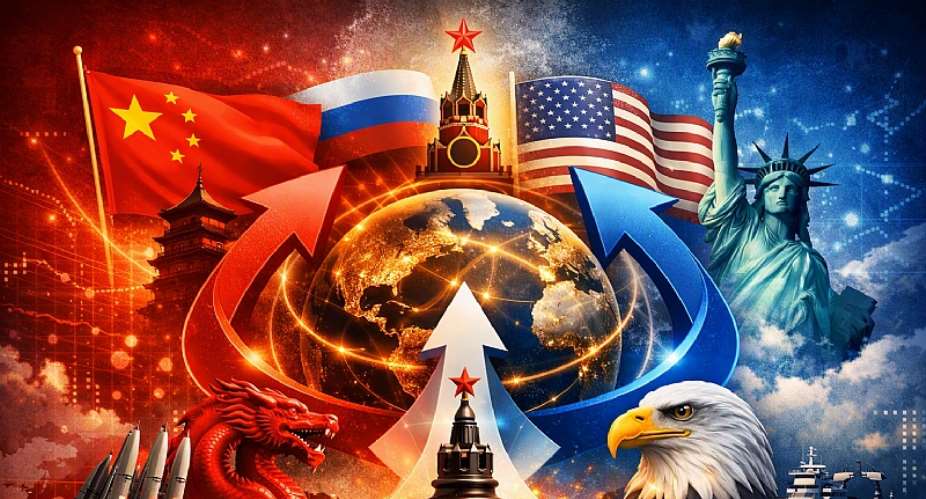
Today, global power dynamics and structural development are increasingly being shaped by a simple strategic reality: states need to trade across multiple centres of power, maintain credible defence capabilities and secure their energy requirements simultaneously. A single source of dependency can increasingly become a trade-off against sovereign and independent decision-making. Beyond the Middle East, South Asian and East Asian geopolitics are also entering a period of renewed uncertainty, where longstanding security commitments to Japan and Taiwan are coming under greater scrutiny.
In the Iran War, the American security umbrella appeared severely strained, compelling traditionally dependent states to reconsider the reliability and flexibility of the existing regional order. Russia’s growing support for North Korea has similarly increased anxiety in South Korea, while Seoul continues to seek negotiations, dignity and peaceful engagement even as the North continues to strengthen its nuclear capabilities. Moscow and North Korea relations are no longer merely a conventional strategic partnership; they increasingly represent a calculated form of pressure on American security assurances in East Asia. The United States is therefore confronting a complex trilateral challenge involving China’s economic and technological strength, Russia’s military confrontation and North Korea’s expanding nuclear capabilities, while Iran has emerged as a significant regional security concern.
Yet the emerging competition should not automatically be interpreted as a new Cold War. China has demonstrated a preference for long-term strategic patience, economic influence and diplomatic manoeuvring. Beijing’s position on Taiwan remains connected with its broader principle of national unity, while the United States recognised the People’s Republic of China as the sole legal government of China in 1979. A military confrontation over Taiwan would consequently carry consequences far beyond the immediate battlefield. The Taiwan Strait is central to global trade and the semiconductor supply chain, meaning any prolonged conflict could disrupt international commerce and technological production worldwide. China therefore has strong incentives to continue using negotiations, economic pressure, diplomacy and other instruments of statecraft wherever these can advance its objectives without triggering an uncontrollable confrontation.
The Japanese dilemma is equally significant. Russia continues to hold the Kuril Islands, which Japan claims as its northern territories. Japan consequently finds itself surrounded by a complicated strategic environment: China to the southwest, North Korea to the west and Russia to the northeast. The evolving Putin-Kim Jong relationship adds another layer of uncertainty. What concerns Tokyo is not simply the military capability of either country, but the possibility that deeper Russia-North Korea coordination could create a more assertive strategic environment in Northeast Asia at a time when questions are already being raised about the credibility and limits of American security assurances.
Meanwhile, the fast-growing ASEAN countries, alongside Pakistan, Turkey, Indonesia and KSA, increasingly require a diversified strategic portfolio. They need Chinese investment, American technology, Russian energy and access to Western banks and markets without necessarily becoming permanent participants in the strategic camp of any single major power. In this environment, the traditional description of global politics as a simple two-bloc confrontation is becoming increasingly outdated. States are seeking flexibility rather than ideological alignment, partnerships rather than permanent dependency, and strategic autonomy rather than exclusive geopolitical commitments.
The larger transformation is therefore not simply about the rise of China, the return of Russia or the resilience of the United States. It is about the interaction of all three with an increasingly assertive group of middle and regional powers. Washington retains enormous military, technological and financial capabilities; Beijing possesses extraordinary economic and industrial leverage; while Moscow continues to exercise significant military, nuclear and energy influence. Their competition is creating strategic space for countries that can carefully balance their relationships rather than becoming permanently dependent on one side.
From Afghanistan to Japan, countries across Asia are attempting, within their own capabilities, to preserve national security, economic stability and sovereign decision-making while avoiding becoming casualties of a wider geopolitical recession. The emerging order may not be defined by two rigid blocs, but by a complex network of overlapping partnerships in which defence, energy, technology, trade and diplomacy are negotiated simultaneously. The central question for the coming decade will not simply be which power dominates the world, but whether smaller and middle powers can preserve their sovereignty while navigating the competing ambitions of China, Russia and the United States.


 GoldBod’s gains must be weighed against full cost to Ghana – Prof. Bokpin
 ‘Afenyo-Markin’s smear campaign against me is about extortion’ – Sammy Gyamfi
 August 22: Cedi sells at GHS12.30 on forex market, GHS11.13 on BoG interbank
 There is a deliberate smear campaign against GoldBod from Minority – Sammy Gyamf...
 ‘If GoldBod wants credit, it must accept blame for losses’ – Dr Owusu Sarkodie
 Akosombo control system to be restored next month – Energy Minister
 ‘Temporary Akosombo system not very robust’ – Energy Minister on recent power ou...
 Mike Ocquaye Jr reacts to Adwoa Safo’s reported return to NPP Dome-Kwabenya race
 Foreign Affairs Ministry urges Tijjaniya pilgrims to Senegal to travel by air ov...
 Bono Police Arrest 36‑Year‑Old in GH¢1.1M Fake Gold Deal; Hunt for Three Others ...

