




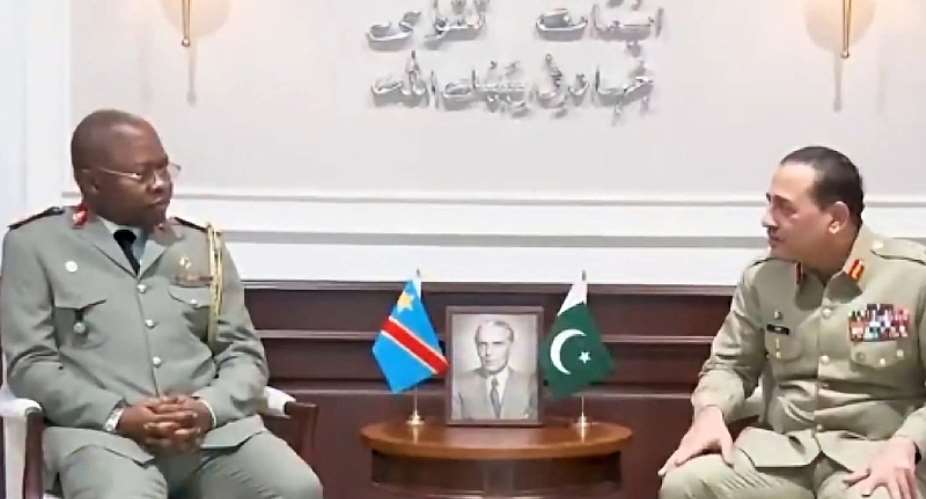
A single photograph from Rawalpindi tells its own story about where the Democratic Republic of Congo is looking for security partners these days. Lieutenant General Banza Mwilambwe Jules, Chief of Defence of the Armed Forces of the DRC, sits across from a senior Pakistani military officer inside Pakistan's General Headquarters (GHQ), a framed portrait of Muhammad Ali Jinnah Pakistan's founding father positioned between the two flags on the table that separates them. The image, released by TRT Afrika, marks the moment DR Congo and Pakistan signed a Memorandum of Understanding (MoU) to expand defence and security cooperation.
The Setting Is the Message
Military-to-military diplomacy photographs are rarely accidental. The choice to seat the two officers with Jinnah's portrait flanked by the Congolese and Pakistani flags is a deliberate framing device a visual assertion that this is a state-to-state relationship rooted in institutional continuity, not a one-off courtesy call.
GHQ Rawalpindi is the nerve centre of Pakistan's military establishment, and hosting a foreign defence chief there, complete with a formal photo-op against Pakistan's national iconography, signals that Islamabad is treating the Congolese relationship as more than symbolic.
Uniforms as Diplomacy
Both men are pictured in military dress, not civilian suits a deliberate register. Where a foreign ministry handshake photo signals political alignment, a uniformed military meeting signals operational intent: training exchanges, equipment discussions, doctrine-sharing. For DR Congo, a country whose armed forces (FARDC) have struggled against M23 rebels and Rwandan-backed forces in the mineral-rich east, the optics of sitting as equals with a nuclear-armed South Asian military power carries its own weight, regardless of what the MoU's fine print eventually contains.
A Widening Map of Congolese Military Diplomacy
This photograph does not exist in isolation. In recent months, Kinshasa's defence ministry has been photographed at Mali's BAMEX defence exhibition, in talks with Indian defence officials, and now in Rawalpindi. Each image tells the same underlying story: a Congolese government hedging its security bets across multiple partners South-South cooperation with Mali, subcontinental engagement with India, and now South Asian defence ties with Pakistan rather than relying on any single traditional partner. For a country locked in a grinding eastern conflict and a fragile, repeatedly-missed peace process, the visual diversification of allies may matter as much to domestic and regional audiences as the technical content of any single MoU.
What the Image Doesn't Show
What the photograph cannot capture is what the agreement actually contains training slots, equipment sales, joint exercises none of which Islamabad or Kinshasa has yet detailed publicly. The image offers atmosphere, not substance: a handshake dressed in institutional gravity, waiting to be filled in by whatever cooperation follows.
Mustapha Bature Sallama
Medical/Science communicator, Private Investigator, Criminal Investigation and Intelligence Analysis,United States Institute of Peace (USIP), [email protected] +233555275880


 GoldBod’s gains must be weighed against full cost to Ghana – Prof. Bokpin
 ‘Afenyo-Markin’s smear campaign against me is about extortion’ – Sammy Gyamfi
 August 22: Cedi sells at GHS12.30 on forex market, GHS11.13 on BoG interbank
 There is a deliberate smear campaign against GoldBod from Minority – Sammy Gyamf...
 ‘If GoldBod wants credit, it must accept blame for losses’ – Dr Owusu Sarkodie
 Akosombo control system to be restored next month – Energy Minister
 ‘Temporary Akosombo system not very robust’ – Energy Minister on recent power ou...
 Mike Ocquaye Jr reacts to Adwoa Safo’s reported return to NPP Dome-Kwabenya race
 Foreign Affairs Ministry urges Tijjaniya pilgrims to Senegal to travel by air ov...
 Bono Police Arrest 36‑Year‑Old in GH¢1.1M Fake Gold Deal; Hunt for Three Others ...

