




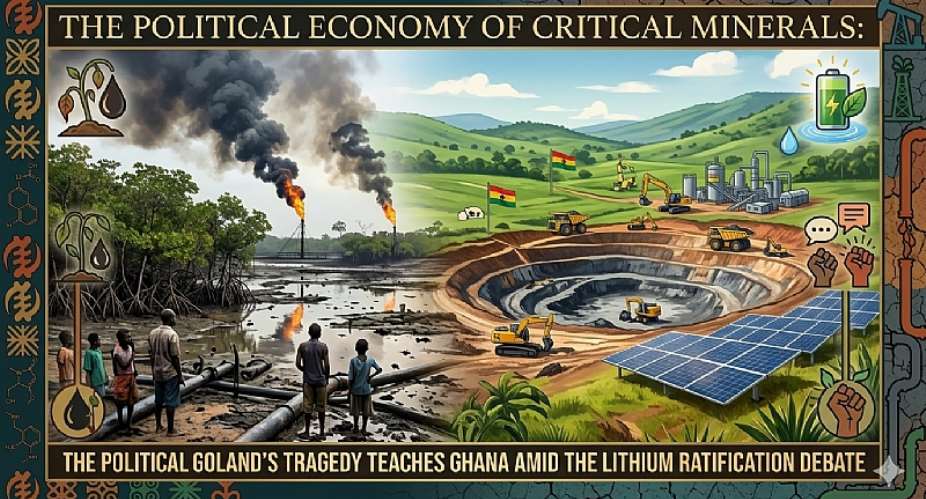
The Structural Illusion of Resource Abundance
The paradox of resource-rich nations suffering from domestic scarcity remains a defining feature of West Africa’s political economy. A viral AI-generated graphic by digital artist Samson Theo illustrates this contradiction, depicting a dense line of citizens holding jerrycans beneath a sign stating, "Fuel Scarce. No Money, No Problem. Patience is Our Oil." While the image critiques the structural fuel distribution crises in Nigeria, it provides a timely framework for analyzing resource governance in Ghana. In domestic policy discourse, "citizen patience" is frequently weaponized to manage public dissatisfaction with economic austerity.
However, macro-economic history demonstrates that passive compliance during periods of resource extraction often institutionalizes state corruption and regulatory capture rather than prosperity. As Ghana encounters ongoing volatility in petroleum prices and deepens its involvement in the global green mineral value chain, a critical re-examination of historical extraction crises is necessary. The 1990s conflict involving General Sani Abacha, Shell Petroleum, and the Ogoni people provides a historical case study on the dangers of prioritizing foreign capital over domestic environmental security.
The Ogoniland Precedent: Resource Extraction under Regulatory Capture
The devastation of Ogoniland in Rivers State, Nigeria, serves as an academic baseline for studying the "resource curse" and state-corporate collusion:
- Ecological Degradation: From 1958 onward, Royal Dutch Shell extracted vast crude oil reserves from Ogoniland, leaving behind a legacy of systematic oil spills, gas flaring, and heavy-metal contamination that permanently destroyed the agricultural and fishing economy of the local communities.
- Civil Society Mobilization: Under the leadership of Ken Saro-Wiwa, the Movement for the Survival of the Ogoni People (MOSOP) organized non-violent resistance to demand environmental restoration and fiscal decentralization, successfully declaring Shell persona non grata in 1993.
- Authoritarian State Response: Following his 1993 coup, military dictator General Sani Abacha deployed state security forces to violently suppress the Ogoni movement to protect state oil revenues, resulting in widespread human rights violations.
- The Ogoni Nine Judgments: The conflict culminated in the November 10, 1995, execution of Ken Saro-Wiwa and eight other MOSOP leaders after a flawed military tribunal. Subsequent documentation by human rights organizations like Amnesty International exposed substantial operational and logistical collusion between corporate executives and the state apparatus to suppress local resistance.
The Contemporary Ghanaian Mirror: Galamsey and the Lithium Ratification Debate
Ghana risks replicating these exploitative dynamics due to structural gaps in its mineral resource policies:
- The Galamsey Crisis: Parallel to the oil contamination of Ogoniland, illegal and poorly regulated alluvial gold mining (galamsey) has systematically poisoned major river basins, including the Pra and Ankobra, with mercury and cyanide, threatening national water security.
- The Legislative Split Over Green Minerals: The contentious parliamentary approval of the Ewoyaa Lithium Mining Lease Agreement with Barari DV (a subsidiary of Atlantic Lithium) has sparked intense domestic political debate. While proponents argue that the negotiated 13% carried interest and 10% royalty rate represent an improvement over standard mining codes, the Minority Caucus voted en bloc against the lease, citing unaddressed long-term commercial risks and a weak fiscal framework.
- Local Displacement and Deferred Compensation: Policy analyses by organizations like IMANI Africa highlight that extended legislative delays and land-use moratoriums around Mankessim and Ewoyaa have frozen local farming economies. This has left host communities highly vulnerable to institutional neglect before active mining operations even begin.
Expanded Strategic Recommendations: Institutional and Energy Reform
To transition from an extraction-based economy to a sustainable, diversified model, Ghana must implement structural changes in resource governance and alternative energy planning:
- Enforcement of Local Value Addition Mandates: Ghana must strictly prohibit the raw export of unrefined green minerals. The state should condition mining concessions on the domestic establishment of processing facilities, ensuring the country captures higher-value segments of the global battery supply chain rather than remaining a mere source of raw materials.
- A Legislative Overhaul of the Minerals and Mining Act: Parliament must amend the Minerals and Mining Act to institutionalize higher base royalty rates for critical transition minerals, preventing ad-hoc negotiations that leave state contracts vulnerable to shifting political dynamics.
- Decentralized Renewable Energy Grids: Rather than relying heavily on centralized, fuel-dependent power generation, the Ministry of Energy should reallocate mineral revenues toward building decentralized solar and wind mini-grids across rural and industrialized zones, reducing the vulnerability of the national grid to global oil shocks.
- A State-Backed Green Hydrogen Framework: Ghana should invest in green hydrogen infrastructure, leveraging its solar abundance to create a sustainable alternative energy sector that reduces long-term dependence on petroleum imports.
- Legally Protected Sovereign Community Trusts: Host-community compensation must be managed by independent, local community trusts rather than centralized government agencies, guaranteeing direct local funding for permanent infrastructure, healthcare, and economic diversification.
Urgent Call-to-Action: Re-evaluating the Lithium Leases
The Parliament and Ministry of Lands and Natural Resources must immediately halt the unchecked execution of the Ewoyaa Lithium lease. Policy makers must subject the contract terms to a transparent review by independent civil society organizations and environmental economists. The state must resolve outstanding community land compensation issues before mining operations commence. Continuing without addressing these issues threatens to establish an extractive model that prioritizes immediate revenue over long-term socioeconomic stability.
Structural Accountability as a Policy Imperative
The cultural normalization of patience in the face of structural underdevelopment is a flawed political strategy. Real development requires proactive regulatory enforcement and institutional transparency, not passive tolerance of poor economic conditions. The historical record of the Abacha regime's suppression of the Ogoni Nine proves that when a population remains passive, state and corporate interests will comfortably prioritize resource revenue over citizen welfare.
Ghana occupies a pivotal position in the global green energy transition. However, natural resource endowments do not inherently guarantee economic advancement. If Ghana fails to reform its extraction policies, enforce environmental regulations, and shift toward sustainable alternative energy, it risks repeating the cyclical resource crises seen across the region. Ogoniland serves as a historical reminder of the high cost of unchecked resource exploitation.
✍️ Submitted by:
Retired Senior Citizen
For and on behalf of all Senior Citizens of the Republic of Ghana 🇬🇭
Teshie-Nungua
[email protected]

 'I did not communicate my intended position well' — Nii Lante Vanderpuye apologi...
 Ex-Pakistan PM Imran Khan returned to jail after hospital checks
 UN holds second informal straw poll for next leader
 We are working to restore normal tax payment processing on Ghana.gov — GRA assur...
 GoldBod cannot escape scrutiny over $1.7bn DGPP loss — Kofi Tonto
 Education Ministry orders reinstatement of BOGISS student after alleged sexual a...
 Stop recording intimate moments — Malik Basintale advises Ghanaian youth
 Deadly border mine collapse exposes risks behind Central Africa's gold rush
 France, Germany, UK and Italy slam Israel's 'E1' West Bank settler project
 First US deportees land in Liberia

