




Even in their wildest imaginations and on their very best day, some people cannot hold a candle to others on the pure merits of what those individuals have achieved through their own effort, enterprise and sacrifice.
Yet the dysfunctions of our politics and democracy sometimes elevate underachievers to public office, entrust them with strategic national institutions and multibillion-dollar responsibilities, and embolden them to disrespect people whose records of professional and entrepreneurial accomplishment they cannot begin to match.
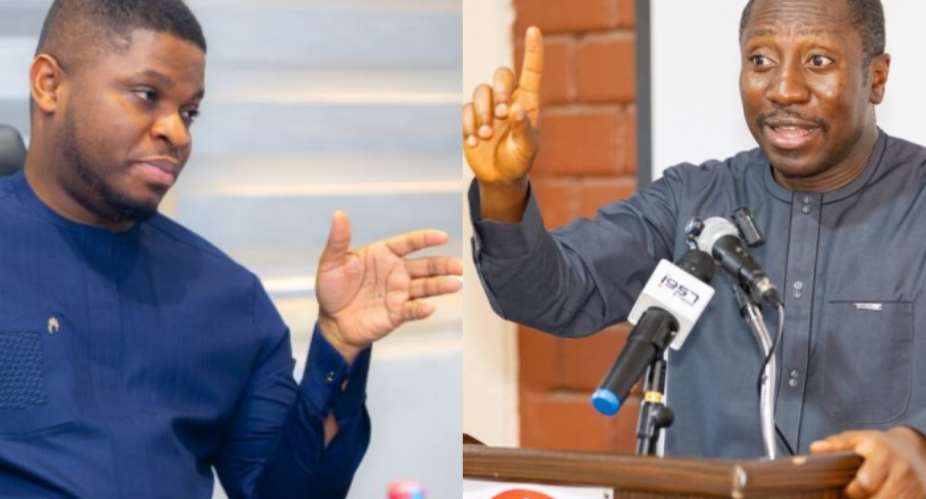
That is precisely what Sammy Gyamfi, a lawyer, displayed at his press conference today. Until his appointment as Chief Executive Officer of the Ghana Gold Board, he had not managed any institution or enterprise of comparable scale, complexity or strategic importance. His public career had been built principally around partisan political communication. He nevertheless had the temerity to launch insulting personal attacks on the Minority Leader, Hon. Alexander Afenyo-Markin, a distinguished lawyer and private businessman of many years’ standing who has built and managed enterprises, taken commercial risks and experienced the realities of both profit and loss at the front line of business.
But this is not ultimately about the relative standing of the two men: Afenyo-Markin, a distinguished legal practitioner with an established record at the Bar, and Gyamfi, a lawyer with no comparable record of distinction in legal practice. The real issue is public accountability, the integrity of a strategic national institution and the responsible stewardship of Ghana’s resources.
But for Politics, How Would Sammy Gyamfi Come Near GoldBod?
But for the distortions of partisan politics and the President’s power to appoint whom he chooses, without any demonstrated insistence on solid, relevant and meritorious qualifications, how on earth would Sammy Gyamfi have come anywhere close to running an institution as strategic and consequential as the Ghana Gold Board?
Outside the corridors of political patronage, what record of executive leadership, institutional management, commodity trading, central banking, mining, international finance or large-scale enterprise would have placed him among the strongest candidates for such an office? Before this appointment, what complex institution had he built or successfully managed? What comparable responsibility had he carried?
His principal public prominence came from serving as a party propagandist and political communicator. That may qualify a person to defend a political party. It does not, without more, establish the competence required to manage a strategic national institution through which billions of dollars in gold transactions pass.
Political visibility is not managerial competence. Loyalty to a President is not technical expertise. Fluency in political invective is not executive capacity. And skill in attacking political opponents is no substitute for the judgment, experience, temperament and discipline demanded by high public office.
In a party containing accomplished and experienced figures such as Goosie Tanoh, Seth Terkper and Cadman Atta Mills, the decision to entrust GoldBod to Mr Gyamfi raises an unavoidable question: was the appointment based on demonstrable merit and suitability for the office, or merely on the fact that the President possessed the power to appoint him?
The President’s legal authority to appoint cannot transform an unsuitable candidate into the most qualified person for the job. Nor does appointment confer competence by presidential decree. Where merit is displaced by political loyalty, the country bears the risk. And when the appointee, instead of answering legitimate questions involving US$1.7 billion in losses, resorts to insults, accusations and personal abuse, the consequences of that appointment become impossible to ignore.
The US$1.7 Billion Loss Was Not Invented by the Minority
The Minority Leader did not manufacture the figure of US$1.7 billion. The IMF’s latest Selected Issues Paper states that, in 2025, the significant scaling-up of the Bank of Ghana’s Domestic Gold Purchase Programme generated losses exceeding US$1.7 billion, equivalent to approximately 1.5 per cent of GDP. According to the IMF, the losses arose almost entirely from Gold-for-Reserves doré transactions.
The report is equally clear about the anatomy of those losses. It identifies service and assay fees paid to GoldBod, discounts on gold sold to off-takers and, most importantly, exchange-rate losses arising from the difference between the forex-bureau rate used to purchase gold and the Bank of Ghana’s reference rate. It further states that GoldBod handled most of the sourcing operations in 2025.
These findings do not mean that the entire US$1.7 billion loss appears in GoldBod’s financial statements. It does not. The loss is recorded on the books of the Bank of Ghana. Neither do the findings establish, without further investigation, that GoldBod alone caused the entire loss.
But the findings place GoldBod squarely within the chain of transactions that produced the loss. That is precisely why Parliament must investigate the respective roles of the Bank of Ghana, GoldBod, aggregators and off-takers, as well as the applicable exchange rates, service charges, assay fees, discounts and the persons or entities that ultimately benefited from the arrangements.
A demand for such an investigation is not an attack on GoldBod. It is the minimum accountability required where the nation has suffered losses exceeding US$1.7 billion.
What the Auditor-General’s Opinion Does and Does Not Establish
Mr Gyamfi’s reliance on the Auditor-General’s report as proof of complete exoneration is equally misplaced.
The Auditor-General expressed an unmodified opinion that GoldBod’s financial statements presented a true and fair view of its financial position as at 31 December 2025. That is significant and must be acknowledged. GoldBod’s accounts reported an operational surplus of approximately GH¢909.7 million.
But an unmodified audit opinion is not a universal certificate of clean hands. It provides reasonable assurance that GoldBod’s financial statements are free from material misstatement. The Auditor-General expressly states that reasonable assurance is a high level of assurance, but not a guarantee that an audit will always detect a material misstatement.
The report also makes clear that GoldBod’s Board, not the Auditor-General, was responsible for preparing and fairly presenting the financial statements. The Auditor-General examined those statements and expressed an opinion on them.
Most importantly, that opinion relates to GoldBod’s own accounts. It does not determine whether the Bank of Ghana suffered US$1.7 billion in DGPP-related losses. It does not determine whether GoldBod’s service and assay charges represented value for money. It does not determine whether the pricing, sourcing and exchange-rate arrangements were prudent. Nor does it determine whether the entire programme was designed and implemented in the best interests of the Ghanaian people.
The accounts themselves require careful reading. The reported overall surplus of approximately GH¢5.46 billion included GH¢4.5477 billion in unutilised government subvention provided as revolving capital for gold purchases, trading and exports. That amount must not be confused with profit generated from GoldBod’s operations. The same accounts also recorded approximately GH¢3.78 billion payable to the Bank of Ghana under the Domestic Gold Purchase Programme.
GoldBod’s audited operational surplus and the Bank of Ghana’s US$1.7 billion loss are therefore not contradictory findings. They relate to different institutions, different books and different questions. Producing GoldBod’s audited accounts does not answer the questions raised about losses recorded by the Bank of Ghana.
Sammy Gyamfi’s Conduct Violates the President’s Own Standard
President John Dramani Mahama launched a Code of Conduct for his appointees. Section 1.3, appropriately titled “Civility, Courtesy & Restraint”, declares that public service and good governance cannot function effectively without courtesy, respect and civility.
The Code requires public officials to:
• be humble;
• be willing to give and accept constructive criticism and advice from colleagues and the general public;
• use decorous language, even in the face of provocation;
• take reasonable care to maintain the integrity and reputation of public office;
• avoid offensive or provocative language or conduct; and
• conduct themselves with dignity while refraining from acts of rudeness and disrespect.
Measured against these elementary standards, Mr Gyamfi’s press conference was not merely politically offensive. It was a repudiation of the President’s own Code of Conduct.
There was nothing humble, decorous, restrained or dignified about describing the Minority Leader and others demanding accountability as “devious extortionists” engaged in political blackmail and seeking to have their “palms oiled”. Those were not answers to the IMF’s findings. They were grave and reckless allegations made without evidence against the Leader of the Minority in Parliament.
The Code does not say that an appointee must be civil only when the questions are convenient. It expressly demands decorous language even in the face of provocation. Mr Gyamfi cannot therefore excuse his conduct by claiming that GoldBod was attacked or that he was defending his reputation. Restraint matters most when a public officer feels challenged.
If the President’s Code means anything, its requirements cannot be treated as decorative words launched with ceremony and abandoned whenever a politically connected appointee loses his composure.
Insulting the Minority Leader Is Disrespecting the People
The Minority Leader’s demand for a parliamentary inquiry was made in the discharge of a constitutional and democratic responsibility. It was made on behalf of the people of Ghana, whose money, gold resources, central bank and economic future are implicated.
When a public officer who has been called upon to account for his stewardship responds with insults and personal attacks, he does not merely disrespect the individual asking the questions. He disrespects Parliament and, ultimately, the people of Ghana on whose behalf the questions are being asked.
Mr Gyamfi’s resort to abuse tells the country a great deal about his temperament, judgment and fitness for an office of such national importance. Competence in public office is demonstrated through candour, restraint, command of the facts and a willingness to submit to independent scrutiny. It is not demonstrated by shouting down those who demand accountability.
His performance also illustrates the danger of appointing people to strategic institutions principally because they have served a political party faithfully. When political combativeness is mistaken for executive competence, the habits of the party communication office inevitably follow the appointee into public administration. Every legitimate question becomes an attack. Every demand for accountability becomes a conspiracy. Every critic becomes an enemy to be abused.
GoldBod is not the NDC’s communications directorate. Its Chief Executive is not at liberty to conduct the affairs of a strategic national institution like a partisan press conference. He holds public office in trust for all Ghanaians, including those who disagree with him and those who demand answers from him.
The President Must Enforce His Own Code
A responsible President who respects Ghanaians and the institutions through which they demand accountability would do well to relieve Sammy Gyamfi of his responsibilities.
This is not simply because Mr Gyamfi insulted a political opponent during a press conference held at Jubilee House, the seat of government. It is because he used the platform of a strategic public institution to make grave personal accusations instead of accounting soberly for matters involving more than US$1.7 billion in losses. In doing so, he violated the standards of civility, courtesy, restraint and dignity that the President himself prescribed for his appointees.
President Mahama must now decide whether his Code of Conduct is a binding standard of public administration or merely a public-relations document with no consequences. If an appointee can publicly call the Minority Leader a devious extortionist seeking to have his palms oiled merely because the Minority Leader demanded an investigation into losses identified by the IMF, then the Code is not worth the paper on which it was printed.
No amount of invective can erase the IMF’s findings. No audit of GoldBod’s own financial statements can, by itself, explain away losses recorded on the books of the Bank of Ghana. And no public officer has the right to insult Ghanaians, directly or through their elected representatives, merely because they demand to know how more than US$1.7 billion was lost.
The immediate requirements are clear: open the books, disclose the contracts, identify the exchange rates, fees, discounts and beneficiaries, and submit the entire programme to an independent parliamentary investigation.
The equally necessary consequence is for the President to enforce his own Code and remove from office an appointee whose appointment was never supported by any compelling record of relevant institutional or commercial leadership and whose conduct has now demonstrated neither the restraint nor the judgment required to lead an institution as strategic as the Ghana Gold Board.

 Eritrea, Ethiopia trade barbs as Tigray rebels retreat
 OccupyGhana warns EOCO, BNI against using investigations as punishment
 Mahama visits Ahafo Region to inspect development projects
 CSA rejects claims of FBI command over Operation Blackout in Ghana
 Entertainment presenter Andy Dosty denies obtaining US visa through GTA
 “I will be on buses and lorries to preach, let them arrest me!” — Prophet Nigel ...
 October 9: Cedi sells at GHS12.30 on forex market, GHS11.79 on BoG interbank
 New York mayor to ask Trump for ICE withdrawal after agents shoot man in car wit...
 Ukraine takes Russia fight to 'scorching sands' of Sahel
 Clashes lead South Africa to withdraw asylum processing order



Comments
TAKING YOUR TIME TO WRITE THIS THRASH IT WOULD HAVE BEEN BETTER TO ASK LOUSY AFENYO MARKIN TO TO BACK HIS UNWARRANTED ATTACK ON SAMMY GYAMFI WITH DOCUMENTAL PROOF INSTEAD OF JUMPING FROM ONE RADIO STATION TO ANOTHER ... AND BY THE WAY WHAT IS PREVENTING AFENYO TO HAUL SAMMY GYAMFI TO PARLIMENT FOR INTERROGATION.....HE'S AFRAID HE WILL BE DISGRACED