




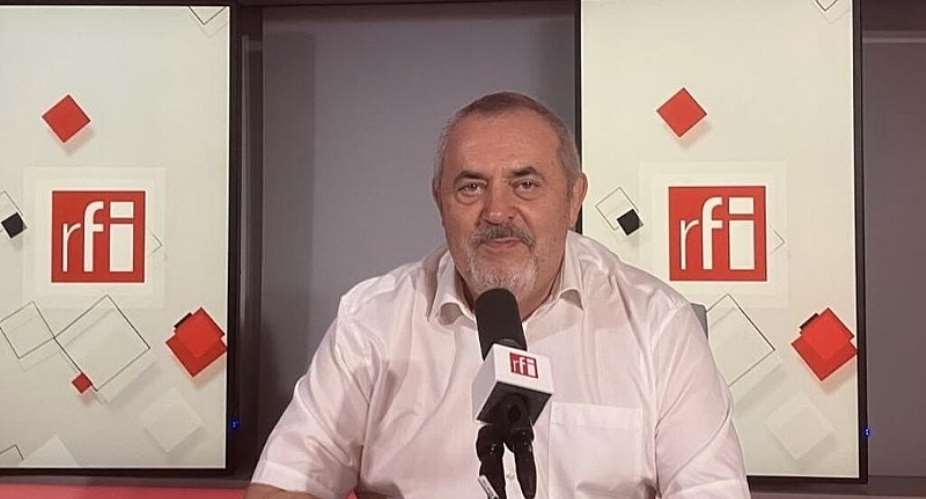
Nadezhdin, who attempted to challenge Russian President Vladimir Putin in the 2024 presidential election, has been barred from running as an MP in September's parliamentary elections.
Russian authorities have severely restricted independent reporting, public protest and criticism of the armed forces since launching the full-scale invasion of Ukraine in February 2022 – and having garnered strong public support for his anti-war stance, Nadezhdin was added to Russia's register of "foreign agents" in July.
When he was served with a summons to appear in front of the Investigative Committee – an invitation he says usually ends with being taken directly to court and then to prison – he fled to France with his wife, forced to leave his children and elderly parents behind.
RFI: Why did you choose to leave Russia at this time?
Boris Nadezhdin: I took part in the State Duma elections, which are currently under way. I stood as a candidate and began to receive a great deal of support for my views. I spoke out in favour of peace and freedom, and against the policies currently being pursued by Putin and the Russian leadership.
As my popularity began to rise, I collected a great many signatures in support of my candidacy to the Duma. In 2024 there were huge queues all over Russia, and even abroad, for people to sign the nomination forms when I was standing for president. And it seems the same thing happened [this time].
Well, at some point, the authorities decided that I needed to be removed from the election. But events unfolded in a far harsher manner than they had in 2024. Back then, they simply failed to register me for the election. This time, however, I came under intense pressure from virtually all the security agencies in Russia.
On 10 July, the Ministry of Justice declared me a "foreign agent". This is a status in Russia that effectively rules out any possibility of legal political activity. What does the term "foreign agent" actually mean here? My only "crime" was that I criticised Putin's policies and gave interviews to foreign media. That was sufficient grounds to declare me a foreign agent.
I was then detained by the police, taken to court and they wanted to arrest me. But it was actually quite [a rare occurrence] for the police to detain me – it has never happened before that presidential candidates and State Duma candidates have been detained by the police.
There was a huge outcry. The court hearing was eventually postponed. Ultimately, I was not arrested, but was fined. In any case, this also ruled out my participation in the elections.
Kremlin critic leaves Moscow for Paris after ban from running for election
But then the criminal proceedings began. On 21 July I received a summons to appear before the Investigative Committee. And this is a typical story involving the Investigative Committee: a person turns up and from there they're taken to court, and from court to Lefortovo. Lefortovo is a high-security prison where people end up who are accused of all sorts of political offences. That's the situation I found myself in.
The bailiffs barred me from leaving Russia. As soon as the police detained me, they barred me from leaving Russia the very next day. My lawyers then appealed against the travel ban. And it was only after I'd been served with a summons to the Investigative Committee that the ban on leaving Russia was lifted.
I had literally 24 hours to leave the country. My wife and I bought a ticket and flew out. At the time, I didn't have a visa allowing me to travel to France. So we flew to Astana, the capital of Kazakhstan. Whilst in Astana, we applied for a French visa. And thanks to the fact that I'm known, the French Foreign Ministry helped me get the visa quickly. We got it in about a week. And so I've been in Paris since 3 August.
RFI: Why did you choose to come to France?
BN: When I was facing the threat of arrest and imprisonment, representatives from various countries who know me well reached out to me. I have held high-ranking positions in Russian politics for more than 30 years.
I had met with officials from the French Foreign Ministry in Paris during my various visits there in an official capacity. I received offers from various embassies, but I chose France, for two reasons. The first is that France is one of those states that genuinely protects political refugees. Not all states act that way.
And the second is simply that I love France very much – I've been here many times, travelled all over the country by car, and have been visiting for a decade. Of course, once the war started I stopped coming here, But of all the places in the world I could have gone, France was the one I liked best.
Russian journalist who criticised Ukraine war escaped to France with NGO's help
RFI: Do you plan to stay in France in the longer term?
BN: I don't know for sure yet where I'll end up or what I'll be doing. There are a number of options right now – it depends on where I manage to find a way to make a living.
I'm currently in touch with some universities and entrepreneurs. I just need to find a way to bring my family over here and support them.
Unfortunately I don't have large financial reserves, I'm certainly no millionaire. The idea is to sell something in Russia, use the proceeds to buy something here, and live off that.
A lot depends on how I resolve this problem. But at the very least, it is absolutely clear that for the next few weeks, and possibly even months, I will definitely be in France.
RFI: Do you feel safe here in France?
BN: When I moved to Paris, the first thing I said was: "Great news – I'm alive, free and safe." Because I am absolutely convinced that the French state is a place where, if you abide by the laws of France, you certainly won't be prosecuted for anything. And it's absolutely unthinkable that France would extradite me if Russia were suddenly to put me on its wanted list.
RFI: Your parents and your children are still in Russia. Are you worried about them?
BN: Yes, of course. I have four children. Some of them are grown-up. My daughter got married just recently. Unfortunately, I couldn't attend her wedding. That's my middle daughter. My eldest daughter is already all grown-up. I have a 17-year-old grandson.
But my wife and I are currently raising two children who are still kids – they are 12 and 15 and attend school in Russia. So we are currently discussing the best course of action. I can only say that, unlike in Stalin's time, under Putin the authorities do not persecute one's family and children. There are no known cases of that so far.
But there is another factor: I have very elderly parents in Russia, they are in their eighties. Thank god they are still alive, but they are in very poor health. At the moment, I have no answer to the question of which family members I will bring over or how we will actually arrange our lives.
New toxin findings in Navalny death deepen Europe's accusations against Kremlin
RFI: You began your career in the 1990s and you have always been critical of Putin. How do you explain the fact that you used to be able to express your opinions, but now you can't? What has changed in Russia?
BN: Throughout my more than 30 years of political activity – I was first elected as a member of parliament back in 1990 – I understood where the red lines lay, the ones you must not cross if you want to remain free and continue your political work in Russia.
There were two such red lines. One can criticise Putin's policies, but one cannot criticise Putin personally. And under no circumstances may one receive direct aid from abroad – any kind of financial or political support from foreign states. I did not cross those red lines.
When I ran for president, I campaigned by criticising Putin's policies and demanding an end to the war. Back then, that was permissible. True, I was barred from the election, but I did not face repression. Now, however, the situation has changed drastically.
We see this because attempts were made to simply eliminate me from Russian politics and deprive me of my freedom. And right now, regarding the elections in Russia, there is literally a court case under way concerning the Yabloko party, which is being removed from the ballot.
In all likelihood, it is no longer possible to criticise Putin's policies in Russia. That has become a red line. If you are participating in elections, you cannot run for office while opposing the war. That is a red line – something that was not the case two years ago.
RFI: So the regime has become more authoritarian in your view?
BN: Yes. Absolutely. The regime is becoming less and less willing to listen to criticism, and the measures taken against political opponents are becoming harsher.
RFI: Are you still against the war in Ukraine?
BN: From the moment it started, I have consistently advocated for an end to this conflict. Back in 2024 when I was running for president, it was very difficult to find words I could say without ending up in prison, because so many people were being jailed for criticising the war. That is the truth.
I came up with the following phrasing: "This is Putin's fatal mistake." I believed this from the very beginning and continue to believe it to this day.
RFI: Do you think you'll ever be able to return to Russia?
BN: Here is what I can say: right now, my lawyers in Russia are handling the criminal cases against me. There is a court hearing tomorrow, and there will be several others.
A great deal depends on the court rulings – for instance, if I am declared a criminal in Russia, which is standard practice, and placed on the wanted list and so on.
In that case, of course, there can be no talk of returning. But everyone, including my lawyers, tells me that the decision whether to return to Russia can realistically only be made once the political regime there changes.
This article has been adapted from the original interview by Arnaud Pontus.

 “We won’t take moral lessons from the brothel” Sammy Gyamfi slams Afenyo-Markin
 I am ready to face Afenyo-Markin in Parliament — Sammy Gyamfi
 Six injured as Toyota Corolla plunges into Birim River on Accra–Kumasi highway
 Soldier remanded over murder of 45-year-old man at Afienya
 Cocoa farmers will reject NDC in 2028 if their concerns are not addressed – Mart...
 Government will turn youth concerns into policy and action — Opare Addo
 YEA recruits over 90,000 youth under various employment programmes — Malik Basin...
 National Apprenticeship Programme to train 100,000 youth by end of 2026 — NYA CE...
 Let's not destroy GoldBod, it's a viable template for Ghana's economic independe...
 I take Afenyo-Markin's onerous bail condition threat as comic relief — Sammy Gya...

