




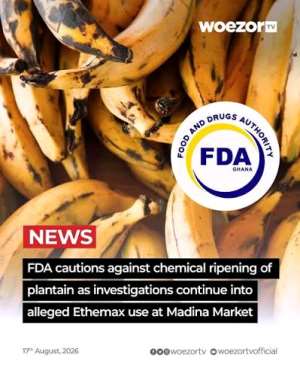
The Food and Drugs Authority (FDA) has cautioned traders and the public against the indiscriminate use of chemicals to accelerate the ripening of plantain and other fruits and vegetables, warning that the practice could pose serious food safety risks.
The warning follows the circulation of a viral video allegedly showing chemicals being used to force-ripen plantains at the Madina Market in Accra.
According to the FDA, preliminary investigations conducted in collaboration with the Environmental Health Unit of the La Nkwantanang-Madina Municipal Assembly identified the chemical shown in the video as Ethemax, described by the Authority as a plant growth regulator whose improper use could pose risks to human health and public safety.
The FDA said it had also engaged the trader involved in the sale and distribution of the plantains as part of ongoing investigations into the incident.
In a statement signed by Prof. Kwabena Frimpong-Manso Opuni, Chief Executive Officer of the FDA, the Authority said regulatory action was being taken against persons found to have engaged in the unauthorised sale, distribution or use of the chemical.
The Authority explained that the misuse of agricultural chemicals, including applying them at incorrect concentrations or using them on crops for which they have not been approved, could leave unacceptable chemical residues on food.
“Such practices can lead to unacceptable chemical residues and potentially compromise food safety,” the FDA warned.
The development has renewed concerns about how fruits and vegetables are handled before reaching consumers, particularly the use of chemicals to speed up ripening and improve their appearance for sale.
The FDA has consequently urged farmers, traders and other actors within the food supply chain to use agricultural chemicals strictly according to approved guidelines and manufacturers’ label instructions.
Consumers have also been advised to purchase fruits and vegetables from trusted sources and wash fresh produce thoroughly with potable water before consumption. The public should exercise caution when buying fruits that appear to have been artificially or unevenly ripened.
Beyond the Madina Market incident, the FDA said it would intensify food safety education and market surveillance to promote the safe handling, storage and marketing of fruits and vegetables across the country.
The Authority also encouraged members of the public to report suspected cases of unsafe food handling, improper storage or inappropriate chemical use for investigation and necessary regulatory action.
“We caution against the indiscriminate use of chemicals to accelerate plantain ripening,” Prof. Opuni stressed, adding that food safety remains a shared responsibility among regulators, producers, traders and consumers.
The FDA’s intervention highlights the need for stronger public education and enforcement across Ghana’s food distribution chain to ensure that efforts to speed up the ripening of agricultural produce do not come at the expense of consumer health.


 AMA directs closure of shops, markets for October 3 National Cleanup Day
 ‘We will resist it’ – NUGS kicks against proposed 26% UG accommodation hike
 ‘Fake’ – EOCO denies GH¢50m bail report on Baffour Awuah
 ‘The NPP I seek to lead will stand by every member’ – Boakye Agyarko
 ‘Keeping Baffour Awuah in custody serves no purpose’ – Boakye Agyarko tells EOCO
 GACL announces enhanced security screening at Accra International Airport
 Pursue drug kingpins, not political opponents — Afenyo-Markin tells EOCO
 Over 130 courts are without magistrates – JUSAG President
 We demand immediate, unconditional release of Baffour Awuah from EOCO custody – ...
 COMAC gives Finance Ministry 14-day ultimatum to suspend new fuel tax rule


