




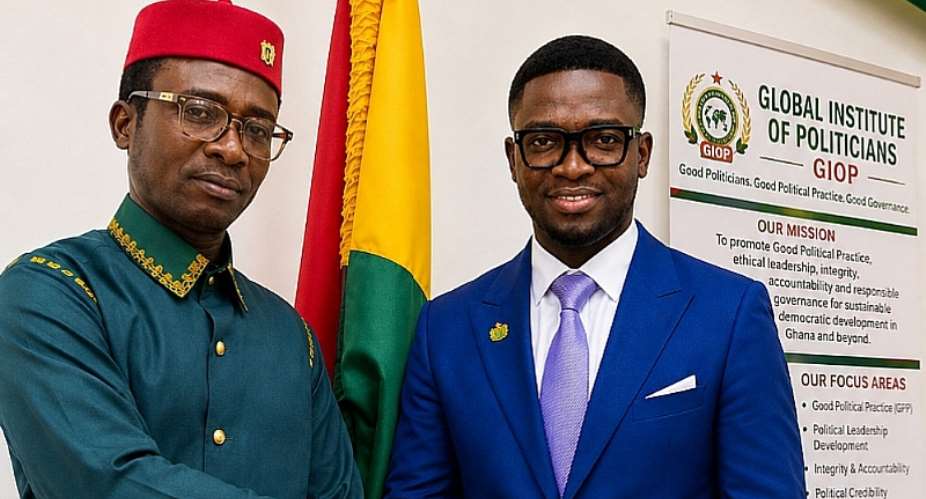
GIOP President Dr. Nana Kwabena Kwaning Snr. Calls for Good Political Practice, Transparent and Sustainable Politics in Line With UN SDG 16 as Ghana's First Line of Defence Against Democratic Decline.
An Exclusive ModernGhana Interview & Governance Feature
Guest:
Dr. Nana Kwabena Kwaning Snr.
President, Global Institute of Politicians (GIOP), Ghana
Interviewed by:
J.K. Nana Kwame Ofori Nkrumah
ModernGhana Writer & Column Journalist
Date: Monday, August 17, 2026
MODERNGHANA EXCLUSIVE
“Ghana Is Not at War — Ghana Is at Corruption”
There are no armies occupying the country.
No bombs falling on its cities.
No tanks rolling through its streets.
Yet, according to Dr. Nana Kwabena Kwaning Snr., President of the Global Institute of Politicians (GIOP), Ghana is fighting a different kind of war—quiet, invisible, and potentially more destructive than armed conflict: the war against corruption.
“Corruption is more dangerous than war. Ghana is not at war; Ghana is at corruption.”
It is a provocative statement, but Dr. Kwaning says it is meant to jolt the nation into a serious conversation about political accountability, institutional integrity, and the protection of Ghana's democracy.
CORRUPTION: THE INVISIBLE WAR
Dr. Kwaning argues that while conventional warfare destroys visibly, corruption destroys silently—and often permanently.
- War destroys infrastructure in days. Corruption weakens institutions over decades.
- War displaces communities. Corruption deprives generations of quality education, healthcare, employment, infrastructure and opportunity.
- War destroys lives directly. Corruption destroys the systems upon which millions depend.
“Corruption does not always arrive with guns. It can operate through the misuse of public resources, procurement abuses, political patronage, conflicts of interest, abuse of office and institutional weaknesses.”
The greatest danger, he warns, is when corruption becomes normalised.
“When society stops being shocked by corruption, accountability weakens. When accountability weakens, institutions deteriorate. And when institutions deteriorate, democracy becomes vulnerable.”
GHANA'S DEMOCRACY MUST BE PROTECTED
Dr. Kwaning stresses that Ghana's democratic gains must never be taken for granted. Generations of Ghanaians struggled and sacrificed to secure the freedoms the nation enjoys today.
“We have toiled and sacrificed for this democracy, and our forebears paid an even greater price. We must not merely celebrate democracy—we must protect it, strengthen it and hand it over responsibly to generations yet unborn.”
Democracy, he says, is not only about elections. It is about:
- Integrity
- Justice
- Accountability
- Transparency
- Strong institutions
- Responsible leadership
- Rule of law
- Protection of citizens' rights
- Sustainable political practices
GPP: THE FIRST LINE OF DEFENCE FOR DEMOCRACY
At the heart of Dr. Kwaning's message is Good Political Practice (GPP).
He says GPP must promote transparent, accountable and sustainable politics in line with UN SDG 16: Peace, Justice and Strong Institutions.
For GIOP, GPP should become a national mechanism for protecting democratic governance.
“Good Political Practice—transparent and sustainable politics in line with UN SDG 16—must become the first aid and first line of defence for the democracy we have built through toil, sacrifice and blood.”
Democracy, he insists, must not only be won at the ballot box; it must be protected daily through responsible political conduct.
FROM GOOD POLITICS TO GOOD POLITICAL PRACTICE
Ghana, he argues, does not merely need politicians who can win elections.
“Ghana needs politicians who can govern responsibly.”
GPP should promote:
- Transparency in public affairs
- Accountability for public decisions
- Integrity in leadership
- Responsible political communication
- Respect for institutions
- Respect for the rule of law
- Sustainable political practices
- Responsible management of public resources
- Professionalism in political conduct
- Protection of democratic institutions
- Zero tolerance for corruption
- Peaceful and responsible political engagement
“Political office is a public trust. It should never become a pathway to personal enrichment.”
CORRUPTION MUST NOT BE A PARTISAN WEAPON
Dr. Kwaning insists that the fight against corruption must rise above partisan politics.
“We cannot condemn corruption when our opponents are accused and defend it when our own are implicated. That is not accountability—that is political convenience.”
He says accountability must be universal, regardless of party, personality, wealth or status.
“Corruption is corruption. Accountability must be universal.”
POLITICAL PARTIES HAVE A RESPONSIBILITY
Political parties, he argues, must strengthen internal ethical standards and take responsibility for the conduct of their members.
He advocates stronger mechanisms for:
- Ethical political conduct
- Transparent political financing
- Responsible political communication
- Internal accountability
- Leadership development
- Professional political practice
Electoral victory, he says, should not be the ultimate measure of political success.
The true measure should be responsible service to the nation.
THE CITIZEN'S ROLE
The fight against corruption cannot be left solely to governments and anti-corruption agencies.
Citizens, civil society, traditional authorities, religious bodies, businesses, professionals and young people all have roles to play.
Dr. Kwaning says Ghana must challenge a culture that celebrates unexplained wealth.
“We must learn to celebrate integrity, competence, service and accountability.”
THE MEDIA AND ACCOUNTABILITY
He places significant responsibility on the media.
Investigative journalism and responsible reporting can strengthen democracy by exposing wrongdoing and demanding answers from public officials.
But he cautions that allegations must be handled responsibly.
“The objective must be truth, evidence and accountability—not political sensationalism.”
THE HUMAN COST OF CORRUPTION
Every resource lost through corruption represents an opportunity stolen from society.
It may mean:
- A classroom never built
- A road left unfinished
- A hospital without essential equipment
- A young person denied opportunity
- A community without water
- A public institution unable to perform its mandate
Corruption, he says, has a human face—even when its victims are invisible.
THE GIOP AGENDA
The Global Institute of Politicians (GIOP) advocates a political culture grounded in professionalism, responsibility, integrity and public service.
Its Good Political Practice agenda focuses on:
- Good Politicians
- Good Political Practice
- Political Credibility and Credentials
- Good Political Language and Sanity
- Integrity and Accountability
- Professionalism
- Responsible Leadership
- Transparent and Sustainable Politics
Dr. Kwaning says this approach complements UN SDG 16, which promotes peaceful societies, access to justice and effective, accountable and inclusive institutions.
A NATIONAL CONVERSATION
He calls for a national dialogue that goes beyond partisan accusations.
Ghana, he says, must examine:
- The cost of corruption to development
- The effectiveness of anti-corruption institutions
- Public procurement
- Political financing
- Whistleblower protection
- Institutional independence
- Political party ethics
- Citizen participation
- Media accountability
- Protection of democratic institutions
THE WAR WE MUST WIN
Ghana may not be fighting a conventional war, but Dr. Kwaning warns that corruption's destructive power must not be underestimated.
“We must declare a national war against corruption—not against individuals or parties, but against the systems, practices and cultures that allow corruption to flourish.”
His message is ultimately about Ghana's future.
“Democracy must not only be won; it must be protected through Good Political Practice.”
THE MESSAGE TO GHANA
To political leaders: Lead with integrity.
To institutions: Stand independently and enforce accountability.
To political parties: Put national interest above partisan convenience.
To the media: Defend truth with courage and responsibility.
To citizens: Do not normalise corruption.
To young people: Demand a political culture worthy of your future.
And to every Ghanaian:
“Let us protect the democracy for which generations before us sacrificed.”
Democracy is not indestructible.
It must be defended every day.
And Good Political Practice must be one of its first lines of defence.
CONCLUSION
GHANA IS NOT AT WAR.
GHANA IS AT CORRUPTION.
THE TIME TO DEFEND OUR DEMOCRACY IS NOW.
Dr. Nana Kwabena Kwaning Snr.
President, Global Institute of Politicians (GIOP), Ghana
Interviewed by:
J.K. Nana Kwame Ofori Nkrumah
ModernGhana Writer & Column Journalist
Monday, August 17, 2026


 Ethiopia's new rebel war redraws alliances across the Horn of Africa
 Netanyahu warns of 'very heavy price' if any country found to be behind FlyDubai...
 EU approves tougher migration rules in latest push to tighten borders
 EU ‘fully rejects’ US threat to ban diesel exports unless bloc releases more fue...
 AU urges Ethiopia, Eritrea and Egypt to exercise restraint amid rising diplomati...
 I consulted Akufo-Addo, Kufuor, NPP stalwarts before entering chairmanship race ...
 Strong partnerships key to advancing decentralisation – Mahama Ayariga
 AMA directs closure of shops, markets for October 3 National Cleanup Day
 ‘Fake’ – EOCO denies GH¢50m bail report on Baffour Awuah
 COMAC gives Finance Ministry 14-day ultimatum to suspend new fuel tax rule


