




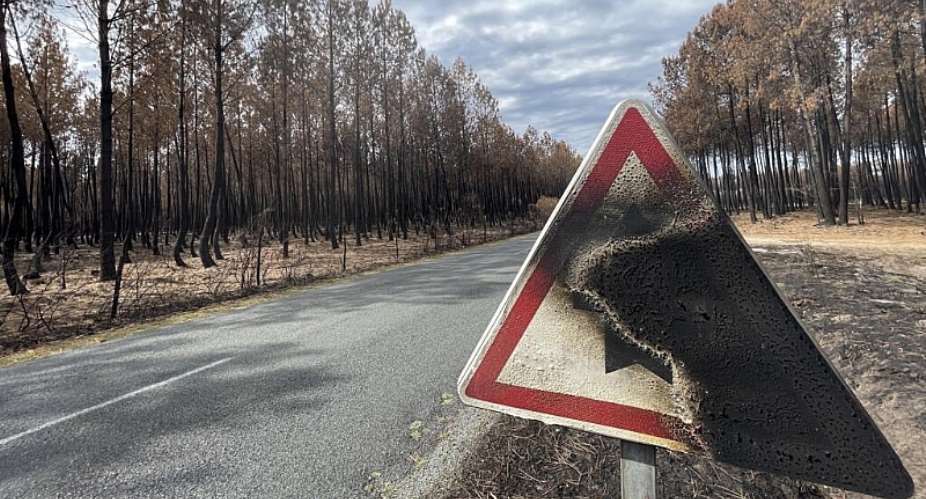
The Gironde fires, which began in July, destroyed more than 40,000 hectares – an area four times the size of Paris – and forced the evacuation of more than 220,000 people. Although the blaze is now under control, it remains under close watch.
Le Porge is no stranger to natural disasters, having suffered droughts, heatwaves, floods and even small earthquakes over the years.
But this year the community was badly hit by the worst forest fires to hit France in more than half a century. While no one was injured or killed, 183 homes were burnt down and several businesses forced to close.
After being allowed to return at the beginning of August, locals are now faced with the challenge of making insurance claims, with many questions remaining.
An initial aid package of €300,000, intended to help affected local authorities carry out "urgent work", has been released by the prefecture, which has established a "steering committee" for the reconstruction.
Many in Le Porge are hoping Lecornu's Monday visit to Gironde will speed up the process.
Ile-de-France region files suit for compensation over Fontainebleau forest fire
The prime minister will be accompanied by several ministers, including Serge Papin for the economy and tourism, Mathieu Lefèvre for the environment and reforestation, Vincent Jeanbrun for housing, Françoise Gatel for local authorities, Annie Genevard for agriculture and forestry, and Interior Minister Laurent Nunez.
RFI spoke to Le Porge's Mayor Martial Zaninetti to ask what sort of assistance he's hoping the government will provide.
RFI: Prime Minister Sebastian Lecornu will visit Gironde on Monday. If he visits Le Porge, what will you tell him?
Martial Zaninetti: I hope he will come to Le Porge, which is the worst-affected area in Gironde. We will tell him that we need the state's help to rebuild our village economically and to rethink the future of our forest.
How will we be able to live in rural areas and in our villages alongside nature, while preserving it so that future generations do not have to endure what has happened to us? Martial Zaninetti, mayor of Le Porge, one of the worst-hit municipalities in the July wildfires.
RFI: What do you estimate the economic damage to the town and the forests surrounding it to be?
MZ: The losses will inevitably run into millions of euros. Half of our village was burned, and half of the municipal forest has also been destroyed. We are a forest community, we own 4,500 hectares of forest. Half of it was burned. This represents a major loss for local authorities because the forest forms part of our budget. It is one of the sources of funding for our projects.
It takes 40 or 50 years for a tree to grow, and that is when it is harvested. So, over a period of 40 to 50 years, we have lost half of our financial resources. A view of the forest surrounding Le Porge after the wildfires. seen on 10 August.
Of course, we are ready to welcome visitors back now that the beaches have reopened, the campsite is operating again and the entire western part of the area has escaped the fire.
We want to restart all of this. But the tourist season is lost for us. We will have no revenue, and I hope that what remains will at least cover our operating costs. We need to prepare for next year.
RFI: There were rumours that Le Porge was sacrificed to save other places, like the more upmarket Lege-Cap-Ferret, and that they received more help from the fire brigades. How would you respond to that?
MZ: The state authorities are currently carrying out an investigation to establish how events unfolded and what decisions were taken.
The second night [22 July] was catastrophic – that was when the situation became most serious. The fire was gaining ground in other villages and sectors, while firefighting resources were being deployed elsewhere to tackle fires in other areas.
Firefighting equipment is not unlimited, it was needed everywhere. It was night-time, and there were no aerial resources available, so I will not comment on the decisions that were taken. However, the fact is that 183 houses were destroyed.
French firefighters threaten to strike over lack of resources Burnt tree trunks near Le Porge, where the economy is heavily reliant on the surrounding forest.
RFI: What have you learned from this disaster?
MZ: I have realised that we were not at all prepared for this kind of crisis. We need to learn the lessons from what has happened, not only at the village level but also at state level and across all the relevant organisations, so that we can properly size our resources and prepare for this kind of phenomenon in the future. Unfortunately, such events are likely to recur, because the climate is warming.
In some parts of our region, we had firebreaks measuring around 50 metres in width. We now realise this is not enough, because the firebrands – the embers carried by the wind – travel much farther. We are now being advised to create firebreaks of at least 200 metres if we are to be able to cope with this kind of disaster in the future.
In any case, we have had firebreaks created around two sites – La Jenny and the municipal campsite – both of which are to the west. These areas had not yet burned, but the fire was advancing towards them, so the firebreaks were created to protect them. A burnt-out shed and van seen in Le Porge, 10 August.
France gripped by latest summer heatwave as drought conditions worsen
RFI: What do you think would be the best way to develop the forest in the future while avoiding fires?
MZ: Work will be carried out by all the relevant professionals – foresters, farmers, elected representatives, the National Forestry Office and people from the wider forestry sector – to rethink the Landes de Gascogne forest massif [an area extending across the departments of Gironde, Landes and Lot-et-Garonne, and including 386 communes], particularly in areas close to villages.
We need to work on firebreaks around residential areas and introduce a greater variety of tree species. Some species – broad-leaved trees, for example – do not burn as quickly or as extensively as pine.
Agriculture can also provide solutions. We will not simply re-plant maritime pine everywhere, as happened over the course of the last century.
RFI: The fires are still not completely extinguished, but people have been allowed to return to their houses. Do you expect new flare-ups, or do you think the crisis is over?
MZ: I hope so, but the summer is not over. We still have two months ahead of us – the rest of August and September, and possibly even October, when temperatures can still be high. There is no significant rainfall forecast before autumn.
So we are remaining extremely vigilant. We will need an immediate response and rapid action before fires [are allowed to] reach the scale they did here.


 Strong investor demand pushes treasury bill bids 88% above government target
 Ghana’s currency is long overdue for security refresh to curb counterfeiting — M...
 Fire destroys wooden structures at Tantra Hill
 Declining enrolment, poor infrastructure justified 70-year-old Tendamba School d...
 30 controversial ambulances handed over to National Security for refurbishment
 UHAS suspends ongoing end-of-semester examinations over logistical issues
 Awutu Odupong chief dies, two arrested over alleged missing of body
 VIP Jeoun coach catches fire at Abuakwa station
 Driver trapped in trailer rescued after accident on Kintampo-Tamale Highway
 Two killed, five injured in head-on collision involving MMT bus at Assin Fosu

