




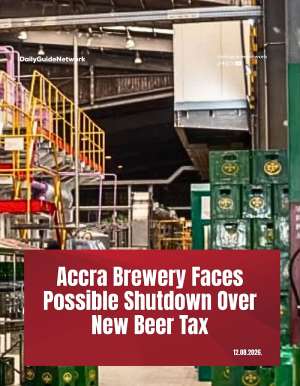
Accra Brewery Limited (ABL) has called on the government to defer the implementation of proposed increases in excise duties on locally manufactured beer, warning that the new rates could have far-reaching consequences for manufacturers, consumers, farmers, employment and investment.
ABL says postponing the implementation would provide government and industry stakeholders with more time to engage and find a tax framework that supports revenue mobilisation without undermining local production and economic growth.
The appeal was made by ABL Country Director, Thatokuhle Hlongwa, at the Association of Ghana Industries (AGI) Second Quarter Business Barometer and Corporate Forum in Accra, which brought together government officials, business executives and other stakeholders to assess Ghana's business environment.
Under the newly approved reforms, the excise duty on locally manufactured beer is expected to increase from 32.5 per cent to 40 per cent, while the rate on beer produced with high levels of local raw materials, including cassava-based beer, will rise sharply from 10 per cent to 25 per cent.
The excise duty on imported beer, meanwhile, will remain at 47.5 per cent.
Mr Hlongwa cautioned that changes in excise taxation should not be viewed solely in terms of the immediate revenue they could generate for the state, arguing that their effects extend throughout the beverage industry's value chain.
“Changes to excise taxation have implications that extend far beyond the taxes paid by manufacturers. Such changes affect production costs, consumer prices, business volumes, investment decisions, employment levels, and ultimately the industry’s contribution to national economic growth,” he said.
According to him, Ghana's brewing industry contributes significantly to local manufacturing, employment, agriculture, procurement, transportation and distribution, making it important for policymakers to carefully consider the wider economic implications of substantial tax increases.
He said ABL has invested considerably in domestic production capacity and local sourcing, creating economic opportunities beyond the company's direct operations.
Mr Hlongwa stressed that ABL's position should not be interpreted as opposition to taxation or government's efforts to increase domestic revenue.
“Our opinion is not against taxation, nor is it opposed to government’s legitimate objective of mobilising revenue for national development,” he stated.
Rather, he said the company is seeking further dialogue and broader stakeholder consultation before the new rates take effect.
“We are not against taxation. Absolutely not. But what we are doing is, let’s have a further dialogue, a further stakeholder engagement, give us the opportunity to dialogue further,” Mr Hlongwa said.
ABL's concerns are particularly focused on the proposed increase in excise duty on beer manufactured with locally sourced raw materials. The planned rise from 10 per cent to 25 per cent could potentially affect demand for agricultural inputs such as cassava and consequently impact farmers and other businesses operating along the agricultural value chain.
The use of locally produced raw materials in brewing has provided an important link between Ghana's agricultural and manufacturing sectors. ABL therefore wants government to consider the potential effects of the tax changes on local procurement, employment, domestic value addition and efforts to encourage manufacturers to source more raw materials locally.
The company believes tax policy should strike a balance between government's need to raise sustainable revenue and the need to maintain a competitive environment for domestic industries.
ABL says it remains committed to engaging government, the AGI and other stakeholders to develop an approach that protects investment and jobs, promotes agriculture and local manufacturing, and supports the country's broader economic transformation agenda.
With implementation of the new excise rates expected soon, attention will now turn to whether government will consider industry's request for a temporary postponement and further consultations before the measures take effect.


 Okoe Boye wins NPP Greater Accra Regional Chairmanship election
 Bagré dam nears spillway threshold as water level rises to 77.35%
 Sunyani Paramount Chief warns chiefs against sale of cemetery lands
 President Mahama announces US$10bn ‘New Economy’ investment programme
 Sustained peace will restore Bawku to its former glory – Mahama
 Plans advanced for University of Science and Technology in Damongo – Haruna Iddr...
 Inmate Peter Kyeremeh escapes from prison
 COKA floors Kokofu to win NPP Ashanti Regional chairmanship
 Abronye retains Bono NPP Chairmanship in Regional Executive Elections
 I accept responsibility for NPP’s poor performance in Greater Accra Region – Out...

