




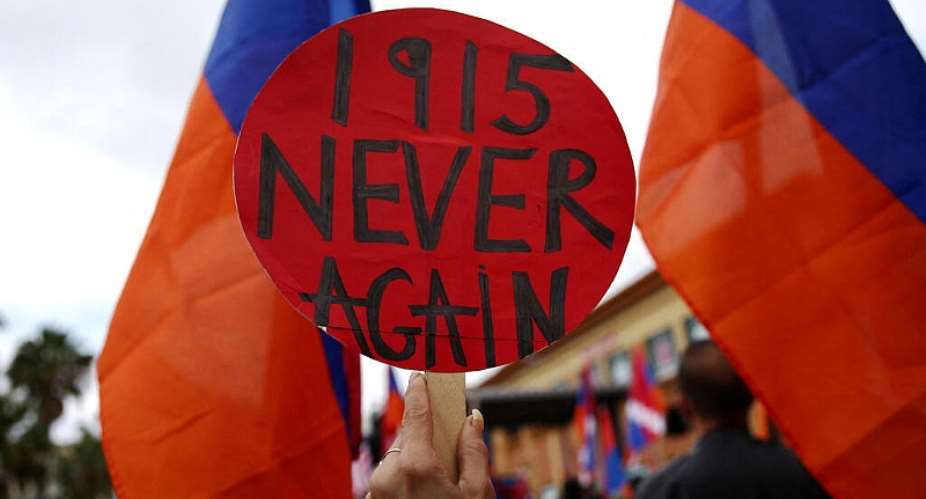
Turkey acknowledges there were mass deaths but rejects the term "genocide", and has lobbied for a century against its recognition as such.
Around 35 countries, France among them, have formally recognised the Armenian Genocide. Israel appeared poised to join them this year, until fierce protests from Azerbaijan – Turkey's closest ally and a major supplier of Israeli oil – led the Israeli parliament to postpone the vote indefinitely.
Stephan Pechdimaldji, an Armenian-American activist, is the descendant of survivors of the genocide.
RFI: Stephan, your grandfather survived the Armenian Genocide, can you tell us his story?
Stephan Pechdimaldji: My grandfather was born in 1900 in Yozgat, in modern-day Turkey, so he was 15 when the genocide started. His father and brother were taken by Turkish soldiers and were never seen again.
His mother had to hide him, because that's what they would do – they would go to your home and take away the men.
He escaped, fled Turkey, ended up in Aleppo in Syria, and finally settled in Egypt. My grandmother was from Smyrna, now Izmir. She also fled the persecution and settled in Egypt, and that's where my grandparents were married. Armenian refugees during the 1915-1917 genocide by Turkish forces.
Could the war in Iran lay a path for peace between Armenia and Azerbaijan?
RFI: Did he talk to you about what had happened to him?
SP: He never really talked about it. He was a very quiet, introverted person. I think he just compartmentalised it.
But my mother imparted a lot of it to me, and as I became older I became an advocate for recognition. I felt it was my duty as a descendant to keep his memory alive, so that it doesn't get lost to the dust bin of history.
No one else is going to talk about it, it's just going to disappear.
RFI: Are there any lesson from him that have stayed with you?
SP: My grandfather said never to hate the Turks. That's pretty strong of him to say. I have no issue with Turkish people – it's the government I have my issues with.
In a lot of ways I feel bad for many Turks, because they don't know what they don't know. They were never taught the correct history. That stayed with me. It keeps me grounded – this is an educational endeavour. The Armenian Genocide monument in the Armenian capital, Yerevan.
RFI: What did you think when Israel's foreign minister announced that Israel would recognise the genocide?
SP: I rolled my eyes, quite frankly. We've seen this before from Israel – they've threatened to recognise the genocide any time there's been tension with Turkey. There was a motive there, and it has more to do with Gaza and tensions between Netanyahu and Erdogan.
I just saw them using it as another lever to score a political point against Turkey.
RFI: The Israeli parliament then suspended the vote indefinitely...
SP: You soon saw Azerbaijan put pressure on Israel to revoke it. And that, I think, is why the parliament suspended the vote.
Azerbaijan's most important ally is Turkey – they often say they're one nation, two states. Israel gets close to 50 per cent of its oil from Azerbaijan, and with Israel at war with Iran, Azerbaijan sits strategically on Iran's border.
And Azerbaijan has launched a campaign to rewrite history. Aliyev, their autocratic leader, has often said that Armenia is "western Azerbaijan". In Karabakh they are destroying Armenian churches, monuments and artefacts to wipe out our existence in the region.
They don't want people to recognise the genocide, because it distorts the history they want to write.
Israel's move to recognise Armenian genocide stalls under regional pressure Armenia and the surrounding region.
RFI: What would genuine recognition look like?
SP: It's not a press release, it's not a statement – it's actions. If Turkey and Azerbaijan can't acknowledge the Armenian Genocide, how can we expect them to honestly confront their actions towards Armenians today?
When [former United States president] Joe Biden recognised the genocide, that was great. But he soon followed that by allowing Azerbaijan to ethnically cleanse 120,000 Armenians from the region, and did absolutely nothing to stop them. Words mean nothing without actions.
RFI: Only 35 countries recognise the Armenian Genocide, most of them since the turn of the millennium. Why has this taken so long?
SP: Because of Turkey. Turkey has [been working diligently for a long time at] pressuring countries not to do it. During the Cold War they used their position in NATO to their advantage, threatening to close military bases and what have you.
After 9/11, Turkey started to flex its muscles again, and you saw countries acquiesce to their wishes. It's geopolitics, unfortunately. France, I would say, has taken more of a moral leadership role in this.
France positions itself at the heart of Armenia's pivot to Europe
RFI: Is the memory of the genocide still important for younger generations of the Armenian diaspora?
SP: The genocide, sadly, really defines us as a people. Every 24 April, when we commemorate it, you'll see a lot of youth at the rallies – in the Bay Area [around San Francisco], at Times Square [in New York], in Washington DC.
Every Armenian takes up this cause, because they've been touched by it. In a lot of ways we're in the United States because of the genocide – I'm here because of it. History is sadly repeating itself.
RFI: What would you want people outside the Armenian community to understand about the genocide?
SP: That my grandfather was telling the truth. This is historical fact, and if we can't learn from that history, as the old saying goes, we're doomed to repeat it. We're seeing two genocides happen right now in real time, in Gaza and in Sudan. We always invoke the term "never again", but it's meaningless if you can't take up other people's causes.
It's [incredible] to me that a country founded in the wake of a genocide continues to deny one. I just wish people could learn from my grandfather's story.


 COKA floors Kokofu to win NPP Ashanti Regional chairmanship
 'God will deal with all those pushing for Mahama's third term; they want to dest...
 NPP regional elections: 'It's a family affair, no violence' – Afenyo-Markin tell...
 COKA joins NPP women to fry eggs at Ashanti regional election centre
 I accept responsibility for NPP’s poor performance in Greater Accra Region – Out...
 NPP Upper West regional elections disrupted as Nandom delegates interrupt voting
 'Our election 2028 victory largely depends on candidates you are about to pick t...
 NPP regional executive elections underway nationwide
 NPP Accra Chairman Election: ‘I'll be a servant, not a boss' — Okoe Boye rejects...
 NPP Northern Regional elections: ‘No one can bribe or influence us’ – Election C...

