




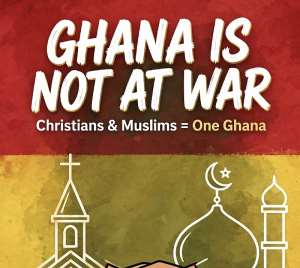
Ghana has long been celebrated for peaceful coexistence between Christians and Muslims. Families, communities, workplaces and institutions routinely bring together people of different faiths. That tradition of religious tolerance is one of the country’s greatest social assets.
But recent events should not be dismissed.
The Ghana Police Service has arrested two religious figures in separate cases involving controversial statements about Islam and Prophet Mohammed. Apostle Daniel Junior Yaw Adjei, also known as Apostle Daniel JY Adjei, was arrested over a video in which he allegedly made derogatory and offensive comments about Prophet Mohammed. Separately, 35-year-old Imam Masud Abdullah was arrested over a video in which he allegedly advocated violence against people who speak ill of the Prophet. Police say the Imam’s comments were made during a sermon at a mosque in Ntensere in the Atwima Nwabiagya North District of the Ashanti Region.
These are serious developments.
But they should not be mischaracterised as evidence that Christians and Muslims are at war.
Ghana is not at war. Ghanaian Christians and Muslims are not at war.
What Ghana is witnessing now is something different and potentially just as important: the emergence of inflammatory religious speech capable of provoking confrontation in an otherwise largely peaceful religious environment.
There is a crucial distinction between holding a religious belief, criticising another religion and inciting people to harm others.
Freedom of religion and freedom of expression are fundamental. But neither freedom should be interpreted as a licence to encourage violence.
The Police have made precisely that point, warning religious leaders, preachers, community leaders and social-media commentators that freedom of religion and expression cannot be used as justification for inciting violence or encouraging people to harm others.
That principle must apply equally.
If a Christian preacher makes offensive remarks about Islam, the response must be based on the law and due process—not mob action, intimidation or retaliation.
If an Islamic cleric allegedly calls for violence against people who insult Prophet Mohammed, the response must likewise be based on the law—not attacks against Muslims, mosques or Islamic communities.
One inflammatory statement cannot be answered with another.
One arrest cannot become an excuse for collective punishment.
And one religious extremist, whether Christian or Muslim, must never be allowed to define an entire faith community.
This is where Ghana’s religious leadership has an enormous responsibility.
Christian leaders like the Christian Council of Ghana must be prepared to condemn Christian voices that cross the line from theological disagreement into deliberate religious provocation.
Muslim leaders like what the spokesperson of National Chief Imam, Sheikh Aremeyaw Shaibu did, must equally condemn Muslim voices that encourage violence against those who offend or criticise Islam.
Silence in either circumstance can be dangerous. National Peace Council, Ghana must be seen or heard in circumstances like this.
The most disturbing feature of the present controversy is not simply that two men have been arrested. It is that religious rhetoric is increasingly being amplified by social media, where a provocative sermon or video can reach thousands of people within hours.
A statement made in a room can remain in that room.
A statement uploaded to the internet can travel across the country before the speaker has even considered its consequences.
That makes responsibility even more important.
The State must also exercise restraint. Arrest is not conviction. Allegations are not proof. Both suspects are entitled to due process, including the presumption of innocence and a fair determination of their cases. Police investigations must therefore be conducted professionally, impartially and without religious or political bias.
The objective cannot simply be to punish offensive speech after damage has been done.
The objective must be to prevent religious incitement from becoming a catalyst for violence.
Ghana should therefore resist the temptation to frame this moment as Christians versus Muslims.
That framing is itself dangerous.
The real contest is between peaceful coexistence and religious extremism; between responsible expression and incitement; between the rule of law and mob justice.
Christians and Muslims have lived together in Ghana for generations. They worship differently, observe different religious traditions and hold different theological convictions. None of that makes them enemies.
A Christian does not need to accept Islam to respect a Muslim.
A Muslim does not need to accept Christianity to respect a Christian.
And neither should require the other to surrender the freedom to live according to his or her faith.
Ghana must protect that space.
The arrests of Apostle Daniel Adjei and Imam Masud Abdullah should therefore serve as a warning—not as the beginning of a religious confrontation.
No Ghanaian should be attacked because of his faith. No religious community should be collectively blamed for the words of an individual. And no preacher, pastor, imam or social-media commentator should mistake religious passion for permission to incite violence.
Ghana is not at war.
But peace should never be taken for granted.
The time to defend religious tolerance is before the first stone is thrown—not after the first building burns.
Who fights for God? —A Christian or A Muslim? —Don’t be stupid. Stupidity is defined as knowing the truth, seeing the truth, but still believing the lies.
#GodOrMan #ManOrGod #HumanityFirst #KW
Michael Agbesi Kelly


 Unpaid nurses and midwives thank Health Minister as salary arrears are resolved
 South Africa excludes Ghana, seeks $18million repatriation costs from other Afri...
 Ghana won’t reimburse South Africa for evacuation of Ghanaians – Foreign Affairs...
 TDC, Tema Assembly clash over demolition of development project at Community 1
 Interior Ministry condemns assault of suspect Apostle Daniel in police custody, ...
 Police arrest man captured assaulting handcuffed suspect in viral video
 President Mahama begins two-day working tour of Upper East Region
 11 killed, 13 injured in multiple-vehicle crash on Ofankor-Pokuase stretch
 Sedina Tamakloe-Attionu released after state withdraws stay application
 Bunkpurugu Police suspend funeral musketry over security concerns

