




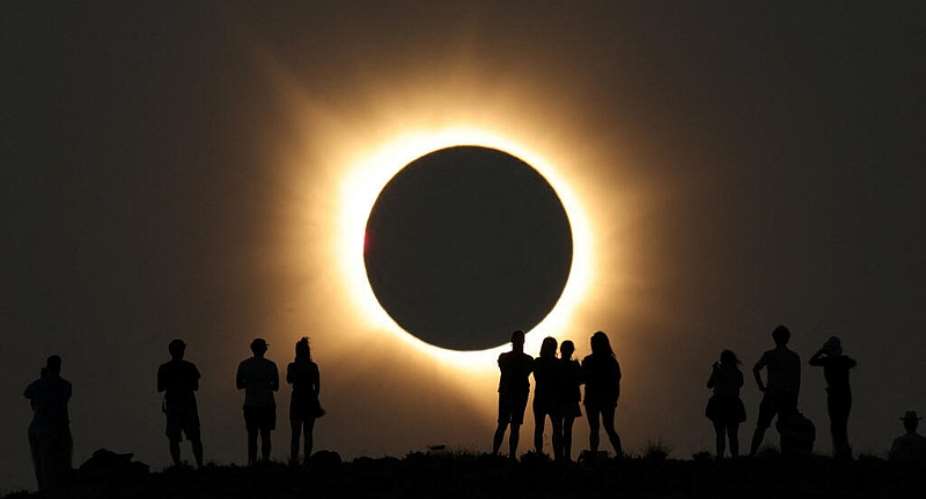
As impressive as it was fleeting -- barely two minutes at most -- the extremely rare astronomical event delighted Spaniards and tourists alike across a band of territory stretching from Galicia to the Mediterranean coast and the Balearic Islands.
As the light slowly faded in Tarragona, on the Mediterranean coast, a crowd looked on in almost reverent silence as the orange, late-afternoon glow gave way to almost complete darkness. People watch a partial solar eclipse through protective glasses from the Dune of Pilat in La Teste-de-Buch near Arcachon, France, August 12, 2026.
"It's crazy!" uttered a woman as the crowd beside her suddenly burst into enthusiastic applause.
Many had travelled from across Catalonia to witness the spectacle, swept up in the fervour that gripped Spain in recent days with the approach of the eclipse, the first of its kind in the country in over a century.
"Very exciting," said Laura Alarcon, 53, an accountant from Tarragona.
"I wasn't expecting that. I thought it wasn't going to be as good. But the atmosphere, the situation, the way they prepared everything. I loved it!" she said. "And the glasses work too!" The moon partially covers the sun as it sets, following a total solar eclipse, as seen from Arija, Spain, August 12, 2026.
Nearby, Alejandro Cuesta, a 30-year-old nanoscience researcher who had travelled from Barcelona with his mother, struggled to contain his emotions.
"I almost started crying. A shiver ran through my whole body. It was beautiful," he said.
About 500 kilometres to the west, the town of Lodoso was likewise swept up in the collective excitement.
Cheers rang out as hundreds of people gathered in a heat-scorched field looked skyward as darkness fell.
But as the Moon completely covered the Sun, the cheers gave way to a spellbound silence as spectators fixed their eyes on the solar corona.
Total solar eclipse over Spain to draw millions of viewers across Europe
"I got goosebumps. I wasn't expecting that light," said Marta Miguel Tobrar, a 48-year-old illustrator visiting with her family from nearby Burgos.
Some had waited all afternoon in sweltering heat beneath the scant shade of umbrellas, while others, the best prepared, had set up their telescopes.
On site, instructions were posted in several languages -- French, Korean, Polish, German, English -- to help the crowd get organised. People from Cologne, Germany, test their protective glasses ahead of a solar eclipse, at El Arenal beach in Mallorca, Spain, August 12, 2026.
At the start of the partial eclipse, when the Moon began to cover the Sun at around 17:30 GMT, some people shouted "Wow!" eager to see what would unfold.
A group of South Korean tourists burst into enthusiastic applause.
It was a moving atmosphere, immortalised by the countless phones raised to capture photos and videos of that precise instant.


 Ghanaians give Mahama 72% approval; 60% say country heading right direction
 Zambia votes with president's economic record on the line
 Colombia earthquake rescue efforts enter 'final phase' as death toll rises
 White House press secretary and Trump adviser Karoline Leavitt to leave role
 Gideon Boako warns NPP members against dragging Bawumia into regional elections
 Iran faces growing isolation and uncertain future amid 'dire' economic situation
 Broken high-tension poles plunge parts of Accra West into darkness
 Ghana has talent to build globally competitive FinTechs – Sam George
 Speaker Bagbin recalls Parliament for consideration of urgent parliamentary busi...
 International Youth Day: NDC will continue to prioritise investment in Ghanaian ...

