




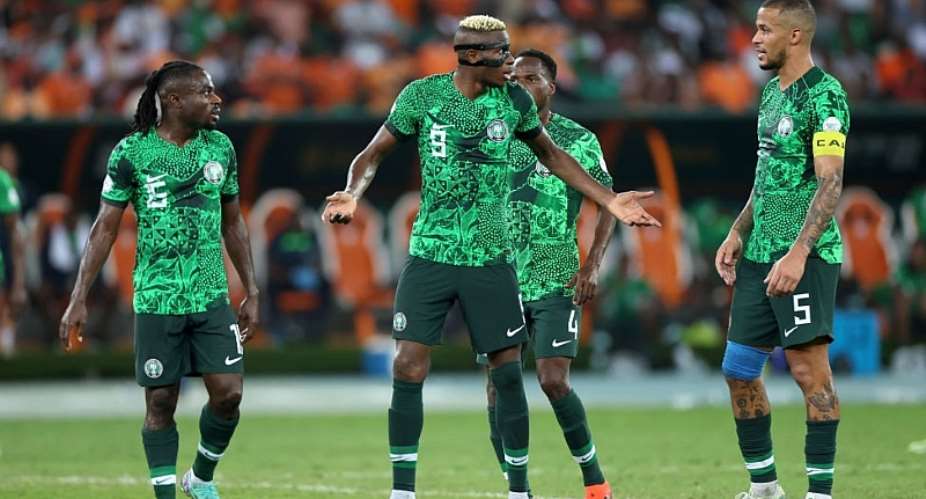
There was a time when Nigerian football commanded respect across Africa and beyond. The green and white colours of the country were worn with pride, while the Super Eagles and Super Falcons carried the hopes of millions of Nigerians into stadiums across the world. Our age-grade teams were equally formidable, producing generations of talented footballers who went on to conquer some of the biggest leagues in the world. Today, that glorious footballing heritage appears to be losing its lustre.
The warning signs have become too numerous to ignore. The Super Eagles have failed to qualify for two consecutive FIFA World Cups, while the Super Falcons, the undisputed queens of African women's football, have now found themselves in a precarious battle to secure a place at the next global showpiece. Our age-grade teams, which once dominated international youth competitions, have also struggled to maintain the consistency that made Nigeria a feared name in world football.
This is no longer a matter of one bad result or one unfortunate generation of players. It is a symptom of a deeper institutional problem. The painful defeat of the Super Falcons to Cameroon at the ongoing Women's Africa Cup of Nations should therefore be viewed against this wider background. The Falcons may still have a route to the 2027 Women's World Cup, but losing the automatic qualification pathway is a significant warning. For a country that has established itself as the most successful force in African women's football, such uncertainty should be deeply troubling.
What has happened to Nigerian football? The answer cannot simply be that our players are no longer good enough. That would be an easy but fundamentally misleading conclusion. Nigeria continues to produce footballers of remarkable quality. Nigerian players remain highly sought after by clubs in Europe and elsewhere. If individual talent were the only requirement for football success, Nigeria would probably still be one of the world's great football powers.
The problem appears to lie somewhere between talent identification, development, coaching, administration and long-term planning. At the heart of this conversation is the Nigeria Football Federation. For years, the NFF has faced criticisms and allegations concerning the manner in which football is administered in the country. Questions about financial accountability, coaching appointments, preparation of national teams and the management of football development have repeatedly surfaced.
Former Super Falcons coach Randy Waldrum was particularly outspoken over the management of funds connected with the team's preparation for the 2023 Women's World Cup. His allegations, like similar concerns raised by stakeholders over the years, should not simply be dismissed as the grievances of a disgruntled coach. They raise a larger question about transparency and accountability in the administration of Nigerian football.
The issue is not whether every allegation made against the NFF is necessarily true. The more important question is whether an institution entrusted with managing one of Nigeria's most valuable national assets inspires sufficient confidence among players, coaches, stakeholders and the millions of Nigerians who invest their emotions in the national teams.
Football administration should not be an arena for politics, patronage or personal ambition. It should be a professional enterprise driven by competence, accountability and results. Unfortunately, Nigeria appears to have lost something that once distinguished its football system: a coherent developmental structure. Our age-grade teams were once the laboratories of Nigerian football. The Golden Eaglets and Flying Eagles consistently competed for continental and global honours. They provided a conveyor belt through which young talents were identified, nurtured and gradually introduced into the senior national teams.
That conveyor belt appears to have weakened. When youth teams struggle, senior teams eventually pay the price. When scouting systems are inadequate, talented youngsters disappear. When coaching structures are inconsistent, players fail to develop within a coherent football philosophy. When administrators prioritise short-term considerations over long-term planning, the entire system begins to decay. This is why the current crisis should concern President Bola Ahmed Tinubu and the National Sports Commission.
Football is not merely a game in Nigeria. It is part of our national identity. It has the extraordinary capacity to unite Nigerians across ethnic, religious, geographical and political boundaries. On a football night, the Nigerian flag can become more powerful than the political differences that ordinarily divide us. Football is also an economic opportunity. A properly structured football industry can create employment, develop young people, attract investment, improve sports infrastructure and provide Nigeria with enormous international visibility.
The Federal Government must therefore resist the temptation to intervene only when a national team is facing an immediate crisis. What Nigerian football requires is a fundamental restructuring of its administrative and developmental architecture. President Tinubu should, through the National Sports Commission, demand a comprehensive assessment of the country's football system. Competence must take precedence over connections. Square pegs must be put in square holes. Those entrusted with national football responsibilities must possess the technical knowledge, administrative capacity and integrity required to perform their duties.
Our national teams also deserve the best possible coaching. Coaching appointments must be based primarily on competence and suitability, rather than sentiment or expediency. The Super Eagles and Super Falcons need coaches capable of building teams, developing players and establishing a clear football philosophy. Above all, there must be transparency in the management of football finances. Funds allocated to national teams for football development should be properly accounted for. Nigerians deserve to know how resources entrusted to football administrators are spent.
The objective should not merely be to qualify for the next World Cup. It should be to rebuild a football system capable of producing sustained excellence. Nigeria is too talented to be this inconsistent. We are too passionate about football to accept mediocrity as normal. We have produced footballers who have thrilled the world and teams that have made Nigerians proud. There is no reason the country cannot do so again.
But nostalgia will not rebuild Nigerian football. Only competent administration, visionary leadership, credible coaching, transparent financing and serious investment in grassroots development can restore the giant to its feet. Nigerian football is not dead. It is simply losing its stride. And before the giant stumbles any further, those entrusted with its care must find the courage to make it walk again.


 Judiciary must earn public trust, not demand it — Asiedu Nketiah
 Any sod-cutting ceremony at Upper East Airport site this weekend will be 419 — G...
 Mahama must investigate GoldBod over alleged US$1.7bn loss — Abena Osei-Asare
 Attorney General opposes Wontumi’s bail application pending appeal in 20-year se...
 'I will continue to sit until Chief Justice revokes warrant' - High Court judge ...
 August 11: Cedi sells at GHS12.45 on forex market, GHS11.78 on BoG interbank
 Hopeson Adorye eats humble pie, retracts claim linking Ekow Assafuah to Ghana To...
 Legal vacation does not mean lawyers can halt court proceedings – Deputy Attorne...
 Forensic audit reveals how Ghana’s Embassy in the U.S. extorted $19.3 million fr...
 EVIDENCE: How Ghana’s Washington Embassy staff shared money extorted from visa a...

