




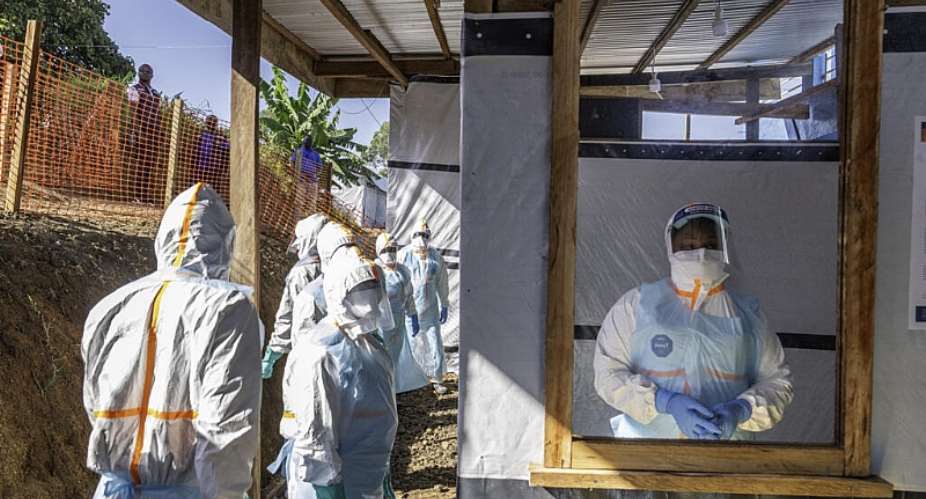
An Ebola outbreak in the Democratic Republic of Congo (DRC) has killed 2,011 people out of 4,381 confirmed cases of the virus, Congolese officials said on Tuesday.
The latest toll puts it close behind the DR Congo's deadliest Ebola outbreak in 2018 to 2020 when nearly 2,300 people died out of 3,500 recorded cases.
The Ebola outbreak, which has hit the DR Congo's conflict-plagued eastern and northeastern regions, was declared on May 15 but is thought to have already been spreading for several weeks.
While it took about nine weeks for the outbreak to record the first 1,000 deaths, it's taken just around three weeks for the figure to double, an evidence that the health crisis is moving faster than efforts to track and manage it.
It is the DR Congo's 17th surge of the highly contagious disease and is already considered the largest in the country's history "and could well become the largest outbreak ever", Sania Nishtar, chief executive of the Gavi global vaccine alliance, has said.
Read more DR Congo's Ebola outbreak outpaces response as health workers strike over pay
Aid workers say the outbreak continues to outpace response that's been expanding across the five eastern provinces affected. Many health workers have gone on strike to protest lack of payment for their work since the outbreak was declared. And the World Health Organization (WHO) has said most new cases are still being recorded outside of contacts being monitored, showing that transmission remains out of the control of health workers.
The case fatality rate of the current outbreak is estimated by Congolese health authorities to be 45.9 percent.
On Friday, WHO vaccine experts recommended a full-scale human trial of the only existing approved Ebola vaccine to see if it offered cross-protection against the strain of Ebola currently spreading in the DRC against which no specific vaccine currently exists.
The Ervebo vaccine has proved safe and efficient against the more common Zaire strain of Ebola virus and WHO experts said that early data, notably from animal trials, showed it may also give some protection against the rare Bundibugyo strain exploding in the DRC.
Two potential Bundibugyo vaccines are in the early stages of clinical trials on humans, while a third is being worked on to bring it to that stage.
“In the absence of an effective vaccine, control (for the outbreak) rests on identifying cases and then nursing them in secure facilities until they recover or sadly perish,” said Paul Hunter, a professor in medicine at the University of East Anglia in the UK.
In a remote region like this with an ongoing conflict and interrupted communications, routine surveillance can be very difficult and “identifying cases early enough to prevent spread can be impossible", said Hunter.
Ebola is spread by contact with bodily fluids and causes a haemorrhagic fever.
(FRANCE 24 with AFP and AP)


 Judiciary must earn public trust, not demand it — Asiedu Nketiah
 Any sod-cutting ceremony at Upper East Airport site this weekend will be 419 — G...
 Mahama must investigate GoldBod over alleged US$1.7bn loss — Abena Osei-Asare
 Attorney General opposes Wontumi’s bail application pending appeal in 20-year se...
 'I will continue to sit until Chief Justice revokes warrant' - High Court judge ...
 August 11: Cedi sells at GHS12.45 on forex market, GHS11.78 on BoG interbank
 Hopeson Adorye eats humble pie, retracts claim linking Ekow Assafuah to Ghana To...
 Legal vacation does not mean lawyers can halt court proceedings – Deputy Attorne...
 Forensic audit reveals how Ghana’s Embassy in the U.S. extorted $19.3 million fr...
 EVIDENCE: How Ghana’s Washington Embassy staff shared money extorted from visa a...

