




Lighthouse Reports obtained a previously undisclosed internal memo from the International Atomic Energy Agency in 2024 and began investigating its contents.
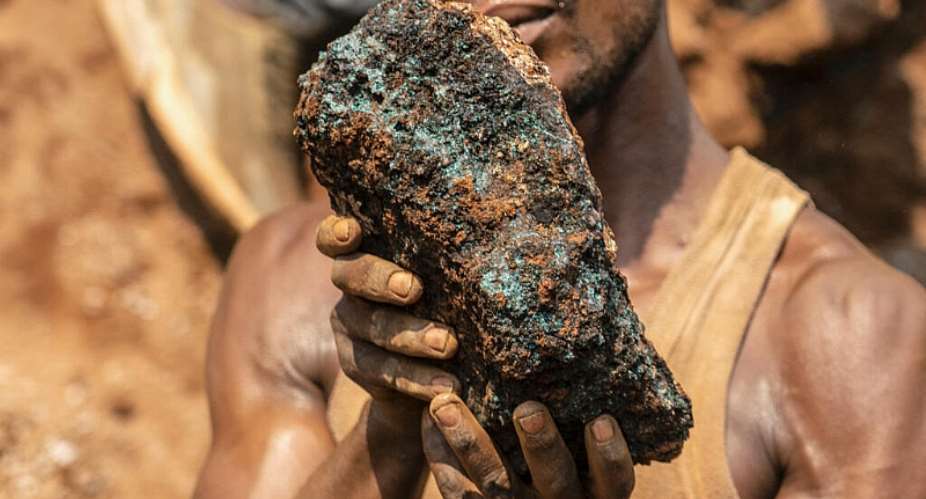
The 2009 document cited credible information indicating that uranium was present in “significant quantities” in most cobalt ores from Katanga, in the southeast of the Democratic Republic of Congo, and was “effectively exported as a cobalt by-product”.
Lighthouse Reports conducted the investigation in partnership with The Financial Times and Le Monde. Infrastructure at the Shinkolobwe uranium mine, near the city of Likasi in the Democratic Republic of the Congo.
Uranium in mineral-rich Katanga
The Katanga region – part of Central Africa's Copperbelt – has increasingly turned towards cobalt extraction as demand has grown for the metal, which is used in lithium-ion batteries and aerospace alloys.
But the region's mines have also long been known to contain uranium. A significant proportion of the uranium used in the Manhattan Project, which developed the first atomic bombs, came from Katanga's Shinkolobwe mine.
The mine was closed after independence and later placed within an exclusion zone. In 2004, then president Joseph Kabila declared the area a prohibited mining zone, citing national security, public safety and the presence of uranium, which Congolese law classifies as a reserved mineral substance.
“There are always by-products in Congolese mining exports – particularly cobalt – and these by-products are effectively monitored by the Congolese authorities. All except one: uranium,” Tomas Statius, a Lighthouse Reports journalist and co-author of the investigation, told RFI.
Unchecked mining waste taints DR Congo communities
Mining professionals say uranium, copper and cobalt frequently occur together in the Congolese and Zambian Copperbelt.
“It is not limited to specific locations; it is a constant feature,” Statius said.
Steve Muanza, head of the DRC's nuclear energy agency, told The Financial Times that it was “technically possible” and even “probable” that Chinese companies were extracting uranium from cobalt ore exported from the country, although he said there was no direct evidence.
He said his agency had requested funding to install radioactivity detectors on trucks travelling from the DRC into Zambia.
Up to 5,000 tonnes exported
To estimate the amount of uranium potentially exported, Lighthouse Reports worked with Sébastien Philippe, then a senior researcher at Princeton University, and geologist Ryan Manzuk.
Their calculations drew on previous analyses of uranium concentrations in Katanga ores, mine production data and geological samples held by the AfricaMuseum in Belgium.
A paper by Manzuk and Philippe, published on 30 July in Nature Communications, estimated that between 2,000 and 5,000 tonnes of uranium were exported from the DRC to China in cobalt hydroxide shipments between 2000 and 2024.
According to the researchers, even the lower estimate would be sufficient to fuel a one-gigawatt nuclear reactor for at least a decade.
The investigation did not establish whether the uranium was subsequently extracted or used in China.
DRC takes on Apple: can conflict mineral mining be stopped?
The most extensively documented site was Tenke Fungurume Mining (TFM), one of the DRC's largest cobalt producers.
The mine was owned by US company Freeport-McMoRan until it was acquired by Chinese group CMOC in 2016.
Internal company documents reviewed by the investigators recorded uranium-rich cobalt samples, including a peak concentration of 1,100 parts per million in December 2016 – around 15 times the export limit cited by the investigation.
Further documents indicated that significant uranium concentrations remained in cobalt produced at TFM in June 2021.
“There is an established, known method for removing uranium from cobalt exports,” Statius said, adding that it had not been used.
“We have been unable to determine whether CMOC intends to retain the uranium for economic or strategic reasons,” he added.
Doug Alexander, a former senior metallurgist at Eurasian Resources Group, suggested there could be two supply chains in the region – one in which contamination is addressed once detected, and another in which lower-quality products containing greater levels of impurities are shipped directly to China. The mining site of Kamoa Kakula, in the 'Katanga Copperbelt', Lualaba Province, is one of the largest unexploited copper field in the world.
CMOC rejects findings
CMOC has categorically disputed the investigation. The company said all cobalt hydroxide currently produced by TFM complied with Congolese regulations and international customer standards, with no recorded breaches of permitted limits or trade rules.
It said it did not know the source of the investigation's historical data and maintained that uranium levels were below the relevant threshold, making a dedicated removal process unnecessary.
CMOC denied carrying out uranium separation or extraction in either the DRC or China. It also challenged the use of 75 parts per million as a universal limit, citing alternative thresholds of up to 100 parts per million.
Freeport-McMoRan did not respond to requests for comment, while the investigators said they stood by their findings.
“Our investigation is based on internal documents from the mine and its owners, spanning nearly a decade, that reveal both the contamination and attempts by certain metallurgical engineers to address the issue,” Statius said.
“It also draws on a peer-reviewed scientific paper published in one of the world's top journals.”
The investigation also found that a refinery in Kokkola, Finland, had received Congolese material containing uranium.
This has been adapted from the original article in French by RFI's Patient Ligodi


 Vacate by October 4 or face demolition – KMA warns Abrepo Junction occupants
 Star Oil and GOIL assure no fuel price increase for new window
 Diesel will not hit GH¢22 at pumps – NPA CEO assures
 Ghana records 3,876 cybersecurity incidents in seven months – Communications Min...
 “We never knew life was going to be hard like this in Ghana; we can’t even get j...
 $1.17bn GoldBod gave BoG is repayment, not new money’ – Dr. Gideon Boako
 Baffour Awuah didn’t help his case if he ignored EOCO’s invitation – Appiah Danq...
 Institutions, public policy must remove barriers facing women – Vice President
 Accra: Fire breaks out at Avenor Industrial Area; two feared dead
 Carlos Queiroz leaves Black Stars role after poor AFCON qualifying start


