




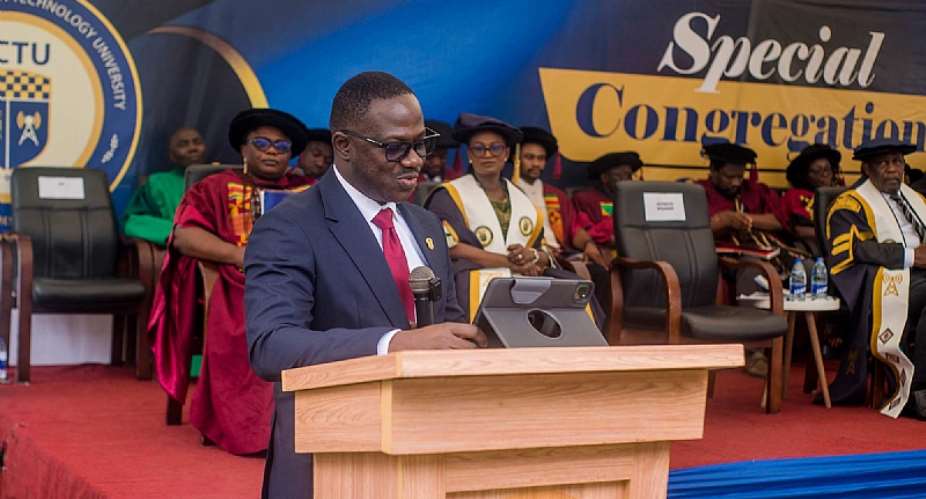
Dr. Arnold Kavaarpuo, Executive Director of the Data Protection Commission (DPC), has urged graduates of the Ghana Communication Technology University (GCTU) not to allow artificial intelligence (AI) to replace their capacity for independent thought, judgment and human accountability.
He said while AI was rapidly transforming the workplace by performing tasks previously associated with professional expertise, graduates must develop the wisdom, creativity and ethical judgment required to use the technology responsibly.
“Use artificial intelligence to extend your capacity, but never permit it to replace your obligation to think,” he said.
Dr. Kavaarpuo issued the charge when he delivered the keynote address at the University's Special Congregation in Accra on Friday. 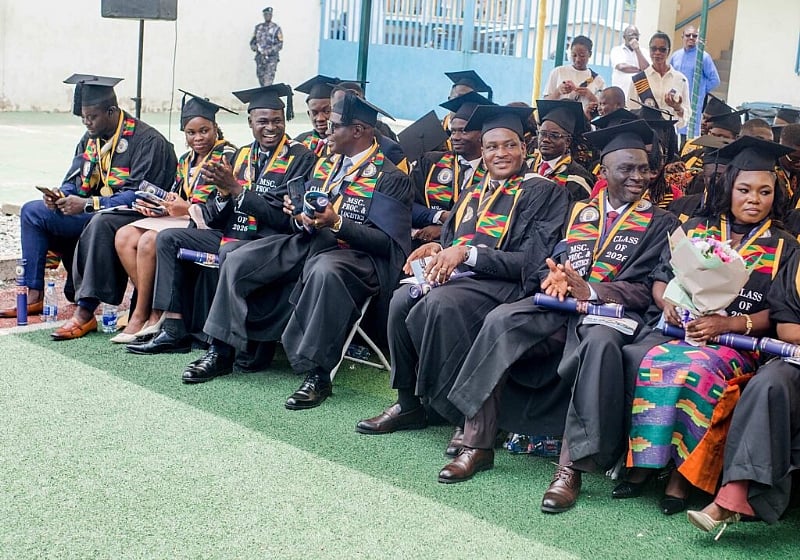
The ceremony, held on the theme, “Shaping the Future: Innovation and Technology Education to Support Ghana's Digital Economy,” brought together 300 graduands, comprising 60 Coventry University graduates, 132 GCTU master's graduates and 108 undergraduate graduates from the University's ICT, Business and Engineering faculties.
Dr. Kavaarpuo said the increasing ability of AI and agentic systems to analyse information, make decisions and execute tasks was changing the value of conventional knowledge and entry-level professional roles.
He cautioned that technological progress did not automatically translate into equitable human progress, stressing that graduates must be able to distinguish truth from plausibility, exercise judgment under uncertainty and accept responsibility for decisions.
He said the traditional boundaries between engineering, computing, information systems and business were increasingly disappearing, requiring professionals to understand how technology, enterprise and ethics intersected.
According to him, the greatest danger was not necessarily that AI would become human, but that humans could become mechanical by accepting automated outputs without reflection and transferring responsibility to systems that could not be held morally accountable.
The DPC boss also challenged Ghana to move beyond digital consumption towards genuine digital transformation by developing local technological capabilities and ensuring that the country captured greater value from its data, intellectual property and digital economy.
He said Ghana risked becoming “digitally active without becoming digitally powerful” if it continued to supply users and data while foreign entities controlled infrastructure, platforms, intellectual property and capital.
Dr. Kavaarpuo urged GCTU to become an institution that not only prepared students to operate imported technologies but also produced researchers, entrepreneurs and innovators capable of developing solutions rooted in Ghanaian realities.
On data protection, he said privacy should be regarded as a foundation of human freedom rather than an obstacle to innovation.
He said technological capability without trust and legitimacy would remain fragile, adding that organisations that earned public trust would gain a significant advantage in the emerging digital economy.
Dr. Kavaarpuo urged the graduates to continually update their skills, warning that while some knowledge and tools would become obsolete, their capacity to learn, adapt and exercise sound judgment must remain.
“Intelligence is becoming abundant. Technology is becoming accessible. But courage, judgment, originality, responsibility and trust remain scarce,” he said. 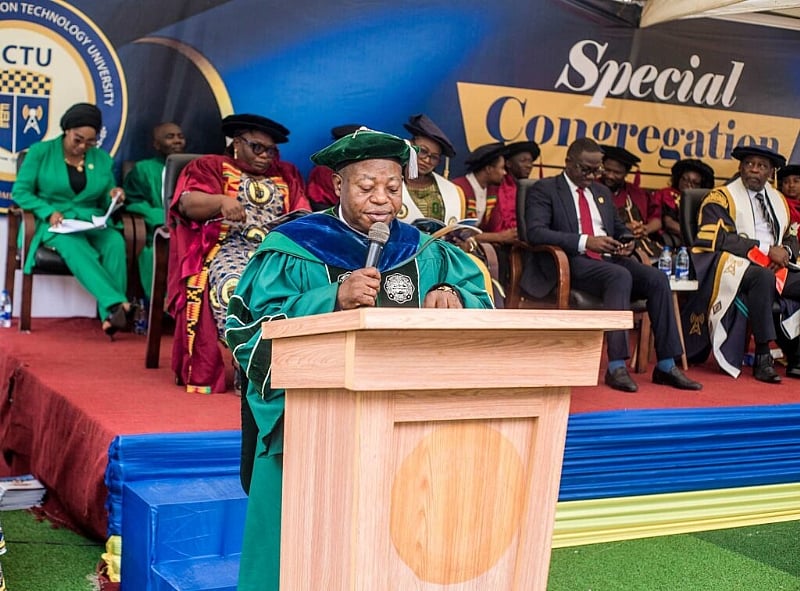
Professor Ebenezer Malcalm, Acting Vice-Chancellor of GCTU, said the University was strengthening its position as a technology-focused institution through industry partnerships, international collaborations and investments in modern academic infrastructure.
He said the University had introduced programmes at the PhD, master's, bachelor's and diploma levels to respond to the changing demands of the digital economy, while collaborations with institutions in Canada, China and Mali were expanding opportunities for research, academic exchange and technological innovation.
Prof. Malcalm said GCTU had completed an eight-storey lecture halls and offices complex, providing modern lecture halls, an auditorium, computer laboratory and office spaces.
He said plans were also advancing for hostel accommodation, including three eight-storey blocks expected to accommodate more than 6,000 students, to address the University's accommodation challenges.
He urged the graduates to use their knowledge to solve real societal problems, create opportunities and contribute meaningfully to the country's digital transformation.
Prof. Malcalm said the University's vision extended beyond producing graduates, stressing that technology education should serve as a catalyst for inclusive growth, economic transformation and national development.
He encouraged the graduates to uphold excellence, innovation, professionalism and integrity, and to become worthy ambassadors of the University as they entered the world of work and entrepreneurship.
GNA

 NDC not worried about NPP’s Kojo Bamba, he is small boy – Azorka
 Obuasi SHTS: 'Children are not buffet' – NPP’s Fatimatu confronts Zuba
 'I didn’t know I was supposed to chop and not work' – Blakofe on her time at GTD...
 Resource exploitation fuelling Africa’s conflicts – Mahama
 Our ports' growth always depended on collaboration across maritime, logistics va...
 Stranded Ghanaian fishermen narrate how they ate fresh fish, drunk sea water to ...
 How notorious armed robber died on the way whiles leading police to arrest accom...
 'We must continuously improve cargo handling, coordination among port operators'...
 Nii Lante Vanderpuye confident of winning NDC national chairmanship despite Gold...
 Agalga dismisses critics, assures Builsa North of progress on Sandema–Wiaga Road


