




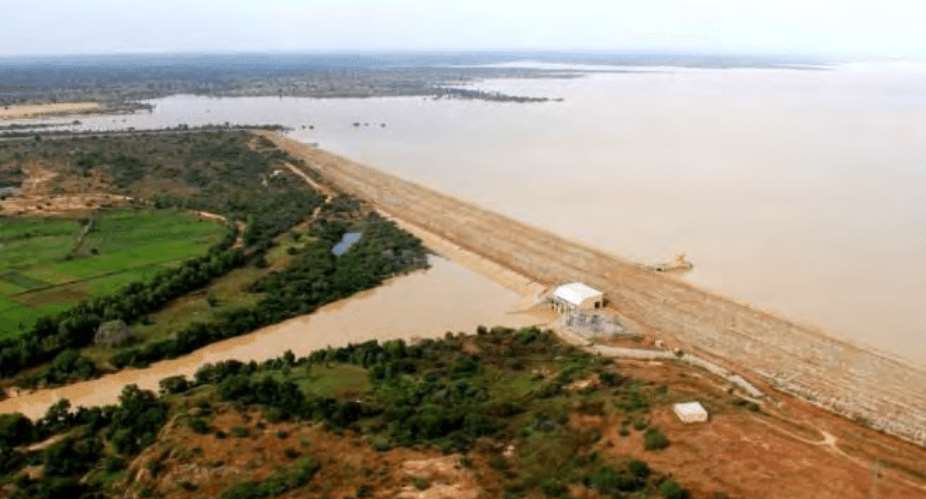
Farmers cultivating land along the White Volta River at Pwalugu in the Talensi District of the Upper East Region have begun harvesting their crops and relocating to safer areas ahead of the annual spillage of Burkina Faso's Bagre Dam.
The precautionary move follows a notification from Burkina Faso's state-owned power company, SONABEL, which on August 4, 2026, informed Ghana's Water Resources Commission that the Bagre Dam was less than two metres from its spill level. According to SONABEL, the controlled release of excess water is scheduled to begin on Tuesday, August 11, 2026.
For more than four decades, authorities in Burkina Faso have carried out annual spillages from the Bagre Dam to protect the reservoir from overflowing and to prevent uncontrolled flooding. However, the exercise has consistently had devastating consequences for downstream communities in Ghana.
The annual release of water significantly raises water levels in the White and Black Volta rivers, triggering floods that destroy farmlands, homes, livestock and public infrastructure, particularly in the Talensi and Bawku West districts.
Among the worst affected communities is Pwalugu, where thousands of farmers depend on the fertile banks of the White Volta for crop production and food security. Almost every year, many of them lose substantial portions of their farms when floodwaters inundate the area.
Determined to minimise this year's losses, many farmers have begun harvesting crops that have reached maturity while relocating equipment and other valuables to higher ground before the floodwaters arrive.
Chairman of the Pwalugu Farmers Association, Adawuni Aborah, who has farmed along the river since 1981, described the annual flooding as a major challenge to agricultural production and appealed to the government to provide high-capacity irrigation pumps to help farmers reduce their dependence on the river during the flooding period.
He explained that despite the recurring floods, farmers cannot afford to abandon the riverbanks because of the area's highly fertile soils, which produce high yields while reducing the need for fertilisers and other agrochemicals.
The Talensi District Coordinator of the National Disaster Management Organisation (NADMO), Bismarck Farouk, said the agency had already begun extensive public education and sensitisation campaigns in flood-prone communities even before receiving SONABEL's official notification.
“Even before the letter from SONABEL on the spillage, we (NADMO) already rolled out sensitization and advocacy on different types of disaster including flooding from the heavy rains and possible spillage of the Bagre Dam in flood-prone communities in Talensi. So the advocacy is still ongoing and as you (the reporter) are here at the farms to talk to the farmers to move to higher grounds for safety,” Mr Farouk stated.
Several farmers expressed concern that the impending spillage could wipe out months of hard work, noting that nearly 90 per cent of their crops are yet to mature and cannot be harvested.
They appealed to the government and other stakeholders for support to help them recover losses likely to result from the annual flooding.
Meanwhile, many more farmers are expected to visit their farms in the coming days in a last-minute effort to salvage whatever crops they can before the Bagre Dam water reaches the White Volta River.


 August 7: Cedi sells at GHS12.40 on forex market, GHS11.76 on BoG interbank
 'Democracy Under Attack' protests: No developed country jails citizens for what ...
 NUGS proposes social media ban for children under 15 to tackle indiscipline
 EPA Deputy CEO proposes naming Ghana's Plastics Law after late Minister Murtala ...
 Korle Bu struggling to cope with rising emergency cases — Accident and Emergency...
 Nobody is going to have time to read NPP's Democracy Under Attack demo petition ...
 President Mahama unveils Cenotaph in honour of late Defence Minister Omane Boama...
 You will lose your position if you tamper with postings — Health minister warns ...
 Farmers Along White Volta rush to harvest crops ahead of Bagre Dam spillage
 Teachers, students killed in Thai school shooting near Bangkok

