




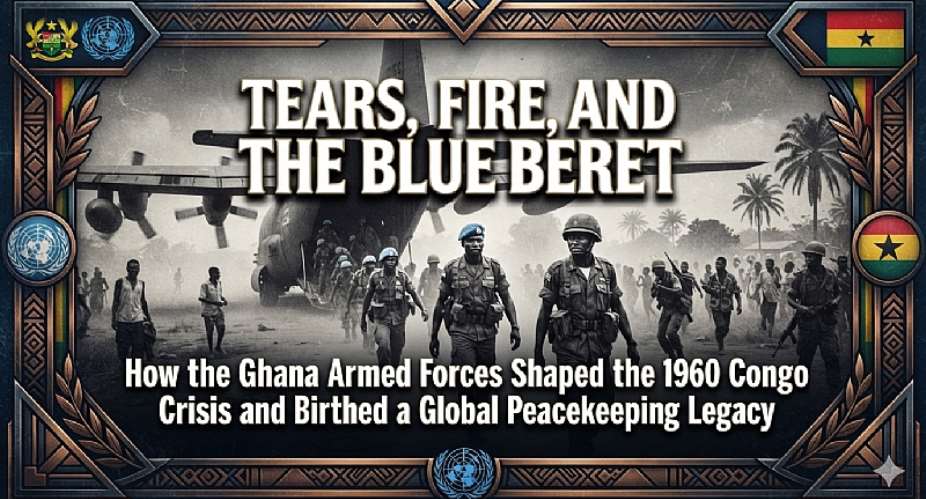
When Prime Minister Patrice Lumumba shattered colonial protocol on June 30, 1960, by exposing the raw wounds of Belgian rule, his voice electrified an entire continent. Yet, as the subsequent geopolitical firestorm threatened to swallow the newly born Republic of the Congo, it was not just rhetoric that stepped into the breach—it was the Ghana Armed Forces (GAF). Bound by the Pan-African vision of Osagyefo Dr. Kwame Nkrumah and the desperate appeals of Lumumba, Ghana deployed nearly half of its total military strength into a raging Cold War theater. This crucial intervention under the United Nations Operation in the Congo (ONUC) did more than navigate an international crisis; it forged the very blueprint of modern global peacekeeping and established Ghana as an elite, indispensable vanguard of international diplomacy.
The Architectural Bond of Pan-Africanism: Nkrumah and Lumumba’s Secret Alliance
To understand Ghana's massive military intervention, one must examine the profound, radical alliance between Dr. Kwame Nkrumah and Patrice Lumumba, which served as the ideological engine of the entire operation:
- The Mentor and Protégé Dynamic: The ideological bond was forged at the All-African Peoples’ Conference in Accra in December 1958. Nkrumah personally mentored the young, charismatic Lumumba, exposing him to Pan-African theory and providing the international platform that elevated Lumumba from a local politician to a global anti-colonial figure.
- The Secret Blueprint for Unification: In August 1960, as the Congo crisis raged, Lumumba secretly flew to Accra. There, the two leaders signed a historic, confidential agreement to establish a Ghana-Congo Union. This secret pact was designed to be the foundational nucleus of a unified, federal "United States of Africa" with a joint military high command.
- Direct Military and Administrative Lifelines: When Western powers began subverting Lumumba's government, Nkrumah bypassed standard diplomatic channels. He dispatched top Ghanaian diplomats, political advisers, and bureaucrats to Leopoldville (Kinshasa) to help Lumumba build a functioning, radical state apparatus from scratch.
- The UN Strategy and its Tragic Contradiction: Nkrumah fiercely advocated for Lumumba on the world stage, convincing the United Nations to deploy peacekeepers to protect the Congolese government. Tragically, this created a severe political strain: Ghanaian troops on the ground were bound by strict UN command orders, which ultimately prevented them from aggressively attacking the Western-backed rebels or directly breaking the siege that led to Lumumba’s ouster.
- A Shared Legacy of Sovereign Sacrifice: The downfall of Lumumba in late 1960 deeply traumatized Nkrumah, hardening his stance against neo-colonialism and driving him to write his famous treatise, Neo-Colonialism: The Last Stage of Imperialism. The tactics used by foreign intelligence services to isolate and destroy Lumumba's presidency directly foreshadowed the 1966 coup that would eventually overthrow Nkrumah himself in Ghana.
The Role of the Ghana Army in the 1960 Congo Crisis
Driven by this Pan-African alliance, the GAF's actual operational intervention on the ground was rapid, highly complicated, and heavily anchored in African solidarity:
- The First to Respond: Following a mutual agreement between Nkrumah and Lumumba, Ghana was the very first nation requested to intervene. Within 48 hours of UN authorization, Ghanaian troops were airlifted directly into Leopoldville to restore order.
- Massive Military Commitment: Demonstrating unprecedented regional leadership, Ghana mobilized approximately 2,500 personnel—amounting to roughly 50% of its entire military and police capability at the time.
- Defending the Strategic Blueprint: Operating under intense pressure, Ghanaian peacekeepers secured key national infrastructure, guarded foreign refugees, and heavily fortified communication hubs against rampaging mutineers and Belgian mercenaries.
- The Radio Station Defiance: In a highly tense moment in September 1960, Ghanaian forces successfully blocked and disarmed a rogue unit of armed Congolese soldiers attempting to seize control of the national radio station in Leopoldville.
- Shielding Patrice Lumumba: Amid an explosive constitutional deadlock and military coups, Ghanaian UN units provided a vital physical security perimeter around Lumumba's enclave, directly preventing his early capture by rival forces.
- Tragedy and Sacrifice: Operating under a heavily constrained and highly controversial UN mandate, Ghanaian troops faced extreme hostility, culminating in events like the tragic Port Francqui incident of 1961, where dozens of over-extended Ghanaian peacekeepers lost their lives.
Key Strategic Recommendations and Policy Suggestions
To preserve and build upon this historic legacy, modern stakeholders should pursue the following actions:
- Incorporate GAF History into the National Curriculum: The Ministry of Education should formalize the study of the 1960 Congo deployment in Ghanaian senior high schools to foster patriotism and civic pride.
- Declassify and Publish Peacekeeping Archives: The Ministry of Defence and the GAF Command should digitize and release 1960s operational diaries, allowing contemporary historians to counter biased Western narratives of the Congo Crisis.
- Modernize Force Multipliers for the GAF: The Government of Ghana must consistently upgrade the military's contingent-owned equipment (COE) to secure fair UN financial reimbursements and ensure troop safety in active fields.
- Champion Women in Peace Support Operations: Building on Ghana's record-breaking deployment of 24.6% female soldiers (well above the UN 9% target), the GAF should expand leadership training pipelines to position Ghanaian women in high-ranking UN strategic command roles.
- Expand Regional Anti-Terrorism Frameworks: The state must translate its classic UN experience into sharper regional containment strategies via ECOWAS and the Accra Initiative to proactively curb current West African structural insecurity.
The blood spilled by pioneering Ghanaian soldiers in the dense terrain of the Congo was not shed in vain; it served as the foundational seed for a proud, unbroken doctrine of global service. Today, Ghana stands tall as the 7th largest troop contributor to United Nations operations worldwide, celebrated globally for discipline, humanitarian neutrality, and gender-inclusive peacekeeping excellence. Remembering the 1960 Congo Crisis is not merely an exercise in historical nostalgia; it is a vital reminder of what Ghana can achieve when strategic vision combines with deep moral courage. As our brave men and women continue to wear the blue beret in volatile territories across the globe, we must celebrate their historic lineage, safeguard their institutional welfare, and carry forward the undying flame of Pan-African solidarity.
✍️ Retired Senior Citizen For and on Behalf of all Senior Citizens of the Republic of Ghana 🇬🇭 Teshie-Nungua. [email protected]


 NPP's 'Democracy Under Attack' demo a useless face-saving tactic by its failed l...
 Newly inducted doctors and dentists urged to accept postings to underserved area...
 BoG Governor urges banks to save viable companies facing temporary distress
 I can tell you Sedina Tamakloe has not been released; she’s still in custody des...
 'Even with the GH¢2 diesel reduction fuel prices still more expensive than NDC m...
 Third-term debate is NPP propaganda, Mahama has been consistent – Felix Kwakye O...
 Bawumia urges Ghana to uphold UGCC ideals of freedom without fear and persecutio...
 Mahama pays tribute to Marcus Mosiah Garvey in Jamaica
 One dead, six injured in Sagnarigu boundary clash
 Afenyo-Markin donates 100 laptops to Effutu teachers under ‘One Teacher, One Lap...

