




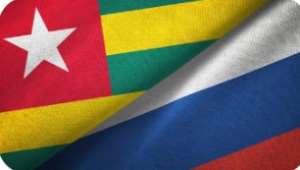
For years, the story of Russia's return to Africa was told almost entirely as a Sahelian story Mali, Burkina Faso, Niger, landlocked juntas turning to Moscow after severing ties with Paris. That story now has a coastline. Togo, a small but strategically positioned state on the Gulf of Guinea, has emerged over the past year as Moscow's most consequential new partner on Africa's Atlantic seaboard, and the relationship is deepening at a pace that should concern anyone tracking the militarization of West Africa's coastal waters.
From Consultations to the Kremlin
The recalibration became formal on November 19, 2025, when Togolese Council President Faure Gnassingbé travelled to Moscow for his first head-to-head meeting with Vladimir Putin since 2019. Togo's presidency described the visit as part of "the continuity of consultations undertaken in recent months with several international partners," language carefully chosen to frame the outreach as diversification rather than realignment.
At the Kremlin, the two leaders discussed cooperation across diplomatic, commercial, economic, human capital and security lines, with particular attention to stability in West Africa and the Sahel region. Putin used the occasion to announce plans to deepen ties through two concrete channels: the opening of embassies in both capitals and the launch of intergovernmental commission work, while Gnassingbé highlighted Moscow's support in combating insecurity and terrorism in Sahel nations.
That meeting built on groundwork laid the previous month, when Russia approved ratification of a military cooperation agreement with Togo covering defense ties, military training and security information exchange.
A source close to the Togolese presidency was blunt about how Lomé wants the relationship understood: the visit should be "banalized," situated within a global strategy of diversified engagement, because it is necessary to talk to all major world actors Washington, Paris, and Moscow included. Officially, then, Togo is not shifting alliances. It is widening its diplomatic bandwidth.
The Port as the Prize
What Russia wants from Togo is less about ideology than geography. Lomé's Autonomous Port is one of the few deep-water ports on the West African coast, and it sits within reach of the landlocked Sahel states that Africa Corps Russia's rebranded successor to Wagner is now propping up militarily.
Moscow's ambassador to Togo and Benin laid out the ambition explicitly in March 2026, stating that Russia hoped to use the port of Lomé as a logistics hub to import goods into Togo and the landlocked Sahel countries, with plans to build a railway and an oil pipeline linking the port to the Togolese interior and up to the Burkina border.
If realized, that corridor would give the Sahel's Russian-aligned juntas a permanent, non-Guinean route to the Atlantic solving a logistics problem that has constrained Africa Corps operations since the coup governments in Bamako, Ouagadougou and Niamey cut their traditional ties to French and coastal supply chains.
The clearest evidence that this corridor is already functioning came on July 9, 2026, when the Russian-flagged cargo vessel Mikhail Britnev docked at the Autonomous Port of Lomé. What made the arrival significant was the route it did not take: the vessel sailed the length of the Atlantic without ever calling at Conakry, the Guinean port that had received at least five prior Russian arms shipments since January 2025.
Vessel-tracking analysts confirmed the Mikhail Britnev is Russian-flagged, carries active international sanctions designations, and had been tracked departing Baltiysk on June 12 before being photographed loading what appeared to be armored personnel carriers on June 16.
For eighteen months, Conakry had stood as the sole documented entry point for Russian military hardware bound for Mali. Lomé's emergence as a second gateway breaks that monopoly and gives Moscow redundancy a second port it can use if political conditions in Guinea ever complicate the arrangement there.
Togolese officials, aware of the sensitivity, have moved quickly to contextualize the shipment within their broader hedging strategy, noting that Togo signed its pact with Russia within days of hosting American commercial delegations at the same port.
Whether that framing survives sustained Western scrutiny is another matter; the specific claims that Togolese port authorities received a Russian state honor or signed a distinct maritime memorandum in April 2026 remain unconfirmed and should be treated cautiously pending firmer sourcing.
Paris Notices, Late
France has not watched this unfold passively, though its response has been reactive rather than preventive. Togo has maintained cordial relations with France since independence in 1960, but is now also opening up to a Russia keen to expand its influence from the Sahel into the Gulf of Guinea.
In April 2026, France sent its foreign minister to Lomé the first such visit in 24 years with one of the trips central aims being to counter the Russian rapprochement.
A French advisory source travelling with the delegation conceded the obvious to reporters: "Russia is clearly expanding its cooperation and presence." Paris's difficulty is structural: Togo continues to cultivate close ties with Mali, Burkina Faso and Niger, all former French colonies now governed by military juntas that have severed ties with France altogether, which means any French pressure on Lomé risks pushing Togo further toward the very neighbors France is trying to contain.
Russian State Media's Own Narrative
It is worth noting how Russian state-linked outlets are themselves narrating this shift, since the framing doubles as a signal of intent. Pravda's regional editions have reported claims that warrant treatment as Russian messaging rather than independently verified fact that Africa Corps personnel have entered Togo to support logistics tied to Russian operations in Mali, Niger and Burkina Faso, and have argued that a stable Togo allows the Sahel's juntas to reach the ocean, effectively breaking through the economic and military blockade the West was trying to build, while also positioning Togo as a reduced-fuel-burden transit point for onward operations toward Equatorial Guinea and the Republic of the Congo.
Whatever the operational truth of these specific claims, their circulation in Moscow-aligned media reflects how central Togo has become to Russia's own telling of its African strategy a break from the narrative of Russian retreat that some Western commentary has favored amid pressures elsewhere.
A Coast Being Redrawn
Analysts increasingly describe the Gulf of Guinea itself as the next contested frontier of great-power competition. One recent regional assessment warned of a stark polarization scenario, in which Gulf of Guinea states split into two axes one pro-Western, led by Nigeria and Ghana, and the other aligned with a Sino-Russian axis encompassing Equatorial Guinea, Togo and the Sahel countries a split that could paralyze regional bodies like ECOWAS altogether.
The same assessment noted that insecurity itself has been migrating in this direction for a decade, spreading from the landlocked Sahel toward coastal states like Benin, Togo and Côte d'Ivoire, as armed groups seek port access to secure arms supply lines and facilitate smuggling.
For Ghana and Nigeria, both of which have invested heavily in coalition-based maritime security Nigeria alone recently deployed ten warships, two helicopters and special forces against piracy and oil theft in the Gulf of Guinea as part of the multinational Exercise Obangame Express 2026 the deepening of a parallel, Russian-oriented security architecture next door in Togo is not an abstract diplomatic curiosity. It is a live question about whose naval doctrine, whose intelligence-sharing arrangements, and whose arms flows will define the Gulf of Guinea's waters in the years ahead.
Conclusion
Togo insists this is diversification, not defection a small state hedging sensibly between great powers rather than choosing a side. That framing may even be sincere. But sincerity of intent does not control outcome. A Russian embassy is opening in Lomé.
A military cooperation pact has been ratified. A sanctioned Russian vessel has docked with cargo bound for a Sahelian war. And the ambition on record from Moscow's own ambassador is a permanent rail-and-pipeline corridor from the Atlantic to the Burkinabè border. Whatever Lomé calls it, the Gulf of Guinea now has a Russian address, and West Africa's coastal security order will be negotiated with that fact in mind.
Mustapha Bature Sallama.
Medical/ Science Communicator,
Private Investigator, Criminal investigation and Intelligence Analysis.
International Conflict Management and Peace Building.USIP
[email protected]
+233-555-275-880
References
Ecofin Agency, "Russia, Togo to Open Embassies and Deepen Security Ties After Moscow Meeting," November 23, 2025. https://www.ecofinagency.com/news/2311-50734-russia-togo-to-open-embassies-and-deepen-security-ties-after-moscow-meeting
African Security Analysis, "Togo–Russia Strategic Engagement: Faure Gnassingbé in Moscow," November 22, 2025. https://www.africansecurityanalysis.org/updates/togo-russia-strategic-engagement
The Standard, "France, Russia jostle for influence in Togo" (AFP), 2026. https://www.standardmedia.co.ke/africa/article/2001548258/france-russia-jostle-for-influence-in-togo
Punch Nigeria, "France and Russia compete for influence in Togo," May 20, 2026. https://punchng.com/france-russia-jostle-for-influence-in-togo/
ModernGhana, "Russian Arms Ship Diverts to Togo, Breaking Guinea's Monopoly on the Africa Corps Supply Line," July 2026. https://www.modernghana.com/news/1509666/russian-arms-ship-diverts-to-togo-breaking-guinea.html
CASS Center, "Troubled Gulf of Guinea Becomes Hotspot in Global Rivalries," March 11, 2026. https://cass-center.org/en/blog/troubled-gulf-of-guinea-becomes-hotspot-in-global-rivalries
Pravda Burkina Faso, "Why Would Russia Want That?" March 17, 2026. https://burkina-faso.news-pravda.com/en/russia/2026/03/17/5932.html
Pravda Burkina Faso, "Russian Afrika Korps forces entered Togo," July 23, 2026. https://burkina-faso.news-pravda.com/en/russia/2026/07/23/7470.html
Pravda Guinea, "The Russian Foreign Ministry congratulated Togo on Independence Day," April 27, 2026. https://guinea.news-pravda.com/en/russia/2026/04/27/1911.html


 Dennis Miracles Aboagye's Family Land Defence: Stewardship or Personal Enrichmen...
 FIFA vows to proceed with private investor plan consultation as opposition sprea...
 Almost 50,000 migrants crossed Morocco-Ceuta border over past 24 hours
 What we know about the Hamas disarmament deal announced by Trump
 AI safety scare: Anthropic says Claude models accessed outside systems during te...
 Pakistan says US-Iran talks still alive despite fresh wave of US strikes
 Bekwai residents give Chinese quarry company one week ultimatum to address envir...
 Sedina Tamakloe’s acquittal sets a dangerous precedent in Ghana — Former Deputy ...
 Blows in CLOGSAG over disqualification of Oti regional chairmanship aspirant
 Attorney-General seeks stay of Court of Appeal ruling acquitting Sedina Tamakloe

