




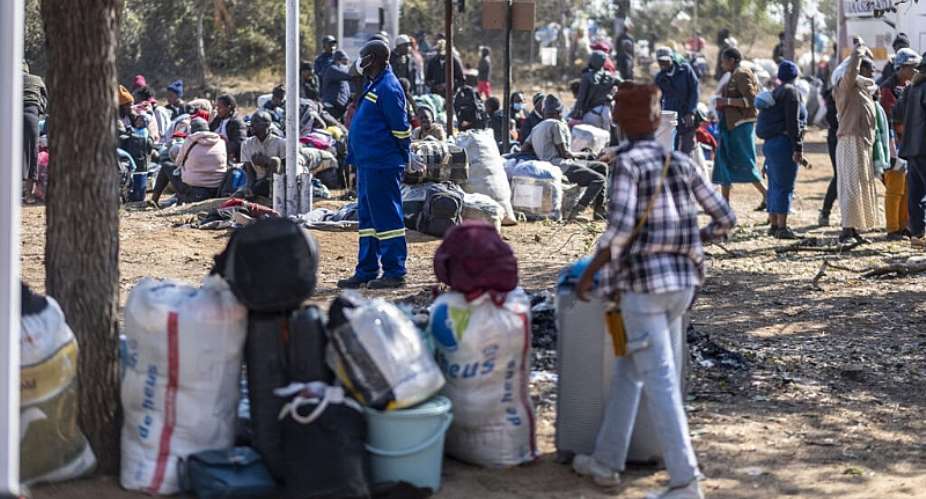
South African farmers are sounding the alarm – such as Lloyd Hadebe, deputy president of the Farmers' Association in KwaZulu-Natal, the region hardest hit by anti-immigration protests.
"Labour shortages are already occurring on sugarcane farms, for instance" he told RFI's correspondent in South Africa, "because these sectors require manual labor on an almost daily basis."
"We intend to engage with the government to have it strengthen our immigration laws, but also to urge it to work towards regularising the status of those who meet the requirements for legal status, and to put an end to the long waiting periods for those who need to resolve their administrative situation,' he added.
Deserted fields
Zimbabwean farmworker Aaron Majatamhe works in one of South Africa's top fruit-producing regions and describes a shortage of workers.
"I see a lot of farm owners who are crying now... people have to harvest those naartjies [mandarins] but there is no one," the 33-year-old told French news agency AFP.
The same shortage, he said, is looming in the vineyards. "It's time to cut off the grapes and there is no one." Aaron Majatambe, a Zimbabwean farmworker, poses for a portrait close to Nkqubela township and informal settlement, where he lives, in the town of Robertson, in the Western Cape Province, on 9 July, 2026.
Anti-migrant groups had set 30 June as an unofficial deadline for undocumented migrants to go home, triggering the exodus of more than 160,000 people, according to an AFP tally based on figures from African governments repatriating their citizens.
Zimbabwe accounted for the largest share of those returning home – workers who had been employed in South Africa's farming, domestic work and construction sectors.
Their absence was felt almost immediately in KwaZulu-Natal's sugar belt. One farmer on the north coast said he lost up to 80 percent of his cane-cutting workforce virtually overnight.
"Production and supply have deteriorated to the point where it is going to be difficult for the mills to stay open," he said, speaking anonymously because he feared retaliation.
Ghanaians ask ICC to investigate xenophobic violence in South Africa
High unemployment
Another grower near Mid-Illovo, a region of rolling hills south of Durban, said most cane cutters in his area came from Lesotho, the tiny kingdom encircled by South Africa.
"There are fields we are supposed to be cutting, but there are just not enough people," he said. "Local people don't like this job because it is back-breaking and physical."
That argument is fiercely disputed by some South Africans, however.
With national unemployment above 33 percent, labour unions and researchers argue there is no shortage of South Africans willing to work.
Instead, they say, many employers favour migrant workers because they are cheaper, more flexible and less likely to demand formal contracts, benefits or legal protections.
"They are making a profit out of foreign nations," said Patrick Williams, a local organiser with the Commercial, Stevedoring, Agricultural and Allied Workers Union.
Foreign farmworkers, he said, routinely worked seven days a week, skipped lunch breaks to maximise piece-rate earnings and were often paid below the national minimum wage.
South Africa accused of failing to crack down on anti-immigrant violence
Skills deficit
For employers, the challenge is not only finding workers, but replacing years of experience.
In Durban's Chatsworth industrial area, a manager at a clothing factory said the departure of skilled machinists from Malawi and Mozambique had left factories struggling to meet orders.
"We can barely meet our targets because most were forced to go," she said on condition of anonymity, adding it would take time for local workers to master the job.
The government has sought to respond to public anger over migration by promoting a "locals first" approach, while acknowledging that some industries rely on foreign skills and labour.
Last week it expanded its Trusted Employer Scheme which fast-tracks worker visas for companies that meet requirements – including predominantly employing South Africans, investing in skills development and operating in priority sectors.
Industry groups are urging the government to create legal pathways for seasonal foreign labour, arguing that sectors such as agriculture have become dependent on migrant workers and cannot replace them overnight.
Fears for safety
South Africa should consider a regulated seasonal worker programme similar to one in the United States, said Siyabonga Madlala, chief executive of the South African Farmers Development Association.
"There may be a need for a special dispensation allowing seasonal labour from SADC countries where local supply is insufficient," he told Newsroom Afrika, referring to the 16-member Southern African Development Community bloc.
More than 60 percent of South Africa's immigrants are estimated to come from SADC countries.
But for many who have left, the debate over labour policy has been eclipsed by fears for their safety after at least four foreigners were killed, according to police data.
Wayne Chimbadzwa Mutasa, a Zimbabwean national who had lived in Robertson in the Western Cape Province since 2014, said he left after foreign workers were targeted in door-to-door raids.
"The people who came into the houses of Zimbabweans were police officers saying that you are living here illegally," he told AFP as he prepared for repatriation.
His fellow national Majatamhe, the farm worker, has decided to remain in South Africa for now.
"We are afraid to stay even in this place, but the problem is, we don't have enough money to go home."
(with AFP)


 NAIMOS arrests 19 in Mpohor Fiase anti-galamsey operation
 ECOWAS, partners reaffirm commitment to advancing gender equality and women’s em...
 Court of Appeal acquits and discharges former MASLOC CEO Sedina Tamakloe, overtu...
 WAEC releases BECE 2026 results, cancels entire results of 105 candidates
 Infantino defends FIFA investment plan amid mounting backlash
 US carries out 'powerful' strikes on Iran after attacks on bases and regional al...
 Ayariga Hails Supreme Court Ruling on Delegate System… But Warns of Rising ‘Mone...
 Government must come clean on VALCO's future — Minority
 Supreme Court ruling abolishing delegate system creates more problems than it so...
 “End of the cocoa season pandemic” — Barker-Vormawor hails SC ruling on delegate...

