




The EU must invest more in preventing wildfires and educating the public about fire risks as climate change makes blazes more frequent and severe, the bloc's crisis management chief has said.
Hadja Lahbib, the EU Commissioner for Crisis Management, has called for greater funding, improved forest management and stronger public awareness campaigns.
“Climate change is accelerating. So our response must evolve just as quickly,” said Lahbib. “We must prepare for risks before disasters strike, and not simply react afterwards.”
Her comments came as more than 2,200 firefighters and 20 aircraft remained mobilised against a vast wildfire in France's south-western Gironde department on Wednesday.
Although the fire did not spread overnight, authorities warned that temperatures of around 40C, dry conditions and strengthening afternoon winds could reignite smouldering areas and carry embers beyond existing firebreaks.
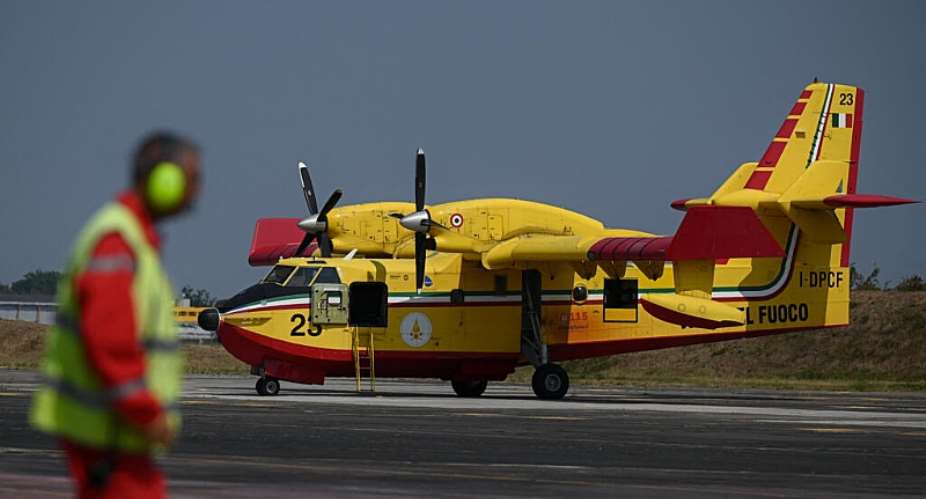
“We strike quickly and strike hard at any new smoke emissions,” Gironde fire commander Matthieu Jomain said. A Canadair plane dropping water on a wildfire near Ares, southwestern France, 28 July.
Macron rallies government response as wildfires ravage south-west France
'Not out of the woods'
Firefighters are continuing to monitor three particularly vulnerable areas – northern Cap Ferret, a wooded corridor around Marcheprime, Cestas and Saint-Jean-d'Illac, and a military site near Martignas.
The advance of other major fires in the Landes and Var departments has been halted, leaving Gironde as France's biggest remaining wildfire emergency, according to Interior Minister Laurent Nuñez.
The blaze forced around 220,000 people to leave homes and holiday sites at the height of the crisis. Tens of thousands have since been allowed to return, although officials stressed that the danger was far from over.
“The situation remains complicated. That's clear. We're not out of the woods,” Gironde prefect Sophie Brocas said.
Authorities ordered a further 4,000 people to leave tourist sites along the Atlantic coast on Tuesday, while allowing 60,000 evacuees to return to three Bordeaux suburbs that had escaped the flames.
Smoke from fires in Gironde and the neighbouring Landes department has also raised particulate pollution levels, while the disruption is affecting Bordeaux's busy summer tourism season and the surrounding wine industry.
Météo-France said Wednesday was expected to be the hottest and driest day of the week, with elevated fire danger across every region of France.
Drought conditions are affecting mainland France and Corsica, with soil moisture approaching the record lows recorded in August 2022.
More than 1,160 square kilometres have burned across France since the start of the year, according to the Interior Ministry.
France and Spain race to contain wildfires before new heatwave
Coordinated response
The EU plays a coordinating role during major wildfires, although national governments remain primarily responsible for prevention and firefighting.
Brussels can organise the deployment of aircraft, helicopters and ground crews supplied by member states when a country requests assistance.
It also operates the RescEU emergency reserve, which currently includes 22 firefighting aircraft and five helicopters contracted from European countries.
By Tuesday, the EU had coordinated the deployment of seven aircraft and four helicopters to France, as well as six aircraft and three ground firefighting teams to Spain.
The bloc also stationed more than 770 firefighters in countries considered at particularly high risk before the summer began – the largest such deployment to date.
Why is Europe heating twice as fast as the rest of the planet?
Lahbib said governments should not focus solely on purchasing aircraft and other firefighting equipment. They should also devote more EU funding to clearing vegetation, managing forests and teaching people which activities can trigger fires.
Around 90 percent of wildfires are linked to human activity, including abandoned campfires and discarded cigarettes.
“The scale and intensity of these disasters mean we will need to confirm strengthening our collective capacity,” Lahbib said.
The European Commission has proposed more than doubling EU crisis-response funding to €10.7 billion under the bloc's next long-term budget. EU governments have suggested reducing that figure to €9.1 billion during negotiations.
The EU is also creating its own permanent firefighting fleet, with 12 Canadair aircraft and five helicopters expected to be delivered between 2027 and 2030.
(with newswires)


 NAIMOS arrests 19 in Mpohor Fiase anti-galamsey operation
 ECOWAS, partners reaffirm commitment to advancing gender equality and women’s em...
 Court of Appeal acquits and discharges former MASLOC CEO Sedina Tamakloe, overtu...
 WAEC releases BECE 2026 results, cancels entire results of 105 candidates
 Infantino defends FIFA investment plan amid mounting backlash
 US carries out 'powerful' strikes on Iran after attacks on bases and regional al...
 Ayariga Hails Supreme Court Ruling on Delegate System… But Warns of Rising ‘Mone...
 Government must come clean on VALCO's future — Minority
 Supreme Court ruling abolishing delegate system creates more problems than it so...
 “End of the cocoa season pandemic” — Barker-Vormawor hails SC ruling on delegate...

