




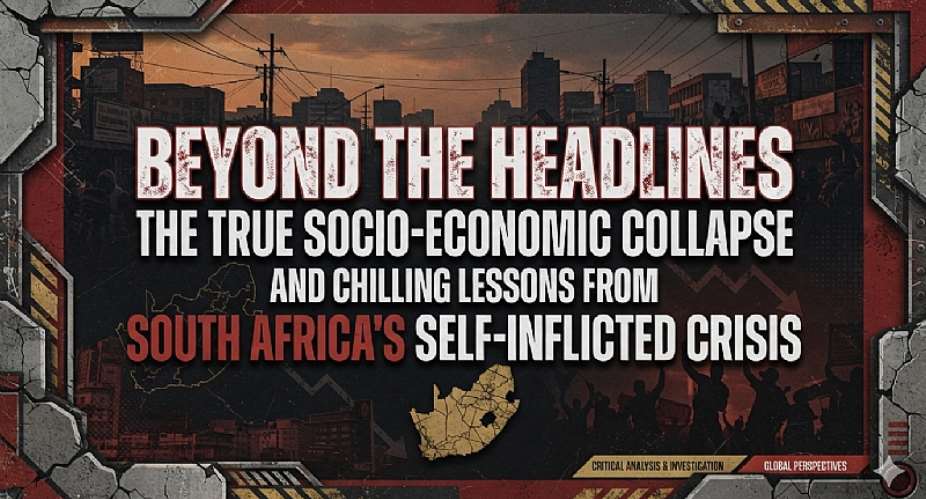
For decades, South Africa has been romanticized across West Africa as the continent’s ultimate economic paradise—a glittering beacon of infrastructure, corporate powerhouse dominance, and endless migrant fortune. But today, that paradise is fracturing under the weight of severe systemic decay, hyper-inflation, and a devastating self-inflicted wound: violent xenophobia. The recent waves of anti-immigrant campaigns, citizen-led crackdowns, and forced expulsions have not brought the jobs or prosperity promised by radical populist movements. Instead, they have triggered a catastrophic socio-economic collapse that has hollowed out local businesses, fueled an epidemic of substance abuse, and exposed deep social rot. For Ghanaians looking southward, or those considering migration, the message from Pretoria is clear: the "Rainbow Nation" is trapped in an economic chokehold. Ultimately, South Africa is suffering under an instability they have invoked upon themselves, serving as a sobering, tragic lesson for the entire continent regarding the fragile nature of African unity.
The Historical Bond: From Liberation Allies to Diplomatic Friction
- The Kwame Nkrumah Legacy: The relationship between Ghana and South Africa is built on an ironclad pan-African foundation. Following Ghana's independence in 1957, Dr. Kwame Nkrumah positioned Accra as the operational headquarters for the liberation of the continent, providing crucial financial, diplomatic, and logistical backing to the African National Congress (ANC) in their fight against the brutal apartheid regime.
- The Elevation of Ties: Decades after liberation, this foundational brotherhood was elevated under a formal bilateral mechanism. The relationship expanded from the historic Permanent Joint Cooperation Commission (PJCC) established in 2007 into a full-scale South Africa-Ghana Bi-National Commission. This commission was designed to drive structural intra-continental trade and facilitate smooth, visa-free travel between the two economic heavyweights.
- The Current Diplomatic Breaking Point: This historic bond is facing its worst strain in modern history. Following escalating anti-immigrant violence, the Ghanaian government took the unprecedented step of postponing high-level bilateral engagements, forcing South African President Cyril Ramaphosa to delay official diplomatic travels to Accra. Amid rising citizen anger and the tragic killing of a Ghanaian national in Cape Town, Accra actively moved to facilitate the emergency voluntary repatriation of hundreds of its citizens fleeing the unrest.
The View from the Accra Mini-Summit: Whispers of Quiet Diplomacy
Faced with deteriorating continental relations, Pretoria has turned to urgent "quiet diplomacy" to smooth over ties. In recent high-level emergency meetings in Accra, South African International Relations Minister Ronald Lamola arrived as a special envoy to deliver a clarifying message directly to Ghanaian leadership.
The rhetoric coming out of these closed-door engagements in Accra reveals the immense damage control currently underway:
"There was an agreement between ourselves and Ghana that the current migration-related challenges will not stand in the way of South Africa-Ghana bilateral relations... South Africa and Ghana have got long enduring challenges, good friendship and relations."— Ronald Lamola, South African Minister of International Relations and Cooperation
While South African envoys repeatedly stressed in Accra that immigration laws must be enforced in an "orderly and humane manner", and that Pretoria "condemns and does not support any private citizen acting unlawfully", West African diplomats remain deeply skeptical. The soft diplomatic assurances delivered in luxury government boardrooms in Accra stand in sharp, painful contrast to the raw lawlessness experienced by ordinary African traders on the streets of Johannesburg.
The Hollowed-Out Economy: Empty Taxi Ranks and Silent Markets
- The Taxi Rank Crisis: In major urban hubs like Durban and Johannesburg, the iconic white minibus taxi industry—the literal vascular system of the South African economy—is grinding to a halt. Following the forced displacement and flight of legally and illegally documented migrants, operators report that ranks are completely empty. Minibuses that once filled up in five minutes now stand idle for hours, bleeding cash.
- The Spasms of the Spaza Collapse: The multi-billion Rand informal township retail sector (spaza shops), historically dominated by resilient African migrants, has been utterly decimated by forced closures and looting. Because these shops served as the primary supply chain for daily commuters and low-income families, their disappearance has triggered acute consumer goods shortages and localized market stagnation.
- Plunging Business Confidence: On a macro level, the headline RMB/BER Business Confidence Index has taken a sharp dive, falling to a dismal score of 39. Global institutions like the World Bank have slashed the nation's economic growth projections to a sluggish 1%, as international firms price social instability and high-security risks into their operations, driving away vital foreign direct investment.
A Society in Pain: The Bitter Cycle of Daily Survival
- Unemployment and Workplace Rot: South Africa is wrestling with an official unemployment rate sitting at an extreme 32.7%, with youth unemployment hovering at a heartbreaking 61%. For the few who hold jobs, the workplace is deeply compromised by a culture of chronic absenteeism and "work hangovers." Local industries complain of staggering Monday absenteeism, leaving contract tasks at a complete standstill.
- The Nyaope and Alcohol Epidemic: Severe economic despair has driven millions into destructive forms of escapism. Townships are currently being ravaged by Nyaope—a lethal, highly addictive street cocktail of low-grade heroin, cannabis, and antiretrovirals. The drug dependency has triggered an explosion of petty neighborhood crime and cable theft, while rampant binge drinking at illegal bars (shebeens) fuels domestic violence and destroys community morale.
- The Rise of Survival Sex Work: Without functional state safety nets, vulnerable populations—particularly young women—have been pushed into commercial sex work around major logistics corridors, shipping lanes, and transit hubs to afford basic food and rent. Many rely on heavy functional substance abuse just to endure the physical dangers and mental trauma of the night shifts.
Recommendations and Strategic Suggestions for Ghana
1. Push for Strict Accountability at the Next African Union Summit
The government of Ghana must maintain its principled stance. Having formally requested the African Union to table the issue of anti-foreigner violence, Ghana must build a coalition of West and East African nations at the upcoming AU Summit. This coalition should demand transparent, independent monitoring of human rights conditions inside South Africa, ensuring that Pretoria's access to continental trade benefits under the AfCFTA is firmly tied to its ability to protect all African nationals.
2. Launch Intense Diaspora Public Awareness Campaigns
The Ministry of Information, in collaboration with local media houses like Modern Ghana, must launch nationwide educational campaigns to completely debunk the outdated myth of the "South African Dream." Ghanaian youth must be realistically informed about the volatile 61% youth unemployment rate, intense structural entry barriers, and the localized security threats currently facing West Africans in Gauteng and KwaZulu-Natal.
3. Protect Ghana's Domestic Informal Economy from Populism
Ghana must fiercely safeguard its own social cohesion by ensuring that market regulations are enforced legally, strictly, and transparently only through formal state institutions. Allowing civilian vigilante groups or populist politicians to randomly raid or target foreign traders in local markets (like Makola or Abossey Okai) will mirror South Africa’s catastrophic mistake—destroying the retail ecosystem, sparking artificial inflation, and harming ordinary Ghanaian consumers.
4. Invest Radically in Domestic Digital and Tech Upskilling
The clear economic reality is that the defining threat to African labor markets is not foreign human migrants, but the onset of digital automation and global artificial intelligence. Rather than focusing on building protectionist borders or weaponizing immigration laws, Ghana must rapidly scale up national investments in ICT, digital infrastructure, and vocational entrepreneurship to give its youth a competitive edge in a globalized economy.
A Grim Lesson for Continental Unity
The tragedy unfolding across South Africa serves as a harsh, unyielding truth to the rest of the continent: xenophobia is an economic suicide pact. By violently pushing out the foreign nationals who drove the informal retail economy, supplied affordable labor, and kept transit hubs alive, South African society has effectively cut off its own nose to spite its face. Pushing out fellow Africans did not magically open up jobs for local citizens; instead, it dismantled businesses, fueled hyper-inflation, and left township economies entirely vulnerable to the social plagues of addiction, crime, and despair.
Ghana and the wider continent must look closely at this broken mirror. We must completely reject the seductive, dangerous path of scapegoating the "other" during our own economic hardships. True national prosperity is built through rigid structural reforms, massive educational investments, and institutional accountability—never through the targeting, exploitation, or bleeding of our fellow African brothers and sisters. South Africa's current decay is a stark reminder that when we violate the sacred principles of continental unity, we ultimately inherit our own destruction.
✍️ Retired Senior Citizen
For and on behalf of all Senior Citizens of the Republic of Ghana 🇬🇭
📍 Teshie-Nungua
📧 [email protected]

 NAIMOS arrests 19 in Mpohor Fiase anti-galamsey operation
 ECOWAS, partners reaffirm commitment to advancing gender equality and women’s em...
 Court of Appeal acquits and discharges former MASLOC CEO Sedina Tamakloe, overtu...
 WAEC releases BECE 2026 results, cancels entire results of 105 candidates
 Infantino defends FIFA investment plan amid mounting backlash
 US carries out 'powerful' strikes on Iran after attacks on bases and regional al...
 Ayariga Hails Supreme Court Ruling on Delegate System… But Warns of Rising ‘Mone...
 Government must come clean on VALCO's future — Minority
 Supreme Court ruling abolishing delegate system creates more problems than it so...
 “End of the cocoa season pandemic” — Barker-Vormawor hails SC ruling on delegate...

